Social Events & Meetings
Group: Newsletters (369 posts)
President's Review - Nigel Lyons
| 06th March 2020 |
Newsletters

Dear All,
This year really is flying by. I have just had my birthday.
After updating you previously on the excellent catch up I had with the Law Society CEO Paul Tennant on his visit to the south west last November, I had not expected to be back in touch with him quite so soon.
Sadly, this time it was in less happy circumstances.
I was, like many of you, shocked and saddened in January to hear the news and see the pictures of the substantial fire at Chancery Lane in London. I have emailed Paul Tennant and James Shepherd, our Law Society Relationship Management Executive, to send our best wishes and we are hoping that the building will be back to full use very soon.
As I write this report, preparations are in full swing for the 2020 DASLS Legal Awards & Dinner. As you know the Annual Dinner is being held again this year at Exeter Cathedral. The event is to take place on the 30th April 2020. After the success of last year, we are hoping that once again the event is sold out which would mean we will have around 480 people attending. If you have not done so already, please contact Llew Nicholls and the team at our Awards partners ‘Grow Marketing’ who have worked very hard alongside our very own Tony and Monique to achieve full sponsorship of this event.
You can contact Llew to book the remaining places by emailing Llew directly at Llew@growmarketinguk.com. There have been more nominations than ever before with more entries making the short list. Please do not miss this dazzling occasion.
You will all have received DASLS latest 2020 training courses programme. Tony Steiner and the team have worked hard to arrange these events. You will see that as members you get preferential rates and if appropriate reduced rates for multiple attendees from your firms. Please take advantage of these services as a proportion of the monies do go to support our Society’s broad continuing education offering.
If I do not see you individually before...
Oology & The SRA
| 06th March 2020 |
Newsletters
The first big social event of the year was the annual DASLS Quiz which is the grand finale of the Challenge Cup. It is an event I thoroughly enjoy and I make no apology for making it a bit challenging.
This year did not disappoint there being just ½ point between first and second place and resulting in joint winners of the Challenge Cup. Congratulations to Ashfords and Michelmores both of whom knew that the study of birds’ eggs is Oology. The next Challenge Cup kicks off with the usual Skittles match in Dawlish when the magnificent Skittles Cup will be contested.
The latest meeting of the County Societies Group took place in February when we were guests of the SRA in Birmingham. DASLS Deputy Vice-President Adrian Richards and I attended. We were welcomed by their Chief Executive Paul Philip who set out some key messages around SRA activity emphasising their desire for light touch engagement with solicitors and good channels of communication. He said that the SRA was working well with The Law Society and was focused on creating an environment where solicitors could be innovative and use the latest in technology. AML is a key area of activity and following the appointment of the new Chair, Anna Bradley, they are working to provide better customer care. He also explained that until now the SRA had not taken any position on issues such as Access to Justice, Rule of Law and Advice Deserts. They were considering looking at, and taking a position on, one or two of these issues each year. There followed several presentations by senior staff at the SRA dealing with Enforcement Strategy and reporting concerns; Customer information – Transparency Rules and clickable logo.; the SQE and Anti-Money Laundering. Comprehensive slides were produced to accompany each presentation which I will forward together with my notes to any member who wishes to see them. Just email me —tony@dasls.com. There followed an interesting tour of the building. SRA have around 600 staff...
The impact of artificial intelligence (AI) in the sphere of human rights
| 06th March 2020 |
Newsletters
You may know that DASLS is fortunate to be twinned with Bilbao, Erlangen, Gdańsk, Leuven, Rennes and Verona. Such twinning arrangements underpin a sense that we belong to one community of values on the basis that these relationships are based on reciprocity. Each year, we meet to discuss and debate important legal issues of the day, whilst discovering the cultures and languages of our partners. 2020 is DASLS turn to host such an event, which will be rounded off with the Sunday Legal Service at Exeter Cathedral on 7 June 2020 and to which DASLS members are cordially invited!
The subject of our conference (on 5 June at County Hall in Exeter) will be around the impact of artificial intelligence (AI) in the sphere of human rights. Rather than understanding AI in terms of a terrifying post-apocalyptic vision of a world controlled by robots, AI features in our everyday lives from Alexa and smart home devices to controversial facial recognition technologies and even Uber! AI is built by lines of code called algorithms. Put simply, an algorithm is a step by step method of solving a problem and is commonly used for data processing and calculation. However, the use of automated data processing techniques in public and private sectors, especially by internet platforms and its impact on the exercise of human rights is somewhat of a hot topic.
When it comes to AI, there is a focus on the usage of huge datasets. AI bias means when an algorithm produces results that may be prejudiced due to erroneous assumptions in the machine learning process and the data used to train the algorithm by data scientists. Bias runs deep in humans and it can be unconscious in nature. AI systems are created by individuals who have their own unique experiences and blind spots all of which can lead to fundamentally biased systems. This issue is compounded by the fact that those responsible for AI (including its deployment and training) may not be representative of society. Accordingly, unfair t...
Who owns this thing, anyway? by Trevor Hellawell
| 06th March 2020 |
Newsletters

New AML Regulations and the pursuit of the beneficial owner.
Introduction
The new Money Laundering & Terrorist Finance (Amendment) Regulations 2019 which came into force on 10 January have modified a number of aspects of the 2017 AML Regulations, with which we have been complying for some time. However, many firms’ procedures hark back to the earlier days of the 2007 Regulations and have not been modified or updated much over recent years.
This article seeks to set out what the new Regulations in fact require, and the steps we should be taking in relevant cases.
The Policy
It has been true for some time that the ultimate aim of all the regulatory rules is transparency – it has always been the case that the use of artificial structures such as trusts, companies, bearer shares, foundations and charities – whilst perfectly legal – have to some extent also benefitted from the extra anonymity they offer to the true owner and recipient of the funds and services we provide.
If we offer services to these types of entity, the Regulations require us to go some way to identifying the individuals who are actually benefitting from our services, and this entails uncovering the true ownership of the organisation.
Whilst this would be difficult in many instances – Cayman Island companies with bearer shares, for example – we must nevertheless attempt to get some assurances from the creators of the companies, accountants or registrars as to the ownership of the shares, and have some way of being notified of any change in ownership.
We also need to be aware of the PEP and Sanctions status of these individuals.
Further, for UK companies, the PSC Regulations 2016 impose an exactly similar obligation on the companies themselves to identify their beneficial owners and notify Companies House of any shareholder with 25% or more of the shares or exercising control over management of the business.
The Regulations
The Regulations prov...
Small Claims Pilot Mediation Scheme – the view of a mediator
| 06th March 2020 |
Newsletters
As one of the mediators on the Devon and Somerset Law Society panel of mediators I wanted to share my experience of the cases referred to us from the small claims pilot mediation scheme. We are currently referred cases from the county court at Exeter, Barnstaple, Torquay and Plymouth.
The idea of the scheme is to try to mediate cases that have been issued at court in the hope a resolution can be reached prior to a court hearing. This frees up court time making the process quicker and more cost effective for the parties involved.
Typical mediations are usually scheduled for a minimum of three hours with more complicated cases set for a whole day or more whereas the small claim mediations are set for one hour only.
I have not found the short time limit listed for these mediations to have a negative impact indeed it seems to focus the minds of all involved to start seriously looking at a possible settlement immediately. In my experience of previous mediations in my capacity either as mediator or legal advisor I have found that it is not until the mediation is nearing the end that serious negotiations take place and all efforts are made by the parties to reach a settlement. I remind both sides in a small claim mediation of the time restraints and that time is ticking by and psychologically it seems to take the parties to the same place as at the end of much longer mediations.
If a case settles at a small claims mediation, which they do more often than not, this avoids the case proceeding through the court process saving both time and money including court fees and legal costs. The settlement when reached is made and agreed by both parties and therefore the parties are in control of the resolution. Whereas a Judge by the very nature of court proceedings will make a finding on each point in the case for or against a party leaving the parties with no control over the result.
Overall the small claim mediation scheme is in my opinion advantageous to all p...
What the reform programme means in the South West by HM Courts & Tribunals Service
| 06th March 2020 |
Newsletters

Practitioners in Devon and Somerset, indeed across England and Wales, will be aware of HMCTS’s ambitious £1bn programme of court reform. Some have been involved in consultations, developing and testing new services and products; for others their work has already been impacted as new technology and modern ways of working are introduced.
Launched in September 2016, the programme is now almost at its half-way stage. We’ve already seen the roll out of several online services covering divorce, probate, civil money claims and social security appeals which have been used by well over 250,000 people. Two new services – immigration and asylum, and public family law – are currently being publicly tested.
Many in the region have been involved in the development of reform services in some capacity. Truro Combined Court, for example, is part of the national pilot in 12 family courts for the Citizens Advice family court domestic abuse support service, which launched in August 2019.
Our south western buildings
Some of your members, especially those who frequently work at Taunton Crown Court and Torquay & Newton Abbot County Court, may already be benefitting from the professional users’ court access scheme. This scheme is being rolled out in stages, across the region and nationwide. It allows legal professionals to avoid delays when being processed by security staff. Although registration for the national scheme has begun with the Bar Council, HMCTS is working with other legal associations who wish to participate and open the scheme for their members.
As part of our estate review process, which aims to improve the physical environment for all court users, Exeter Magistrates’ Court is closing and the work is moving to the Combined Court, half a mile away. To support this move, three new hearing rooms will be built, as well as increased cell capacity, witness and consultation facilities and a new cafe.
The move represents a significant investm...
Call for Nominations - the Somerset Cook's & Hatchard's Law Prize 2020
| 06th March 2020 |
Newsletters

The Cook's and Hatchard's Law Prize is an award which recognises an individual who has achieved not only academic success but has also engaged in charitable initiatives which have raised the profile of the profession; supported junior lawyers and/or the wider community.
The Trustees recognise that the route to qualifying as a Solicitor is an ever changing process. The conventional approach of completing a Degree, undergoing the GDL/LPC and eventually sourcing a Training Contract has been supplemented by a series of alternative routes.
It is now increasingly common specifically in the case of smaller firms and/or Local Authorities for individuals to qualify as Solicitors through a more vocational route. For example, undergoing the conversion from CILEx. Whilst this is not your typical route to qualification, such individuals have nonetheless obtained considerable practical experience and have achieved 'Solicitor' status whilst having to combine study with work, often alongside family obligations. A challenging balance deserving recognition.
The Trustees are intent on ensuring that such individuals are not overlooked, especially in instances where candidates have come from backgrounds where they might have needed to work from school as opposed to being able to attend University and pursue academia.
If you are aware of an individual within Somerset who has achieved the finely tuned balance of academic success whilst also promoting the value of the profession through charitable work or some other means which has benefitted the wider community, then please send full details of the individual whom you are nominating together with the reasons for your nomination to DASLS Administrator, Monique Bertoni, Aston Court, Pynes Hill, Exeter EX2 5AZ by 30 June 2020, for consideration by the Trustees.
Nominations can also be sent by email to monique@dasls.com.
NOMINATION CRITERION:-
Candidates for this year’s Prize must have been admitted to the Roll...

Two topical matters on the new SRA Accounts Rules 2019 by Partner PKF Francis Clark
| 06th March 2020 |
Newsletters

The new SRA Standard and Regulations came into effect on 25 November 2019, replacing the previous SRA Handbook.
Within these latest regulations are the new set of SRA Accounts Rules 2019 which the legal sector is still getting to grips with some of the changes.
In this brief article we look at two of the most topical areas being raised by law firms and their COFAs.
Notification of disbursements
One of the leading questions raised has been regarding compliance with the new rule 4.3, which states that if a firm wishes to transfer money from the client bank account from funds held on account for a specific client to cover costs, the client or paying party must first be sent a bill or other written notification of these costs, before the transfer is made.
As ‘costs’ comprise of fees and disbursements, this is in contrast to the old requirements as it is now necessary to notify the client if the firm wants to take funds to cover disbursements.
Firms are now finding themselves in the position of having to choose between the additional administrative inconvenience of having to notify the clients every time they wish to transfer funds in the interim for disbursement, or face potential cash flow burdens. This will come down to a matter of policy, and will differ from firm to firm. It is helpful to highlight it has been mentioned that an email to the client will qualify as written notification to meet this requirement.
A further topical question has been in relation to disbursements that have been included on a bill, but not yet paid by the firm. Rule 4.3 refers to ‘costs incurred’, which, on the face of it, implies that funds can be transferred to cover disbursements that have been incurred but not yet paid, as long as the client has been notified. This has been queried with the regulators where anticipated disbursements had been included on a bill – could the firm transfer client funds to cover these which would be a fundamental chan...
Introducing DASLS new Partner DictateNow
| 06th March 2020 |
Newsletters

Devon & Somerset Law Society welcome DictateNow as new outsourcing partner
Devon & Somerset Law Society is pleased to announce it has teamed up with leading legal outsourcing provider DictateNow.
The firm, which was the first dictation provider for law firms in the UK, was formed almost 20 years ago, and now works with hundreds of law firms across the country.
“It truly is an honour to work closely with Devon & Somerset Law Society and we are confident we will provide its members with real value through this partnership,” said Maxine Park, who co-founded the firm, and is also a qualified solicitor.
Since its inception in Hertfordshire, at the start of the 21st century, DictateNow has become a leading provider of confidential digital dictation, transcription and business services that helps law firms streamline otherwise labour-intensive processes, reduce overheads, and improve client service.
“Since we started back in the early 2000s we have also expanded to include dealing with overseas clients, and offer other business services as well, with copy typing, proof reading and diary management amongst them,” added Maxine.
The business, which works with hundreds of legal secretaries and experienced administrators all UK based, working around the clock seven days a week, only came into being after Maxine, who was a senior solicitor, was asked by her employer to find a firm that could do the transcription for lawyers. She couldn’t find anyone suitable in the country, so she worked on a plan to fill this gap, with software developer husband Garry. She soon left her job in law, and the reputation of DictateNow gradually spread amongst law firms.
“It is fair to say the needs of law firms have changed greatly in recent years and like all progressive businesses, we are committed to adapting to stay at the forefront. We will never rest on our laurels,” added Maxine.
The business is covered by IS22301 for Busines...
Business Continuity and Coronavirus planning from partner DictateNow
| 06th March 2020 |
Newsletters

Coronavirus (COVID-19)
Business Continuity Planning
With England’s chief medical officer Professor Chris Whitty warning a Covid-19 epidemic in the UK is looking “likely”, and with home working being a key part of the government's 'Battle Plan' to combat the virus, the prospect of fee earners working remotely may become a reality rather than a trend.
With most UK businesses, including law firms carrying out contingency planning in the event of a widespread outbreak we are being called upon by our clients to provide additional support should it be required.
The ability for fee earners to work from home is far easier than for support staff. Fee earners are able to use mobile phones to continue communicating with clients, receiving emails as well as dictating. Internal support staff aren't geared up to work remotely in the same way.
DictateNow has been providing outsourced business support services to law firms since 2002. Our legal secretaries can continue to support fee earners with their typing requirements with fee earners sending dictations via our apps and our typists returning the work as an attachment to an email, or directly into the client's case or document management system.
We take business continuity seriously, achieving and maintaining the ISO 22301 as a testament to the importance we put on being able to support our clients - whatever the circumstances.
Our management, operations, typists, receptionists and support teams all have the ability to work remotely but with the added security of working on our UK based servers.
Under no circumstances would we want to profit from COVID-19. We provide free apps for iPhone and Android mobile phones, a free registration process for disaster recovery and our service is low cost, pay-as-you-go and with no ongoing commitment.
We sincerely hope COVID-19 isn't as serious as some of the newspaper headlines have said it will be, but a little forward planning never goes amiss.
...
Are your conveyancing clients ‘flood aware’? by Partner Landmark Information
| 06th March 2020 |
Newsletters

Last month, Storm Ciara and Dennis brought devastation across the country, including the South West. We saw multiple flood warnings and alerts issued across Devon and Somerset, with many main routes made impassable, and rail passengers stranded as flooding stopped services reaching Exeter and Plymouth (see link at footnote 1).
Due to the increasing concern about flood risk for property owners, the Law Society has recently updated its Flood Risk practice note – the first revision in four years. The practice note provides guidance relating to information sources that better help clients understand the risk that flooding may pose, as well as offer steps that can be taken with regards to insurance and searches.
The practice note includes information relating to the types of flood risks that have the potential to affect property owners. For example, a property doesn’t have to be located next to a river for it to be located in a high risk zone. Flooding from surface water or groundwater is increasingly common and something that should always be researched in advance of a house purchase.
If flooding is a concern, it is important to investigate whether appropriate insurance cover can be arranged before a property transaction completes, to satisfy the risk criteria of the client’s mortgage lender.
On top of this, the Law Society has also published an updated TA6 Property Information Form and guidance notes. In particular, four areas of property information have been updated relating to Flood Risk, as well Japanese Knotweed, Radon and Septic Tanks. The update provides additional information about a property to prospective buyers and is designed to provide greater transparency.
Yet, while there is a plethora of guidance and support out there, unfortunately, recent research conducted by YouGov for Landmark Information has shown that the majority of consumers in Great Britain are still not checking the flood risk of their homes, despite the increa...

Thank you from Step One: DASLS President's Charity 2019-2020
| 06th March 2020 |
Newsletters

Thank You
As we come to the end of being the Devon and Somerset Law Society’s Charity of the Year 2019/20 we reflect on some of the achievements made throughout the year:
Thriving Workplace Project
In 2019 we launched our Thriving Workplace project which focuses on training workplaces in awareness and first aid for mental health. After a successful ‘soft launch’ at the SW Business EXPO, we have been working closely with local organisations to train staff members in spotting the signs and symptoms of poor mental health and starting meaningful conversations. The feedback we have received has been fantastic and we hope that this training not only helps organisations, but the wider communities in which we live.
As part of the project, we have also developed a course which we have delivered in custody at HMP Dartmoor, providing a forum for custodians to discuss strategies to manage wellbeing whilst in prison. Again we have had a brilliant response to the training delivered and are looking to roll out mental health first aid courses across the prison to promote conversations and support whilst in custody and for rehabilitation.
The impact this training has had so far has been excellent, helping individuals and organisations recognise the importance of good wellbeing and supporting colleagues and communities with mental health. With the stretch on services for mental health this is a fundamental project to support each other to good mental health and wellbeing.
Torbay Peer Support Project
The aim of this project is to support people over 50 years of age who are struggling with their mental health to engage with their community. We provide engagement visits to help people feel more relaxed when they first meet us and then encourage them to join one of our courses or groups.
Within the year the project has grown through our group of supportive volunteers, there are now 10 volunteers and they have all been people that we had originally su...
News from the Devon & Somerset Junior Lawyers' Division: March Update
| 06th March 2020 |
Newsletters

National Conference
As the new committee members of the Devon & Somerset Junior Lawyers' Division are starting this year’s culminating activities for our Junior Lawyers' Division members, our National Committee representative has attended the National JLD Meeting held at The Law Society office in London on the 1st of February 2020.
A lot of issues were discussed and tackled and it is important to share the outcome of the discussions. To highlight these, the following are the main points of discussion:-
There will be another consultation with the SRA regarding the SQE as it has been discussed that there are a large number of unresolved issues. The Legal Services Board has opened a call for evidence in relation to continuing competence. Everyone is encouraged to contact us and we would welcome any comments and inputs.
The Law Society has updated its Wellbeing Guidance in the workplace in October 2019 as well as a recently issued guide for firms to re-label work social events to divert the initial perception away from alcohol. This is to promote and encourage individuals to attend events with less pressure to consume alcohol in order to “fit in”. The DSJLD have been in full support of this and our events are being tailored to match this initiative.
In addition, The Law Society is currently developing a new Learning Management System and in the next coming months, The Law Society will launch a beta program for this which will give selected firms a free testing with this program. This will initially be provided free of charge with precedents etc available to firms.
Ibounce
The JLD event season 2020 kicked off in fine style with a groovy disco at I-Bounce in Exeter. With dimmed lights and funky disco beats, the JLD contingent were relishing the opportunity to hone their dancing skills ahead of this year’s highly anticipated JLD Summer Ball!
It is fair to say some members took to the bouncing better than ot...
Are you Fit for Law? By LawCare
| 06th March 2020 |
Newsletters

Some think there is no place for emotion in the law and believe emotions interfere with rational thinking. In fact there is a huge body of scientific evidence which proves cognition and emotion are intertwined. If we consider that emotions affect your actions, decision-making, reasoning, thought processes and judgement, we can clearly see the relevance of emotion in the law.
Often lawyers enter the workplace without the emotional competencies needed to meet the demands of an evolving profession. Emotional competency is about how we understand and handle our emotions, as well as identifying and interpreting emotional responses around us.
Providing legal professionals with resources to enable them to understand and develop key emotional competencies such as emotional self-awareness, self-reflection and better strategies for emotional self-regulation is one way to equip them more effectively for practice, enhance their wellbeing and potentially reduce levels of stress, anxiety and depression.
LawCare and academics at The Open University and the University of Sheffield have developed a new free online resource on emotional competency and professional resilience for the legal community.
The interactive resource, called Fit for Law, is part of an on-going project to promote psychologically and emotionally healthier ways of working within law and was developed based on evidence from focus groups with legal professionals across the UK and Ireland. The course takes 2-4 hours in total to complete but is broken down into smaller sections, and includes videos from legal professionals discussing wellbeing issues as well as a range of interactive activities.
The goal is to foster enhanced wellbeing, to support legal professionals to not just survive, but to also thrive, within a challenging work environment.
In addition to providing resources aimed at individual practitioners, the resources we are developing will include a tool kit for employers, to encoura...
President's Review - Nigel Lyons
| 07th January 2020 |
Newsletters
Happy new year to you all!
I have certainly had a very festive few months.
The Taunton Dinner was a great success. Can I say a big thank you to all who attended. We raised an excellent £858.12 with gift aid, for my chosen charity of ‘Step One’. Our guest speaker Chris Robinson brought the history of the south west to life with his after dinner talk.
It was a great pleasure to welcome the Law Society CEO Paul Tennant to the south west when he visited Exeter on the 13 November.
After Paul attended our committee meeting in the morning it was good to participate in the Law Society Gazette Roundtable ‘South West Discussion’ in Exeter. A cross section of local firms sent members of staff to take part in debating various topics that were relevant to our lawyers and their firms’ development. The hour and half flew by. The debate flowed well and it was clear at the end that everyone felt they had their say and were given an opportunity to express their views. Thank you to Paul Tennant for organising this with Eduardo Reyes the Commissioning and Features Editor of The Law Society Gazette chairing the event.
Can I thank those of you who have entered the 2020 DASLS Legal Awards to celebrate and raise the profile of the solicitors’ profession in our area. I must also thank Grow Marketing Group for all their help to enable us to put together an incredible night in celebration of the legal profession and to showcase the achievements and successes within it. Please do not forget to put the DASLS Annual Dinner 2020 at Exeter Cathedral in your diary. The event will take place on the 30th April when we will celebrate and recognise the achievements of those in the legal profession. Don't miss this dazzling occasion.
With that in mind I may I wish you all a happy and prosperous 2020. I look forward to seeing you in the New Year.
With very best wishes
Nigel Lyons
DASLS President 2019-2020...
Happy New Year from DASLS Office
| 07th January 2020 |
Newsletters
Happy New Year
It is the morning after! No not that sort of morning after – as I write it’s the morning after the deadline for nominations to be made for the DASLS Legal Awards and we are delighted to announce that we have had significantly more entries than in previous years. Thank you to everyone who has entered; we look forward to seeing you at Exeter Cathedral on 30th April when the winners will be announced. No doubt there will be another morning after that! Tickets will go on sale once the shortlist has been announced towards the end of January.
Our new recruitment advertising service has started well with good support and our work behind the scenes has seen increased levels of activity on our website. The advertising package includes a job posting on the Law Society Gazette Online Job Board ensuring a national presence at a very cost-effective price. The DASLS Job Board is now the place to go to look at vacancies available across our two counties and all the latest positions are advertised on the back of this Newsletter. Go to DASLS website for more details.
Looking forward we will be working to improve and refine our provision of training events. The DASLS programme has always been responsive to members’ requests and we would be very pleased to hear about seminars that you would like to see included speakers that we might wish to invite. Look out for new Annual Conferences and masterclass sessions.
The County Societies Group will be meeting in February when we will be the guests of the SRA at The Cube. I am sure there will be some interesting discussions about their direction of travel and current operations to report back.
Can it really be 20 years since the Millennium? The economic and political landscape has changed greatly in that time and new challenges and opportunities in the provision of legal services have emerged. I hope that DASLS has evolved and adapted to continue to be relevant and fit for purpose in that time. Each y...
Interview with Penny Scott, Chair of the Family Law Committee of The Law Society
| 07th January 2020 |
Newsletters

What made you want to serve on The Law Society Family Law Committee?
I was impressed by The Law Society’s campaigning over Legal Aid and felt this was an area in which they really stood up for lawyers such as me, working in a strongly Legal Aid practice. I looked at the kind of work done by the Family Law Committee and saw that it was very interesting; I thought it would be stimulating, and it is. What are the key concerns you have at the moment for the legal profession in the South West?
They are the same concerns as I have about the national picture: people not having access to justice because of the assault on Legal Aid; chaos in the court system; the unknown impact of Brexit. I know for many firms in the South West there will be a direct impact from Brexit; but for all of us, the threat of recession and increased poverty accompanied by its familiar problems is alarming.
What is your dream job?
If I had not been a lawyer, I’d have enjoyed being a psychiatrist or a private detective – I’m very curious (or nosy) about people. If I was embarking on a new career now, I’d be a gardener or a chef. Which sort of work gives you the most job satisfaction?
I’m motivated by fairness. My job gives me the opportunity to try to achieve a bit more of it.
What gets you up in the morning?
Optimism. What do you do in your spare time?
Gardening, food, reading, films, travel, learning Italian, swimming, my family.
I’m very interested in language, generally. What book are you reading at the moment?
Naomi Klein – This Changes Everything
Before that, Elmore Leonard – Gold Coast
Next, I will be reading Margaret Atwood’s sequel to The Handmaid’s Tale, The Testaments.
What is the most recent film you have seen?
Amazing Grace – a documentary about Aretha Franklin
In the Loop – (again; it never gets stale) What are your favourite food / restaurant?
I honestly love food and am happy to go anywhere at all.
The ...
Update from Law Society Council Members Kathryn King and Scott Bowen
| 07th January 2020 |
Newsletters

Having been appointed as Council Members in July 2019, the first two meetings have already flown by. Council met on the 3rd October 2019 and the 5th December 2019. We hope to bring you up to date with developments over the last few months.
Much of this time has been dominated by the word we shall not mention, beginning with “B” and the General Election. A lot of the usual Law Society work has therefore been on hold awaiting the outcome and strategising so as to be prepared for which Government would be in power.
We now know that we have a Conservative Majority Government and whilst many will be happy about that, this may well make some of the Law Society’s campaigning around Access to Justice and Legal Aid a little harder.
Time will tell…..
Prior to Purdah, the Law Society was continuing to support works on funding inquests for people who are unable to access legal aid. The Policy and Regulatory Affairs Committee had approved a plan designed for restructuring legal aid provision, into Law Society policy. The plan detailed the Society’s intention to reintroduce early legal advice in family law cases, to reintroduce legal aid in all finance cases, and to bring back legal aid for alleged perpetrators of abuse in domestic violence cases. There were 120 MPs lobbying for change to practice direction 12J (on child arrangements and contact orders involving domestic abuse and harm), for there to be legal representation provided to alleged perpetrators of domestic abuse. It was a major issue that more children were being killed in situations where there is unsafe contact. There have been ongoing discussions about the Flexible operating hours and the pilot. An update is expected on that.
The Ministry of Justice (MoJ) allocation includes a 4.9% increase in real terms to the department’s resource budget from 2019-20 to 2020-21, with £55 million bookmarked for use across the Criminal Justice System to “support the work of 20,000 additional polic...
53 clicks ....
| 07th January 2020 |
Newsletters
A statistical number from the ‘campaign report’ in respect of the first 5 top links clicked by members looking at the November 2019 Newsletter sent via Mail Chimp. This was my article in between the President’s Letter (no.1 with 56 clicks and the article from PKF Francis Clark (no.3 with 47 clicks) – interesting but not sure what to make of this?
In terms of performance, Mail Chimp tells us “Well, this is exciting. You’re doing great!” with average campaign performance above 32% but when you look more closely …. monique@dasls.com comes up as ‘subscriber with most opens with 209 clicks… well I can assure you I certainly did not click on the Newsletter articles that many times …. but I did post them as drafts, updated them when corrections were needed, proof-read them again before publishing them and finally time to push the SEND button.
Then the perennial question – how do we engage / reach out to the other 70% of our members? What articles would they like to see in DASLS Newsletter and what would really be of interest to them?
2020 … New Year … New Resolution …. Your chance to let us know – we’d love to hear from you!
This brings me to the topic of our Twin / International Bars’ Meeting hosted by DASLS to be held from 5 to 7 June. The working sessions on the Friday will discuss Artificial Intelligence. This is a fascinating if somewhat scary subject and we are all affected by it. It covers so many aspects – algorithms, human rights, ethics etc.
The June 2020 Working Group is putting together the programme and hope to see as many members as possible participating in the AI debate on Friday 5 June. Put the date in your diary now and contact me if you would like to be kept updated as things progress and to receive a copy of the final programme including reserving tickets to take part in the procession at the Legal Service on Sunday 7 June.
There are other ways for you / your firm to be involved – sponsor...
Can’t do right, for doing wrong.. The new SRA STARS 2019 - by Trevor Hellawell, ExL Practice Development
| 07th January 2020 |
Newsletters
Well, it is all over now. The Election is won, Brexit is confirmed and the future will be what it will be – AND the SRA has implemented its new Standards & Regulations (STARS), effective from 25 November 2019.
2020 has a much calmer (and resigned) outlook than did 2019.
Along with new – and briefer – Accounts Rules and the obligation to adopt the SRA clickable logo, the STARS have ushered in a novel approach to regulation. I mention here the main things that immediately occur to me, but in future months I will be offering some further, more reflective thoughts on the implications of the new regime.
My top 5 thoughts are:
1 Loss of monopoly
We – the learned legal profession - have lost our age-old monopoly over the right to employ ‘solicitors’ to offer legal services to the general public. The tide turned against us on this one some years ago, when the Competition & Markets Authority pointed out that 90% of members of the general public with a legal problem will not go and see a solicitor (mainly as a result of misperceptions about the cost of so doing). This has led to the Transparency Rules 2018 the efficacy of which is yet to be determined, but which has led to a rethink over the marketing challenges facing us in the fight against others (professions, as well as commercial entities) who want to offer the services of a solicitor to our historical client-base. Time will tell whether this will increase our recruitment difficulties.
2 Legal professional privilege
One disadvantage of taking legal advice from a ‘solicitor’ working in a non-regulated environment is that the advice sought and given will probably not benefit from the cloak of legal professional privilege, as it would be given by a solicitor on behalf of a non-regulated business, rather than a law firm. Recent Law Society publications have mentioned this drawback, but it is one thing that the SRA clickable logo fails to mention, a...
Closure of the Solicitors Indemnity Fund-how will this affect you?
| 07th January 2020 |
Newsletters

Partners in firms that have closed since 2000 and some employees of such firms may face claims for negligence after 30 September 2020 and may not have the benefit of professional indemnity insurance cover (PII). Many of them are unaware of the risk they face if the firm closed without a successor practice regulated by the Solicitors Regulation Authority (SRA).
The History of Solicitors Professional Indemnity Insurance (PII)
Up until 31 August 2000, the profession self-insured through the Solicitors Indemnity Fund (SIF). SIF provided firms with the compulsory level of cover and if firms closed before September 2000 then run off cover protection was provided without time limitation.
Back in 1999, after the large number of claims in the 1990’s it was recognised that the mutual fund had been an expensive means of providing cover for the profession and that the open market could provide a cheaper alternative for the majority of firms. The Council of the Law Society did not favour the open market solution as it recognised that the 1990s recession had been a difficult time and that the open market may not be a comfortable place when markets hardened. However, the profession was balloted and as a result, it was decided that firms would go to the open market.
The Law Society negotiated minimum terms and conditions (MTC) with insurers, providing far better protection than is normally available in the open commercial market. Insurers in the open market accepted these terms and there have been, despite fluctuating numbers, sufficient numbers of insurers to make the scheme viable. The terms of cover have broadly been maintained by the SRA. Generally speaking, over time many firms have paid less for their insurance than they would have done if SIF had been retained.
The cover for solicitors’ negligence claims is provided on a ‘claims made’ basis, which means that insurance needs to be in place at the time when a claim is made and notified. This is a...
DASLS AGM 2020 CALL FOR MEMBERS TO STAND FOR ELECTION - ACT NOW!
| 07th January 2020 |
Newsletters
Please help shape the future of your local Law Society.
The main Committee is at the heart of the work and decision making of DASLS and also helps to co-ordinate the important work of the many Sub-Committees. As a result membership of the main Committee can make a real difference to the Society and to the working life of solicitors across our two counties.
The Committee is made up of the Officers of the Society together with (see Articles §7.1.5) “not less than 10 or more than 40 elected members”.
If you would like any further information please contact the Honorary Secretary Chris Hart. - chris.hart@wollens.co.uk
Elections will take place at the 28 April 2020 AGM at the Exeter Golf & Country Club.
Contact DASLS office on 01392 366333 or email monique@dasls.com if you would like further information. Click below for the nomination form which must be completed and returned by 31 January.
nomination-form-for-dasls-main-committee-agm-2020-election...
Time Limited Mediations – thoughts from the recent CMC Conference
| 07th January 2020 |
Newsletters
In November I attended the annual conference of the Civil Mediation Council (CMC) and share below three issues raised there.
Those issues were access to mediation for mid-level cases, the increasing numbers of defended county court claims and the effectiveness of half day (or time limited) mediations for more complex disputes.
Particular concerns were expressed by speakers about the availability of mediation services for disputes falling between the small claims limit and larger High Court actions, a ‘gap’ which the Civil Justice Council Working party final report on ADR (https://www.judiciary.uk/announcements/new-report-on-alternative-dispute-resolution/ ) had identified as a concern.
These are disputes, generally in the range £10,000 to £100,000, where the sums involved are too high to trigger the involvement of the court appointed Small Claims Mediation Service (although the lack of availability of that service in practice, even for small claims, was also a recurrent theme at the conference) but at a level where the legal costs involved in mediating (to which the mediation fee is of course only a small part) could still present a significant barrier to the use of mediation or ADR.
Of course, for DASLS members that gap is not an issue as they have, unlike solicitors in much of the rest of the country, their own mediation panel of experienced mediators available to mediate such cases. As one of only two (together with Manchester) ‘pilot’ providers of a court scheme for such cases the DASLS panel is at the forefront of seeking ways solicitors and clients with mid-range claims can access mediation as an alternative to Court proceedings. As Jeremy Ferguson reported, in the September edition of this newsletter, the availability of that scheme has in cooperation with the court service and judiciary recently been extended to all Devon Courts.
Secondly, the CMC conference heard that demand for mediation for such cases has been increasing...
Joint Medico-Legal Meeting with Torquay & District Medical Society
| 07th January 2020 |
Newsletters

Thursday 27th February 2020 AT 7.30 P.M.
The IMPERIAL HOTEL TORQUAY
From Glamour to Gore - the Life of a Make-up Artist
Sharon Anniss
Sharon is a professional hair & make-up artist who covers all aspects of hair & make-up including for film, TV and photography.
20 years ago, Sharon followed a lifelong ambition to work in TV & film, deciding to train as a professional make-up artist. She now has a successful career in that industry.
In 2015 and 2016 Sharon worked for the BBC on its drama series "The Coroner" which was filmed all around the South Hams area.
To reserve your place go to https://torquaymedsoc.com/book-february-meeting
and make sure you tick the box confirming that you are attending as a DASLS member.
Sharon Anniss with Harry Enfield in the process of applying a Bald Cap...
The Right Fit – Why choosing your broker is key to you and your business
| 07th January 2020 |
Newsletters

Louise Chagas
Vice President Global Professional & Financial Risks Lockton
It must be incredibly difficult for the Legal Profession to determine which broker they should trust to place their professional insurances with, especially when being approached by multiple brokers all reporting to be specialists.
Your Professional Indemnity premium is likely to be the third largest spend annually after staff and premises costs. However, it is possibly one of the most critical spends as your PII provides you with your certificate to trade. In light of the importance to your business it is incredibly important you select the right broker. After all, you are entrusting them with your livelihood, and they should appreciate the seriousness of this task that you are entrusting upon them. So how do you differentiate one broker from another, and why is it important to ensure you find the right fit for you?
The financial aspect is just one consideration why finding the right broker is important. Perhaps of equal importance is consideration of the fact that a broker also manages your firm’s reputation within the insurance market which you could argue is more valuable. A good broker will be one whom you feel confident will represent you as you would represent your practice when speaking to insurers. You should feel confident that they not only understand you and your business, but can evidence to you that they are experts within their field, as you and your associates can for your clients.
You should feel confident that your broker understands the ethos of your practice and will relay this fluently to insurers. Importantly, does your broker take the time to ask you questions and listen in order to understand what is important to you? If not, how can they be selecting the right insurers for you or representing your firm adequately?
The relationship between a client and broker should be a true partnership of guidance and support which is utilised throughou...
Tackling the threat of cyber crime by sponsor Barclays
| 07th January 2020 |
Newsletters

Today I take a look at the fast-evolving cyber-crime landscape and how professional services firms can protect themselves from attack.
Cyber Crime Today
Professional Services firms operate in an increasingly data-driven, online world. Data has become critical to the way firms operate and more and more of it is being stored digitally.
As firms continue to operate online and store information in the cloud, the threat of cyber-crime continues to grow.
Cyber attacks against organisations have reached an unprecedented scale and frequency. For example, new variants of global ransomware and wiper attacks have toppled international companies.
Data breaches are also growing exponentially: 10 billion records were reportedly stolen in 2018 and that figure increased to 12 billion for the first half of 2019 alone.
With 72% of large businesses suffering a cyber-breach or attack during 2018, it’s clear that all firms are at risk.
As the technology firms use evolves, cyber attacks become more sophisticated. The integration of 5G and move to cloud infrastructure open different avenues for cyber criminals' to steal data, while recent advances in quantum fusion may render existing encryption methods obsolete within a matter of years.
The impact of cyber crime can be enormous: firms that fall victim to attacks not only face substantial financial losses and regulatory fines, but client confidence is undermined.
Firms therefore need to understand the scale of the cyber economy, how they could potentially be exposed to an attack, and what they should do to protect themselves.
The changing Cyber Economy
The term ‘digital underground’ might bring to mind an image of criminals sitting at computers in dark rooms, using complicated code to hack into systems, but that’s no longer the reality. These days, the digital underground – or dark web as it’s sometimes called – isn’t that far underground.
Crime as a service
A surprising am...
Six out of 10 people admit to never checking their home’s flood risk by Landmark Information
| 07th January 2020 |
Newsletters

Tony Rollason, Regional Manager, Landmark Information
www.landmark.co.uk
People in Great Britain are still not checking the flood risk of their homes, in spite of increased incidents of flood events across the country.
62% of respondents to a YouGov survey, which was commissioned by property data company Landmark Information Group, stated that they have never checked the flood risk level of their home.
The survey found that people in Scotland are the least likely to have carried out any checks with 77% confirming they had never researched their flood risk. This was followed by those in London (71%), 65% of those in the North West of England and 63% in Yorkshire and Humber. In the South West, 57% of people said they had never checked their flood risk.
The survey also found that just 5% of people in the South West have a flood plan and would know how to put it into action if a flood was to occur. More than a third (38%) admitted that they do not have a flood plan and wouldn’t know what to do if they were to experience a flood, while almost half (49%) said they didn’t have a flood plan, yet felt they would know what to do in the event of a flood.
The survey identifies that the public is not necessarily making flood checks part of the research they conduct when moving into a new home; just over a quarter (26%) of respondents from the South West said they checked the flood risk of their home before moving in, with 14% saying they checked afterwards.
People in the East of England are some of the most diligent with 28% suggesting they looked into the risk ahead of moving and a further 17% did so after they had moved into their home. This compares to just 14% of those living in London who said they checked ahead of moving into their home.
The results of the survey show a worrying disconnect. The majority of people across the country – 88% – believe their property is not located in an area considered ‘at risk’ of flooding, yet 6...
Wessex Searches introducing
| 07th January 2020 |
Newsletters

TO REGISTER FOR THE WEBINAR
CLICK HERE...
FROM HMC&TS - Court procedure for confidential contact details
| 07th January 2020 |
Newsletters
Please adopt the following practice if your client wishes to keep their contact details confidential:
Applications submitted by e-mail
If you are filing an application by e-mail please send the C8 Confidential Contact Details form as a separate attachment.
Provide an alert in the e-mail that a party has confidential contact details.
Applications submitted by post
In your covering letter please provide an alert that a party has confidential contact details.
Subsequent correspondence with the court
Please ensure that any confidential contact details are redacted.
Click here for a copy of the letter from HM Courts & Tribunals Service.
3 December 2019....
News from the Devon & Somerset Junior Lawyers' Division new Committee
| 07th January 2020 |
Newsletters

As 2019 drew to a close, a new year for the Junior Lawyers' Division got off to a festive start following November's AGM and elections. November saw the election of the new JLD committee; made up of 10 representatives from 8 different law firms based across Devon & Somerset.
The elections were held during the JLD AGM, hosted by Oddfellows in Exeter. It was a well-attended and enjoyable evening. Whilst a small number of committee members return from last year's committee, it is great to welcome a high number of new committee members. You can find out more information on this year's committee on the DASLS website. At the first meeting of the new JLD committee and following a lengthy discussion the JLD’s charity of the year was unanimously decided. The JLD are very proud to announce that over the course of the year we will be supporting the Devon Freewheelers; a South-West charity that provides a free out of hours service to the NHS. The charity is a blood bike charity which couriers blood, and blood samples amongst other items. You can find out more about The Devon Freewheelers at their website.
The new JLD committee held their first event in December; a Christmas social event held at the Oddfellows Mulled Wine Tent at Exeter Christmas Market. The JLD’s charity of the year for 2019-2020 was announced.
The event was a huge success with an excellent turn-out; over twenty junior lawyers attended the event to socialise in the festive spirit. A collection of mulled beverages, nachos, pizzas and churros were devoured, whilst attendees gathered around the fire pit.
The committee look forward to meeting again in January to share ideas on how to further develop the committee and begin preparations for a series of social, sporting, educational and charitable events.
Details of the upcoming events will be circulated to JLD members in the New Year, so keep an eye out! Jess Clements – Chair
Emily Lakeman – Social Secreta...
Why do solicitors need a charity?
| 07th January 2020 |
Newsletters

Have you ever wondered why solicitors need a charity? After all, legal professionals are successful, wealthy and live a stable lifestyle, right?
You're probably shaking your head at this moment thinking, this sentiment doesn't quite reflect reality. And you'd be right. The truth is, lawyers are vulnerable to life's hazards like everyone else. Simply being a lawyer doesn't shield you from illness, accidents, family breakup, job loss or bereavement and more.
With this in mind, it's no wonder so many solicitors fall into financial hardship each year. Fortunately, there is hope for those in crisis.
SBA The Solicitors' Charity
When you are in financial difficulty, paying for essential day-to-day items can seem impossible. Imagine having to manage the stress of having little to no income, with bills rising and still having to put food on the table. Add in illnesses, struggling to find a new job or caring for dependants and it can feel like a pot boiling over.
Luckily, solicitors don’t need to suffer alone. Lawyers like you have your very own charity to be there for you and colleagues when you are in financial difficulty.
SBA The Solicitors' Charity supports solicitors (and their dependants) through financial assistance. This support pays for essential items most people take for granted. These include:
Utility bills
Groceries
Transport
Household repairs (leaking roofs etc)
The charity also helps with access to services for debt and welfare advice, mental health and career coaching.
How can I help?
Last year, Devon and Somerset Law Society gave £1,750.00 to SBA The Solicitors' Charity. Through this kindness, you and members helped the charity to secure a better quality of life for individuals most in need in the South West.
The quote below comes direct from an SBA beneficiary and shows the difference made by supporters like Devon and Somerset Law Society.
“SBA has made a massive difference in my life. I cannot thank you ...
Are you a procrastinator? by LawCare
| 07th January 2020 |
Newsletters
Many of us will be familiar with procrastinating - putting off or avoiding a task that needs to be done. If often seems as if the more we have to do, the more we procrastinate. There are two types of procrastination, active and passive.
Active procrastinators work better under pressure, they may choose to leave a task until it’s right down to the wire because they thrive on adrenaline.
Passive procrastinators do so to the detriment of their performance. According to a 2013 study procrastination has nothing to do with poor time management or laziness, it occurs because of our inability to manage negative emotion surrounding a task, either focused on an aversion to the task itself or because of the feelings the task provokes ‘I can’t write this, I don’t know enough about it, my boss will criticise me.’ These thoughts then make us procrastinate further.
Procrastination is closely linked to perfectionism, low self-esteem, fear of failure or of moving forward in our lives. Often procrastination is a red flag that we are finding it hard to cope, it can be a symptom of an underlying issue such as stress, anxiety or depression.
So if you are a procrastinator what can you do? Here are some tips.
Practice self-compassion
Be kind to yourself, and don’t beat yourself up for procrastinating. Just accept that you do it. Try and write down some positive things about yourself, perhaps something nice a colleague said to you, or think about a previous time you completed a similar task and it went ok.
Make a list
Start by making a list of everything you have to do. Break big tasks into smaller manageable chunks so they don’t feel overwhelming and set realistic deadlines for each task.
Block out time and remove distractions
Estimate how long certain tasks will take and block out time in your calendar to complete them. Work out what times of day suit you to complete certain tasks, for example if you’re a morning person you might b...
President's Review - Nigel Lyons
| 31st October 2019 |
Newsletters
Dear All
Gosh this year is now galloping by. The clocks went back last month and before long it will be Christmas.
I have certainly had an exciting few months travelling to visit a number of the local law societies.
I had a great time at the Plymouth Law Society (PLS) annual dinner at the beginning of October. It was very enjoyable to go back to the Duke of Cornwall Hotel. Returning to the hotel brought back many happy memories. I had my annual dinner there when I was the PLS President. Long before that, in the early 1970’s, I used to play in the building as a boy. One of my friends' father was the general manager. We would run up and down the stairs, slide down the banisters and have trolley races in the ballroom. Happy days!
I met professional colleagues at the Chartered Institute for Securities & Investment West Country on 10 October. It was interesting to hear that none of the investment managers appeared too phased at Brexit and any risk of leaving the European Union with no deal. I was told… “All the smart money had already been invested in America!” After that I quickly went home to check my pension investments. Oh dear.
I will turn now to happier matters.
It was a pleasure to participate in the DASLS Annual Admissions Ceremony at the Exeter Guildhall on the 14th October. I was proud to see that we have a real wealth of excellent new solicitors coming into our local profession. I wish them all every success for the future wherever they may go. Can I say a special thank you to HHJ Edward Richards and District Judge Griffiths for their attendance.
DASLS Admissions Ceremony on 14 October 2019, Exeter Guildhall
Photograph courtesy of Bridget Batchelor Photography - bridgetbatchelor.com
I would like to congratulate those firms who do invest considerable time and resources into their local training and recruitment processes. Without this continued investment our profession will struggle to recruit and retain ...
Aston Court News introducing Sasha and Christmas 2019/New Year 2020 Opening Hours
| 31st October 2019 |
Newsletters

The last Newsletter of 2019 and another DASLS year draws to a close. It’s been business as usual at Aston Court with the ebb and flow of events through the year and the highlight of the spectacular Legal Awards at Exeter Cathedral. Plans for the 2020 event are well in hand. Those who attended the soft launch Sneak Peek event recently will have heard how the Awards have impacted on those that have taken part:
““Winning the awards had an obvious and immediate impact on the firm. In an age where we fear to even sit down for a meal without checking the restaurant’s online review, mention of the awards on our website offers new clients the reassurance that we have the DASLS seal of approval.” James McNally, Slee Blackwell, Taunton” and
“The publicity has led to more work – more Cafcass’s from Cafcass, people with conflicts were referring to me. Clients referred friends – don’t underestimate the power it has to generate more work for you and your colleagues” Imran Khodabocus The Family Law Company, Exeter
The closing date for nominations is 29th November although you do not have to wait until then to get your entries in. We know that solicitors work to deadlines but it really does help us if you submit early – go on, surprise us!
Following a discussion at the Torbay & South Devon Managing Partner Forum a new South Devon Property Forum has been formed that has brought conveyancers together. They have agreed a protocol of good working practices that has won the support of most of the solicitors and some of the estate agents in South Devon. It is hoped that this can be replicated elsewhere in the DASLS patch; please let me know if your firm would be interested in taking part.
We have had the pleasure of working in partnership with our sponsors through the year and look forward to our continuing association with Alchemy Systems, Barclays, Landmark, PKF Francis Clark, Unoccupied Direct, Webboss and Wessex Searches. We also hav...
National Law Society Excellence Awards 2019 - congratulations to ...
| 31st October 2019 |
Newsletters

Our congratulations to Bartons Marine Department and Ian Walker of Family Law and Mediation Ltd for being Highly Commended in Excellence in Client Service and Practice Manager of the Year respectively.
Lee Hassall
Bartons Marine Department
Ian Walker with
Law Society President Simon Davis...
Reach for the STARs?
| 31st October 2019 |
Newsletters

The remodelled regulatory toolkit from the SRA is to be launched on 25 November 2019. Called the SRA Standards and Regulations, (or STARs for short), its tone is transitional and evolutionary as opposed to revolutionary. However, it does provide some very strong messages about what is expected from us. Compliance professionals employed in SRA-authorised firms should be making preparations to support their colleagues make a safe and appropriate switch to this new regulatory toolkit.
The STARs signify phase two of the SRA’s regulatory relationship with us. Phase 1 was introduced by the SRA in 2011 with the SRA Handbook. This was a revolutionary document with its unfamiliar concepts such as outcomes-focused regulation, compliance officers, regulatory interest in our internal governance and far more self-reporting than perhaps we were comfortable with. In other words, the regulator was creating the expectation that compliance would be a central service in law firms and that openness and accountability should be in evidence.
With phase 2, the SRA is building on these foundation stones and making sure that compliance is embedded as an effective and firm wide function. In fact, in well-run, forward-thinking entities, this is now the norm and compliance is no longer a backroom function. Compliance skills are now recognised as professional skills and many firms are hiring compliance professionals and/or upskilling their employees to facilitate this function.
The key features of the STARs build on this starting point and add further ingredients into the mix. Changes which cannot be ignored include:
Ethical behaviour being more explicitly referenced. Of course, there has always been the need for individuals to deliver legal services in an ethical way, but the SRA Handbook language focused less on this and more on regulatory compliance requirements. The emphasis is shifting again. The realignment is clearly in evidence with the SRA Principles 2019. Whereas t...
Meet Scott Bowen, new Law Society Council Member for West Country & Gwent
| 31st October 2019 |
Newsletters
What made you want to serve on The Law Society Council?
I am a Criminal Law defence Solicitor Advocate and from early in my career I took exception to the way respective Governments undervalued our Justice system and used it as an easy target to reduce the budget afforded to it.
I initially became involved in local action including a sit in at our local Magistrates Court. I thereafter attended the infamous vote of no confidence at The Law Society. My Council Member at that time quite properly said that I would achieve nothing by shouting from the side lines and if I wished to make a difference I would have to get on the pitch and get involved.
I have since 2015 become involved in The Law Society specialist committees and it was a natural progression to then apply for a Council seat when the current Member term came to an end.
I believe apathy is one of the greatest threats to our profession. I appreciate that we are all very busy in our day jobs, but unless we stand up for the profession as a whole we will continue to see our reputation and standards reduced.
What are the key concerns you have at the moment for the legal profession in the South West?
I think the brand “Solicitor” is something we should be proud of. We are professionals and have clients not customers. We no longer share the prestige that other professions receive and that is something we should be fighting for.
I believe we are facing a dumbing down of the profession with the introduction of the Solicitors Qualifying Exam. We have unregulated sectors introducing legal services as well. We have also had the SRA reduce the burden of proof that applies to the SDT and it will be interesting to see how matters are dealt with as more regulations apply to our practices.
Austerity is also affecting the profession with budget cuts biting hard across the board.
What has been the most embarrassing moment during your professional career?
Appearing before a High Co...
Clients’ Own Accounts – To Reconcile or not to Reconcile by Sponsor PKF Francis Clark
| 31st October 2019 |
Newsletters
In this article Jason Mitchell considers one of the most controversial changes within the new SRA Accounts Rules 2019 coming into force on the 25th November 2019 relating to clients’ own bank accounts operated from within the law firm.
So what are the requirements of the new rule 10.1 surrounding client’s own bank accounts?
Under the new rules the definition of client money includes money held or received as a trustee or as the holder of a specified office or appointment, such as donee of a power of attorney, Court of Protection deputy or trustee of an occupational pension scheme.
Rule 10 .1 states the main body of the new accounts rules do not apply for clients’ own accounts except for rules 8.2 to 8.4 covering the accounting records and states:
8.2) You obtain, at least every five weeks, statements from banks, building societies and other financial institutions for all client accounts and business accounts held or operated by you.
8.3) You complete at least every five weeks, for all client accounts held or operated by you, a reconciliation of the bank or building society statement balance with the cash book balance and the client ledger total, a record of which must be signed off by the COFA or a manager of the firm. You should promptly investigate and resolve any differences shown by the reconciliation.
8.4) You keep readily accessible a central record of all bills or other written notifications of costs given by you.
So what is the issue with the changes?
You will notice from the above that rules 8.2 and 8.3 covers the three-way reconciliations requirements which firms and their COFAs should already be fully converse with as part of their duties. Within this process this will now require the inclusion of clients’ own bank accounts.
To be able to include the client’s own account within the three way client account reconciliation process, this would need to be fully integrated into the client accounting records / syste...
Responding to changing client needs and fostering innovation in professional services by Sponsor Barclays
| 31st October 2019 |
Newsletters
As the year draws to a close it seemed like a good time to reflect on some of the issues discussed at our Professional Services Conference at the end of last year – topics that continue to preoccupy all the professions.
Responding to the shift in client demands
There’s no doubt the environment in which professional services firms operate is rapidly evolving.
John Cleland, Managing Director of law firm Pinsent Masons, told our conference he believes change isn’t just linked to market-disrupting technology, but also the changing demands of clients.
This shift in clients’ expectations – towards technology-enabled, more responsive services – was a key theme at the conference. While professional services firms may sometimes be uncomfortable with the sheer pace of change, the needs of clients must come first.
Responding to that challenge should begin with understanding how change is affecting your clients. Given that they are also having to embrace new technology, it’s essential firms understand these emerging technologies, the way they interlink and, crucially, their impact on clients’ businesses and advisory needs.
As a major buyer of professional services, Barclays can provide some useful insights on this. For example, at Barclays we feel that as clients become more sophisticated and demanding, the balance of power is shifting from the law firm to the client and, in particular, away from the ‘magic circle’ and larger firms. “We don’t just want a law firm, we want a solution provider.”
That may be a challenging concept for some – but it also opens up huge opportunities for smaller, agile and progressive niche firms.
Fostering innovation
One of the ways that some firms are responding to change in today’s increasingly complex commercial environment is by developing an ‘innovative culture’ to capitalise on disruptive technology.
This should start from the top. John Cleland believes that senior manageme...
Brownfield redevelopments: what should conveyancers consider? by Sponsor Landmark Information
| 31st October 2019 |
Newsletters

by Chris Loaring, Managing Director, Landmark Information (Legal)
www.landmark.co.uk
As the sustainability agenda becomes more deep-rooted in our political, regulatory, social and environmental consciousness, brownfield land development continues to take a more prominent role in the UK’s redevelopment plans.
With Housing Minister, Esther McVey, recently welcoming more brownfield land development as a way of Government meeting its housing pledge, the Campaign to Protect Rural England (CPRE) has estimated that around 1.8 million new homes are viable, on approximately 35,000 hectares of brownfield land across England and Wales.
Given the Government’s commitment to deliver 300,000 new homes per year, and the challenges identified in doing so raised by the Letwin Review of 2018, brownfield redevelopment is a viable option, which is of course good news for the country’s greenbelt.
While there are many positives around brownfield redevelopment, there are inherent risks that need careful and well considered management to ensure homeowners, or those purchasing properties, are not exposed to significant land remediation costs should historical contaminants be present.
The regulatory and health risks associated with contaminated land are a critical consideration for any brownfield project of the future, and also for those existing residential properties that find themselves located on land associated with our vast industrial heritage.
Some of the largest and most recent brownfield redevelopment projects attest to the magnitude of these risks, with the Avenue Coking Works in Chesterfield providing a compelling example. This facility operated from the 1950s, producing at its peak three million pounds of coke and 27 million cubic feet of gas per day. This benefited the economy however the impact on the underlying ground was a legacy of contamination.
Remediation and clean up began in the late 1990s and is estimated to have cost Homes En...
DASLS AGM 2020 CALL FOR MEMBERS TO STAND FOR ELECTION!
| 31st October 2019 |
Newsletters
Please help shape the future of your local Law Society.
The main Committee is at the heart of the work and decision making of DASLS and also helps to co-ordinate the important work of the many Sub-Committees. As a result membership of the main Committee can make a real difference to the Society and to the working life of solicitors across our two counties.
The Committee is made up of the Officers of the Society together with (see Articles §7.1.5) “not less than 10 or more than 40 elected members”.
If you would like any further information please contact the Honorary Secretary Chris Hart. - chris.hart@wollens.co.uk
Elections will take place at the 28 April 2020 AGM at the Exeter Golf & Country Club.
Contact DASLS office on 01392 366333 or email monique@dasls.com if you would like further information. Click below for the nomination form which must be completed and returned by 31 January 2020.
nomination-form-for-dasls-main-committee-agm-2020-election...
A Milestone for me at DASLS
| 31st October 2019 |
Newsletters

2nd October 2019 marked my 30-year work anniversary! I thought I would take this opportunity, as I’m often asked, to explain what I do. My partner is under the impression that I just open the odd letter between meetings and posh meals out!
My role is mostly admin, hence my title. I look after DASLS Officers, service the main Committee and a number of Sub-Committees (Executive, Vice President, Contentious Business, International Relations and Non-Contentious Business) as well as the Legal Awards Working Group since 2014. I also maintain the membership database and process the annual membership renewal, organise a number of social functions, deal with the AGM reports, Newsletters and more. There is a full job description that I can email if any member is interested.
2020 promises to be an exciting year. Firstly, the Legal Awards Ceremony & Dinner returning to Exeter Cathedral on 30 April.
Then on 4-7 June DASLS will be hosting the Twin/International Bars meeting culminating with the Legal Sunday Service on 7 June – mark these dates in your diary.
I have had the fortune to have been involved in this valuable aspect of DASLS work since 1990 and assisted the various working groups preparing all the meetings hosted by the Society in 1992, 1996, 2000, 2004, 2008 and with Gdańsk, Verona and Bilbao joining the initial twinned core group of the bars of Erlangen, Leuven and Rennes, the rotation became 2013 and 2020. Cross border issues have been and will continue to impact on lawyers’ work. I receive requests for international contacts regularly and DASLS current network is a valuable tool. We are currently updating DASLS International Business Database to market DASLS members with not only our Twin Bars but more widely throughout Europe. If any members would like to be included, email me with contact details (bear in mind all will be public on DASLS website) with area(s) of practice and language(s) spoken.
The job created back in 1989 was tailor...
Customer Satisfaction by Michael Schauer , Director of KIES Consulting Sponsors of DASLS Leader of the Year Award 2020
| 31st October 2019 |
Newsletters

Like any effective Management Consulting Firm we love a good problem and in this article we want to look beyond the more common benefits of professional levels of management practices (cost & quality control, risk mitigation, effective use of resources, employee emotional health, etc. etc.) and explore how important customer satisfaction is for the success of a firm.
Failure in delivering customer satisfaction is the single biggest issue why clients leave their law firm. One study found that as many as 67% simply leave because of an attitude of indifference from their lawyer and law firm staff. Furthermore, customer satisfaction is, at its core, the most effective factor in a successful professional services growth strategy. Not only will well-served clients return with further business opportunities but more importantly they will share their experiences within their social circles. Particularly in the legal sector where clients typically choose their legal support by reputation, specialism and price (in that order) the impact of “word of mouth” is not to be underestimated.
To underline this point, research shows that the cost of winning a new client tends to be 10 times greater than the cost of retaining an existing customer and that the chances of selling to existing customers is 3.5 - 12 times higher than to new customers.
From a client’s perspective, despite successful outcomes they are often left feeling embittered about their experience due to an eroded level of trust that has been created by a lack of:
Timely notification of significant risks and an agreement on a mitigation and/or fall-back plan
Proactive and regular progress updates
Timely agreements on changed scope and therefore changed time and cost estimations
Clearly demonstrated ownership of their matter and an available path for escalations
A feedback loop where the client’s perspective on performance is actively being requested
Prioritisation, as everything seemed urg...
It is not a question of if, but more a question of when!
| 31st October 2019 |
Newsletters

So, as I report to you upon my visit to the City of Leuven for the annual Opening of the Bar of Leuven I suspect you are thinking that the title of my report would refer to that ‘B’ word which should not be spoken. Well, you would be wrong, although there was to be many discussions surrounding the ‘B’ word during the weekend the main topic of conversation related to the high probability of one or more of us being run into by the myriad of bicycles being peddled around the city. If, as the song goes there are nine million bicycles in Beijing, then the City of Leuven runs a pretty close second!
Anyway, back to the visit. The Opening Ceremony was due to take place at a converted Monastery about 10km outside of the city. A coach had been arranged to take us to the venue. We were asked what time we would like to catch the coach back to Leuven the options being 1.00 a.m. or 3.00 a.m. As it was now only 4 p.m. you could be forgiven for thinking that this was going to be a long night!
Upon our arrival we were warmly greeted by our hosts and we quickly became acquainted with our fellow guests who had travelled in from Rotterdam, Cologne and Luxembourg. The opening ceremony then got underway and it was at this precise moment that I encountered my first problem of the weekend. Now, my ability to converse in English is not bad and is followed closely behind with my grasp of French but Dutch, I fear not. There followed a two-hour opening ceremony all of which was delivered in Dutch. My survival instincts told me that if I clapped when the audience clapped and laughed when they did I should get through it. After the Ceremony had concluded, I was relieved to hear from several of my fellow guests that they had also gone into the same survival mode.
Following a drinks reception during the course of which attendee numbers grew significantly we were invited to dinner, a formal affair which was held in the Church which formed part of the old Monastery. ...
Mediation Awareness Week - View of a Willing Spectator
| 31st October 2019 |
Newsletters
DASLS Panel of Mediators put on a training event at Exeter University on the 7th October as part of their promotion of Mediation Awareness Week. The training was timed perfectly as the students were preparing for the ICC International Commercial Mediation Competition which is taking place in Paris in February 2020.
John Loram began by having two students undertake a challenge while blindfolded. John placed a pen between them which the students held using one forefinger each. John explained he was merely placing the pen between their fingers, it was up to them what they did with the pen. They both moved around at first quite nervously but soon became quite confident despite their blindfolds. When they dropped the pen John would pick it up, but off they went again until eventually, after they spoke openly between them, they managed to mirror each other's movements to keep the pen moving intact between their fingertips. This put the role of a mediator into perspective – they don’t dictate the conversation, they get the conversation started and during difficult periods get the conversation back on track.
We then watched a video of a mediation Jeremy Ferguson had conducted. This was extremely interesting to watch, particularly as the students (including me!) had never actually seen a real mediation before. It demonstrated how a mediator has to think on their feet, particularly if like Jeremy, they hadn’t had an opportunity to read the paperwork beforehand.
The second half of the seminar saw the students undertake a mock mediation in which I was able to participate. The students were excellent, all but one of the groups managed to reach an agreement where they decided they needed a Judge to assist as they were unable to reach an agreement.
In my particular group, I thought the student mediator did an excellent job of managing our (some would say difficult) characters, and I believe the students are set for success at their up and coming mediatio...
Support Through Court
| 31st October 2019 |
Newsletters
The Personal Support Unit (PSU) will in future be known as Support Through Court.
The new name, coinciding with the charity’s 18th birthday, is designed to convey more effectively the service the charity offers, which is increasingly vital at a time of extensive cuts to legal aid.
The charity has a rebranded service leaflet to pass on to any litigant in person in need of assistance. As noted on the leaflet, we are now able to provide support for LiPs with hearings in Torquay County Court (by appointment).
To request printed copies of the leaflet and for any Support Through Court queries please contact Matt Bass on exeter@supportthroughcourt.org or 01392 415 335.
Click here to see the leaflet....

News from the Devon & Somerset Junior Lawyers' Division: October Update
| 31st October 2019 |
Newsletters
JLD Update: October 2019
The JLD kicked off October with a fantastic mixed event with DASLS at Sandford Brewery. This event included a tour of the cider works as well as numerous tastings and finally a round of pizzas to soak it all up.
All of the ciders made by Sandford only use apples grown within 30 miles of the press itself. Well known Sandford options which you may have seen at your local include Devon Red and Red Mist.
A firm favourite tasting for the group was the General. This being their finest vintage cider which is aged in their mighty 100 year old oak vat nicknamed ‘The General,’ pictured here.
It was a fantastic evening and we would recommend that anyone who gets the chance visits Crediton to see the cider works in action.
Members of the JLD who had recently qualified as Solicitors and been proudly admitted to the Roll, as well as those who were due to do so in the coming weeks, were honoured at the DASLS Admissions Ceremony on 14 October. The ceremony took place at Exeter Guildhall, with speeches from DASLS President Nigel Lyons and His Honour Judge Edward Richards. Members were presented with certificates congratulating them on their qualification, and celebrated the occasion with friends and family.
On 24 October, the JLD Charity Quiz was a roaring success with teams from a number of local firms battling it out to win as well as help raise the final pennies for our charity of the year, The Wave Project. A fantastic £1,049.40 was raised over this year for The Wave Project and their quiz team were presented the cheque for this sum on the night.
A big congratulations to Alara, Hazel, Amy, Dave and John from Stephens Scown for taking the JLD 2019 Quiz throne.
Coming up! The JLD will be hosting its AGM and Elections evening at Oddfellows Bar, Exeter, on Thursday 7 November from 6:00pm. If you would be interesting in running for election to the JLD Committee for 2019/20, please contact the JLD at dsjld17@...
Have a proper break this Christmas by LawCare
| 31st October 2019 |
Newsletters
Many of us will take time off over Christmas but it can be very difficult to switch off, especially when technology has made it so easy for us to stay connected. Here are our tips to make your break as relaxing as possible.
Prepare
Discuss your workload with colleagues; if the office is open whilst you are off find out who will be covering your work - it might be best to pass your work over to several people. Let clients know as early as possible that you are taking some time off and who they should ask for in your absence.
Set expectations
Use the last day or two before your holiday to clear the decks, put ongoing work into a holding pattern, and update clients on the progress of their matter. Let people know whether you can be contacted, and under what circumstances - don’t say you will be checking email if you don’t want to, or will be unable to. We suggest leaving your work phone and laptop in a drawer at home so the temptation isn’t there. It’s not a break if you are mentally still in the office, and you will be better at your job if you return to work refreshed and well rested.
Checking email
If you must check email whilst on annual leave, disable email notifications so you don’t pick up your phone every few minutes, and don’t carry your work phone around with you. You could ask a colleague to forward anything really urgent to your personal email address so you don’t need to look at all the other emails, or set certain times aside to check your inbox. If you are going away for Christmas remember there may not be Wi-Fi or 4G where you are going, and different time zones may make it difficult replying to emails.
Out of office
Set an out of office and voicemail while you are on holiday – if you are worried about an avalanche of emails on your return ask for important emails to be resent after you get back, or you might want to say you will be back a day or two later than you actually are to give you time to catc...
President's Charity Step One launches its Thriving Workplace project
| 31st October 2019 |
Newsletters

“Step One Charity launches its Thriving Workplace project to help employers support mental health and wellbeing”
2019 has been as busy as ever for Step One Charity, and as we head towards the end of the year we are excited to launch our “Thriving Workplace” project.
As a leading regional charity promoting Mental Health and Wellbeing we are now looking to help employers create a positive culture within workplaces where we can all talk freely about mental health and seek support when we need it.
Did you know?
- Approximately 15.4million working days were lost in 2017/2018 due to work related stress, depression and anxiety (Health and Safety Executive 2018). Many professionals are, in the words of the 2017 Stevenson Farmer Review of mental health and employers, ‘surviving not thriving’.
The most recent ‘Mental Health at Work 2019 Report’ suggests that progress is being made to improve mental health in the workplace, with evidence of increased awareness and positive action – key findings include:
Two in five (39%) of UK workers report experiencing poor mental health symptoms related to work in the last year.
More than six in ten (62%) managers said that they have had to put organisational interests above staff wellbeing.
52% of those who experience mental health problems related to work say this is due to pressure such as too many priorities or targets.
The Thriving Workplace project aims to equip people with the skills they need to support their own and others’ wellbeing at work. For organisations considering training staff in Mental Health Awareness, or appointing qualified Mental Health First Aid ‘champions’, Step One can help. We now offer a range of courses and activities to suit time constraints and different requirements. With 80 years’ experience delivering mental health and employability services, and trainers who have lived experience of poor mental health - our training provides people with th...
President's Review - Nigel Lyons
| 02nd September 2019 |
Newsletters
I hope you have all enjoyed your summer holidays. All in all the weather in the south west was very good.
I would be grateful if you could ensure you get your nominations to us for the 2020 Devon and Somerset Legal Awards and raise the profile of the solicitors’ profession. Grow Marketing Group is again working with us to help to give the associated firms and individuals the significant public exposure they deserve. They help us to put together an incredible night in celebration of the legal profession and to showcase the achievements and successes within it. As you will recall the 2020 Annual Dinner is being held at Exeter Cathedral, on the 30th April when we will celebrate and recognise the achievements of those in the legal profession. Don't miss this dazzling occasion.
You will no doubt have seen that we have two new Council members for the South West and Gwent Constituency that we are a part of. Congratulations to Kathryn King and Scott Bowen on their elections. We look forward to receiving their regular updates on Law Society Council matters. I know from my conversations with Kathryn and Scott at our recent Association of South Western Law Societies (ASWLS) AGM that they plan to alternate their attendance at our DASLS meetings to keep you fully informed. Both Kathryn and Scott are to be DASLS ‘interviewees’ of the month in the near future.
Following the ASWLS theme many congratulations to Mel Bevan-Evans for her election as President of ASWLS for the forthcoming year.
Also, a well done to our very own Stephen Mahoney who has recently completed his ASWLS year in office.
Photo of them together airing the ASWLS brand new medal of office.
I must say a big thank you and express this Society’s very best wishes to Rod Mole for over a decade’s commitment as our Council Member at Chancery Lane. We have in fact been lucky enough to have had 13 years of news from the big smoke delivered to us from Rod. We all wish you well Rod and a...
Aston Court News including DASLS new Recruitment Service
| 02nd September 2019 |
Newsletters
We have exciting plans for the launch of our new recruitment service detailed below. We have thought about this for some time given the disruption to the recruitment market by the internet and the change in the way that firms and candidates come together. The result is a new opportunity for DASLS to create a recruitment hub that will support DASLS member firms and organisations to recruit candidates directly.
Our course programme is busy from late September through to November when we will also host our annual Practice Management Conference on 20th November. This year our headline speaker is Matt Massias, a former premier league FA referee who combines his sporting background with innovative and inspirational coaching to support leaders in business. As well as our accountant’s update with Andrew Allen we have sessions dealing with mystery shopping, online reviews and the client experience, ethics and why lawyers need to take them seriously, the future of the modern workplace, the value of lawyers and environmental sustainability in business.
Our In-House Lawyers’ Conference on 17th October has a fantastic line up of speakers dealing with the new SRA Handbook for in-house solicitors, crisis management, employment law, The Law Society’s in-house section and privilege & disclosure.
Our Environmental Sustainability Group would like to hear from any DASLS member who could share their experience of environmentally sensitive practice and/or management. Please talk to me if you can help.
Plans for the 2020 Legal Awards on 30th April at Exeter Cathedral are occupying our time and several sponsors have signed up to date including Commercial IT as our Headline for the second year running, PKF Francis Clark, Lockton, Exeter Racecourse, Magdalen Chambers and Conveyancing Data Services.
EMPLOYMENT REGISTER NEWS
After 25 years of offering a recruitment agency service we are excited to announce that the Employment Register is evolving. From 1st Oc...
Defend your business against the biggest cause of data breaches: human error
| 02nd September 2019 |
Newsletters
GDPR has become part of everyday life but as Tom Chartres-Moore an Associate at Stephens Scown and Director of NuBright explains human error is the greatest risk to professional firms of exposure to a data breach. DASLS members Stephens Scown have worked with the BlueGrass Group to provide a training platform that will help firms improve awareness of how breaches occur.
GDPR is now in full swing, enabling the Information Commissioners Office (ICO), to levy large fines for breaches or for failing to take proper care of customer and personal data. The biggest cause of data breaches is close to home. It’s human error.
The ICO has said that over 85% of breaches are due to human mistakes and professional services firms both large and small are just as susceptible to a breach of GDPR as any other business. It is imperative that GDPR compliant policies and practices are put in place to reduce risk and ensure that the correct course of action is taken in the event of a breach.
Something as simple as email error is, in our experience, one of the most common mistakes made. It could be a case of not blind copying, or it could simply be sending an email to the wrong address. We all know that these things can easily happen, especially when someone is under time pressure or multi-tasking. But if an incident like this leads to the leaking of someone’s personal, sensitive data then the consequences could be serious, however innocent the mistake.
One notable case ruled on by the ICO involved Gloucestershire Police. An officer sent an update email about an alleged victim of child abuse and put recipients names in the ‘to’ field instead of blind copying them. This made all recipients’ names and email addresses visible to all. The force was fined £80,000 by the ICO. Professional services firms deal with sensitive and financial information on a daily basis, so the risk of a data breach is real.
Other common human error issues include staff simply disclos...
SRA AML Thematic Reviews 2019 by Trevor Hellawell
| 02nd September 2019 |
Newsletters
Introduction
The SRA is currently conducting the second of its 2 thematic reviews for 2019. It has called for copies of 400 law firms’ risk assessments to assess the extent to which firms are integrating the more-detailed requirements of the 2017 Anti-Money Laundering Regulations.
This follows their first review, reported on in May 2019, into trust and company service providers (TCSP) – a survey of 59 firms only but indicative, nonetheless.
That published review identified a number of stark features:
26 of the 59 firms were referred for disciplinary action (though not for actual money laundering, but for sloppy breaches of the Regulations)
4 firms had no risk assessment at all
24 firms had inadequate risk assessments
20 firms had not specifically addressed TCSP work in their risk assessments
14 firms had no or inadequate file-related risk assessments
21 firms were unable adequately to demonstrate that ongoing monitoring was undertaken
14 firms had inadequate PEP processes in place
17 firms failed to provide training about TCSP work
Only 10 firms had submitted SARs in the last 12 months.
Points to emerge
The pointers for us all to take away from this interim review are
1..
..that we ALL need to revamp our written firm-wide risk assessments to encompass all the factors mentioned in the Regulations, as well as the wider issues revealed by the Treasury Risk Assessment published in October 2017 and further guidance from the SRA thereunder.
The Treasury Risk Assessment, inter alia, proscribed 6 levels of badness, of which the second was ‘unwittingness’, and the view was that most professionals fall into this band of oblivion. We are too busy getting on with the job to stand back an inch or two and adequately assess
the circumstances of the client – including a knowledge of their source of wealth and, more specifically, the source of funds for the transaction
the surrounding instructional context
other parties or jurisd...
Meet Kathryn King, new Law Society Council Member for West Country & Gwent
| 02nd September 2019 |
Newsletters

What made you want to serve on The Law Society Council?
I have been involved in The Law Society’s Junior Lawyers Division (“JLD”) for a while and have met some incredible people who inspired me to do more for the profession as a whole rather than just the JLD. They opened my eyes to the possibility of serving on Council and although I never dreamed that anyone would vote for me in the election, I am immensely proud to have been proved wrong.
The challenges we face are evolving. The way we work is adapting. Council, in my opinion, also needs to adapt in order to be more representative of the profession and to fulfil its purpose. I hope that I can bring a fresh perspective to Council which will help to achieve this.
What are the key concerns you have at the moment for the legal profession in the South West?
The ‘South West’ is such a large and varied geographical area that there is no ‘one size fits all’ approach, which I think is misunderstood (or at least not fully appreciated) by many. What works well in the Bristol legal market, for example, does not necessarily have the same relevance for the legal market in Barnstaple. Or Exeter. Or Looe. Smaller practices are not getting the support they need to keep up with changes and there is not enough focus on the regions at Council level.
That being said, I think it has been acknowledged that change is necessary and I understand that there is currently a review underway to address the structure and make up of representation.
What is your dream job?
I have wanted to be a lawyer since I was at primary school so have never seriously considered doing anything else, but based on current interests if I wasn’t a solicitor I would probably be a detective or a forensic scientist. I don’t know the first thing about psychology or forensic science - but I like the idea of solving crimes and pursuing the truth. That and the TV dramas make it out to be quite glamourous and rewarding!
...
WHAT’S STOPPING YOU?
| 02nd September 2019 |
Newsletters

There is usually a belief that underlies every problem that people perceive.
So what are beliefs and where do they come from?
A belief is a statement about reality that you believe to be the truth.
Our initial core beliefs are formed in childhood from parents, teachers and society. We interpret the world every day, through the filter of these core beliefs. I like to call them our personal rule book.
But the beliefs we hold are not necessarily the truth and they stop serving us when they cause us to be, do or have things we don’t want.
Limiting beliefs are often about ourselves, for example, I’m not good enough to be promoted or I’m not sufficiently qualified. So, you don’t put yourself forward for something you want.
Bronnie Ware is a former palliative care giver, who has written a book about the regrets her patients shared with her.
The most common regret was people wishing they had lived a life true to themselves, not a life that others expected of them.
According to Ware, the top five regrets all came down to a lack of courage, because it takes courage to step out and say I don’t care what you think anymore.
So much of people’s lives is shaped by lack of self-belief and fear of failure.
People worry about how they are going to look in front of others and the assumptions or judgements they make about them. They believe what makes them good enough, is having others think well of them.
But what others may think are just their opinion, based upon their beliefs, according to their personal rule book. They are not necessarily the truth and they do not define you, unless you choose to believe them too.
When you let go of what others think of you, good or bad, it empowers you, because you have taken back your personal power.
You can then make decisions that support what you want, because others have ceased to have any power or control over you.
In my experience, it’s difficult to make a change wit...
“The Lord Chamberlain is commanded by Her Majesty to invite ……….”
| 02nd September 2019 |
Newsletters

And so began the honour of being invited to a Garden Party at Buckingham Palace this summer!
In fact, the surprise of the royal envelope arriving in April, complete with the gold embossed invitation printed on the thickest card imaginable and plenty of detailed instructions for the day, wasn’t unexpected although it was still exciting to open the envelope and read the contents from cover to cover.
Back in January I’d been contacted by Sarah Richards, the Law Society’s Relationship Manager for the South West and Midlands. Quite out of the blue she told me that the Lord Chamberlain’s Office at Buckingham Palace had asked The Law Society to nominate a few solicitors to attend one of the three Buckingham Palace Garden Parties this year and that they’d like to nominate me! To say I was astounded is an understatement, but I was thrilled to be invited and considered it an honour for DASLS and the profession in our neck of the woods. I was asked to indicate in order of preference three afternoon dates in May. I opted for the third and latest of the dates – Wednesday 29th May, thinking that it was likely to be the warmer and sunnier option being closest to June. This turned out to be a mistake!
The date quickly approached and with outfits sorted for my wife Liz and I, and a hotel booked for the evening after, we made our way to London by train for the big day. The forecast mentioned the possibility of a shower or two in the afternoon, so we decided to take two small brollies “just in case”. It had been dry for weeks and the previous two Garden Parties had been bathed in sunshine so surely we’d be fine. London was warm and sunny, and we grabbed some lunch before heading to our hotel to change into our finery. Just as we got to the hotel the cloud was building so we thought we’d better take the brollies even though we really didn’t particularly want them with us. The hotel was close to The Palace and as we left we felt the first lit...
Ye Olde Notaries
| 02nd September 2019 |
Newsletters
From Shylock to Antonio in The Merchant of Venice – “go with me to a notary, seal me there” to Scarlett Johannson’s leather clad notary for Stark Industries in Iron Man 2, the term “notary public” may be used in common parlance, but what on earth does it mean?
With its genesis in the Roman era, the modern-day notary public is a member of the smallest and oldest branch of the legal profession (there are around 770 practising notaries in England and Wales). A notary’s signature and seal of office gives legal authenticity to a document, which can then be relied on by overseas individuals and institutions, so the notarisation therefore is the official fraud deterrent process. Notarised documents often form a vital part of international trade whether the matter relates to overseas property transactions; travel consents; commercial transactions; court proceedings; marrying abroad; work visas or immigration matters - the extent of notarial work is very varied. True globalisation in action.
A notary’s function does not stop at authenticating documents. Many countries require additional validation, which is known as legalisation. An apostille is issued by the Foreign and Commonwealth Office and affixed to the document to prove that the notary is who they say they are. Some countries need even more in terms of further legalisation at the country’s London embassy. Different jurisdictions have different quirks and a good notary will keep up to date with embassy and consulate changes.
Notaries are held in high accountability and are relied on by the public in the exercise of their office, which is recognised globally so it is more than “simply signing” a document or acting as a “professional witness” (as a former colleague once said). Unlike solicitors whose duty is to their client, a notary’s duty is to the whole transaction. Although many notaries are also solicitors, each role is completely independent of the other. Notaries are not reg...
Successful Court Mediation Scheme Now Extended
| 02nd September 2019 |
Newsletters
As everyone knows the Society ran a very successful Small Claims Mediation scheme between 2002 and 2008 which was brought to an end by the MOJ who substituted its own scheme. However, following the Briggs Report, that scheme has been restricted to cases of up to £3,000 in value and cases over that figure are now being referred to our mediators including cases well outside the Small Claims limit. Initially this was under a Pilot Scheme which started in February 2018 but the Court has now ordered that our scheme shall now become an official part of the court process in the South West!
A document is now appearing on Court notice boards and flyers are being sent to litigants to confirm that the Court Service and our Society have come together to offer a mediation scheme at the County Courts in Devon and Somerset. The courts presently served are Exeter and Barnstaple (and shortly Torbay), and possibly later in Plymouth. The Citizens Advice Bureaux in Devon and Somerset are now aware of this change of direction and our mediators have received enquiries from both North and South Somerset during the past 2 months although it is not yet known whether an extension of the scheme to Somerset will actually take place; so watch this space! This new initiative is largely due to a change of direction by the Judiciary and by the Courts Service and is much to be welcomed.
To date we have undertaken about 12 mediations with a settlement rate of over 80% and there’s no reason to think that this won’t continue thanks to the dedication and skill of the mediators and encouragement from the judges.
It has been a long road but we’re here at last and my grateful thanks go to all who have made this possible.
Now let’s join together and make a success of our ground-breaking scheme.
Jeremy Ferguson
Mediation Panel Member
To contact DASLS Mediators - Mob. 07840 57 17 53 / daslsmediation@gmail.com...
Professional Indemnity Insurance Market Update by Lockton, DASLS new affiliated broker partner
| 02nd September 2019 |
Newsletters

Whilst the Solicitors PII market has become more challenging it is perhaps not quite as hard as people predicted it to be, at the moment. Despite this, with 1st October approaching, things are likely to get even tougher.
There are certain elements and profile of practice whereby the market has hardened, which will naturally have an impact on the pricing that certain firms receive. The worst affected legal practices in terms of premium or rate increases are likely to be those with claims issues or if they are involved in perceived higher risk areas of practice such as Conveyance and Commercial work, even though they themselves may not have experienced any claims.
In the past year, the severity of claims has increased quite dramatically, which has had an impact upon the active underwriter’s mind sets. Prudent underwriters are acutely alive to the potential catastrophe loss that certain areas of practice could create in the event that they were to go wrong. This is slowing down the process, as more questions are being posed by underwriters which means if practices haven’t started looking at their PII renewal yet, then they should do so without further delay.
What is Happening:
Rates - The majority of insurers are either looking to maintain their rate or applying an uplift. If your fees have increased then it is likely that premiums will at least rise in line with this fee growth.
Excess Layer capacity has shrunk for the working layer (the first layer above the compulsory primary insurance) largely due to claim severity. Meaning that this layer of insurance is going to cost practices more to buy than in recent years.
Shrinking appetite and capacity in Lloyds will continue to make the excess layer placements of some of the largest practices even more challenging and difficult to place. Specialised brokers with excess layer facilities will be best placed to support practices with significant towers of Insurance.
Since last Renewal, two ...
Jason Mitchell: partner and legal specialist at PKF Francis Clark - No ordinary accountant
| 02nd September 2019 |
Newsletters
Jason Mitchell is a partner at PKF Francis Clark based in its Truro office but working right across Devon and Somerset as well as nationally. A Chartered Accountant and legal specialist within PKF Francis Clark’s own dedicated legal sector division.
Jason has a law industry background and works closely with sole practitioners’ right up to some of the UK’s largest law firms – assisting them to improve their performance, profitability, regulatory compliance and supporting them with various other sector-specific business challenges.
A veteran of 18 years with PKF Francis Clark, Jason works alongside Andrew Allen, a well-known industry figure who leads the firm’s legal sector team. Andrew personally advises law businesses within the UK Top 200 and has, in the past, been fundamental in the production of the DASLS annual Law Society Management Section’s benchmarking survey and currently the LawNet annual financial benchmarking report. Jason regularly speaks at legal events across the South West and says that it is the firm’s practical and wide-ranging specialist legal sector expertise that really sets it apart.
Jason says: “As specialists, we understand the issues that law firms face and find that many of our clients come to us because their previous advisers have lacked the sector specialist knowledge and the regulatory ‘know-how’ to assist them effectively. A very prominent current issue being Rule 14.5 of the SRA Accounts Rules, whereby law firms cannot provide banking facilities to their clients.
“There is a lot of confusion around Rule 14.5 and the regulatory evolution of this rule underlines why law firms need the right expertise to identify, advise and assist where there is a risk of non-compliance. A lack of understanding to spot the compliance risks and applying a tick box ‘everything is fine’ approach can leave a law firm and individuals therein exposed to regulatory action.”
Alongside its specialist compliance ser...
The UK’s property market - advertorial by Landmark Information
| 02nd September 2019 |
Newsletters

Author: Tony Rollason, Regional Manager –
Legal, Landmark Information
www.landmark.co.uk
Since becoming Prime Minister, Boris Johnson has stated his intentions of injecting a long-overdue boost in to the UK’s property market.
This is certainly welcome news to everyone – buyers, sellers and the professionals involved in the chain – to help revitalise what is currently a relatively flat market.
The Prime Minister has suggested that he is considering abolishing Stamp Duty on homes worth less than £500,000, which he has been reported as saying is “choking the market”. In doing so, it is reported that around 300,000 property buyers would no longer need to pay the duty – equating to almost three quarters of all residential sales becoming exempt from the charges.
This move, if it were to happen, would help unlock the sub-£500k market. If we look at Government figures from the first quarter of 2019 alone, there were 146,500 reported transactions – of those only 21,400 were for transactions on properties £500,000 or over, showing the impact this change would have.
Any step to rejuvenate the market should be considered and would be welcomed. The next step is to then look at ways the process can be made faster.
In a recent ‘time to sell’ benchmark study1 suggested that, on average, it takes between 129 – 176 days to sell a property. This trend can largely be attributed to the challenging market conditions in the UK residential property sector.
The time it takes to complete a sale has also seen a significant increase since 2016 – except for Scotland and Wales – with all other regions experiencing an upward spike in average timescales. London and the South East are most noticeable with London increasing from just over 150 days to almost 180, according to Rightmove.
In recognising that property transactions can take a great deal of time, from...
Microsoft Windows 7 End of Life by sponsor Alchemy
| 02nd September 2019 |
Newsletters

Microsoft Windows 7, Windows Server 2008R2 and SBS 2011 are some of the most successful operating systems developed by Microsoft and are still in use in many businesses today throughout the world.
The problem is that it will be the end for Windows 7, Windows Server 2008R2 and SBS 20011 in January 2020, which means that Microsoft will put an end to security updates, bug fixes, and support for all these operating systems.
Although theoretically there is nothing preventing your businesses from utilising these retired operating systems even after their End of Life (EOL) in January 2020, you need to be aware that using an outdated operating system will mean you are vulnerable to Cyber-Attacks.
A large number of small to medium size businesses stayed with Windows XP long after its EOL and subsequently suffered from severe Cyber-Attacks from infamous hackers like the WannaCry ransomware that hit the NHS in 2017 and cost them an estimated £92m. There’s a solid possibility that criminals are already acting on how they can exploit the vulnerabilities produced when Microsoft terminates their extended support period for Windows 7.
Don’t be caught out!
New Malware is generated every day so it’s essential to understand that anyone continuing to use Windows 7 could be more vulnerable. Without regular patches and security updates, you’re basically at the hands of hackers.
Another reason to move away from Windows 7 before the end of life in January 2020 is that if you use 3rd party software such as accounting or practice management software, you could become unsupported. If you need to raise a problem with a software vendor and you are not running supported operating systems, then you could find they will not help you until you have upgraded.
In Summary
People do not like change, it is natural, especially if it could cost you money! Although when it comes to something important like your operating system, your company and staff will pr...
News from the Devon & Somerset Junior Lawyers' Division:Summer Update
| 02nd September 2019 |
Newsletters
Thursday 22 August 2019 will forever be remembered as the date seventeen brave voyagers congregated at The Quay to embark on a journey along the River Exe to the eternal alcoholic sanctum that is Double Locks.
After receiving instructions and a short but sweet health and safety demonstration from the provider 'Saddles and Paddles', those in attendance took to the water.
In fairness, all canoeists involved would probably agree that the trip up stream was deceptively challenging and not without the odd difficulty. Nevertheless, aside from the occasional river bank collision and a zig-zag approach to navigating the meandering bends of the River Exe, all canoes and their occupants arrived safe and accounted for at their destination where a welcome array of food and beverages was waiting on dry land.
On behalf of the Devon and Somerset Junior Lawyers' Division, thank you to both those who attended, and to Saddles and Paddles who provided the equipment. Until next time!
Next up for the JLD is Pebblebed wine tasting with tapas and pizzas on 26 September 2019.
We also have a joint event with DASLS coming up at the Sandford Brewery – a tour and tasting session not to be missed on 10th October 2019....
Mental Health and Emails by LawCare
| 02nd September 2019 |
Newsletters
LawCare’s Mary Jackson attended the Association of South Western Law Societies AGM on 23 July to talk about creating mentally healthy legal workplaces. The presentation was received enthusiastically and as a result Mary has been invited to some further speaking events in the autumn. There is growing recognition that working in the legal profession is demanding and can contribute to poor mental health. The responsibility lies with us all to encourage greater awareness of wellbeing both for ourselves and our colleagues. To download LawCare’s booklet on Creating Mentally Healthy Workplaces, and for more useful information visit www.lawcare.org.uk/workplace-hub
In this article we look at how to deal with email effectively
Most of us return to a mountain of emails after taking a holiday. Here are our tips on how to handle email effectively and maximise the time spent at your desk.
Disable notifications
To avoid distractions disable notifications and schedule times during the day to deal with emails. You could use automatic reply even when in the office indicating email is checked periodically.
Manage your inbox
Keep only things to be dealt with in your inbox. Move everything else into relevant folders, or use categories or flags so that you can find them easily.
Save in draft
To prevent the stress of accidentally sending an email before it’s complete, don’t type the address into the’ To’ field until you are quite sure the email is ready to send.
Stay relevant
Change the email subject line as conversations progress, so that it is easy to find if you need to refer to it later.
Keep your cool
Stop and think before sending an email, especially when angry, stressed or busy. You might want to send to yourself or save in draft first.
Delegate responsibility
Ask not to be copied in on all your team’s emails and think twice about using reply all yourself!
Out of office
Set an out of office at week...
President's Review - Nigel Lyons
| 01st July 2019 |
Newsletters
The year is nearly half way through and I have already had a very busy time.
The Committee is planning for future events and we have already booked the Exeter Cathedral again for our Awards Ceremony and Annual Dinner. I am going to try to persuade the Dean to sing this year after his memorable Grace the last time. I hope he takes requests.
Thanks once again to Grow Marketing Limited for their continued support with the organisation of this event. There will be more about the dinner later in the year.
As you can imagine I have been involved on the Society’s behalf in attending various events. I attended our annual Criminal Law Update in May. I am sad to report that Anthony Edwards is retiring this year as he has hit 3 score years and 10. I have attended his courses for over 20 years and I understand he has been delivering them in one form or another for some 40 years. He has been a true asset to those in need of legal representation and an inspirational role model to young lawyers. As well as being a family man, he set up a thriving law firm, was a court and police station duty solicitor and higher court criminal advocate. On top of that he was a king pin at the national Law Society and he kept the profession and the law makers updated with his views and interpretation of all areas of criminal legislation. Tony on behalf of DASLS I salute you and I wish you every happiness for the future. Goodness knows what his wife will do as he has literally been in court / down the police station for the past 40 years……
Staying on the criminal law theme, I would like to thank all those who attended The Law Society Criminal Roadshow that came to Exeter in May. Views were expressed in an honest and forthright way about the dire state of the criminal justice system. Like Lord Neuberger’s recent comments, there was a clear solidarity expressed by those who attended that if there is not a root and branch review of fees and services then inevitably wholly unnec...
Aston Court News including the County Societies Group and Exeter Legal Walk
| 01st July 2019 |
Newsletters

The County Societies Group (CSG) met prior to the recent Presidents’ & Secretaries’ Conference in Chancery Lane and were joined by The Law Society’s Chief Executive Paul Tennant OBE and members of his Regional Management Team (RMT). Paul spoke about his plans to make the national Law Society less London centric and more strident and ambitious in its representation of solicitors. He said the solicitors’ profession was very successful contributing more than £24 Billion to the UK economy including £4 Billion in exports. He saw three main activities for The Law Society: to be the voice of the profession; to support excellence; safeguarding the Rule of Law.
For those not familiar with the CSG the group is made up of Cheshire & North Wales, DASLS, Kent, Leicestershire, Newcastle and Surrey Law societies. We meet three times a year to share ideas and practice and where appropriate to make shared representation to The Law Society, SRA and other bodies.
County Societies Group 14.6.19.
Back Row: L-R- Jon Pitt KLS, Rav Hothi RMT, Christl Hughes LLS, Beth Quinn RMT, Chris Hughill NLS, James Shepherd RMT, Nigel Lyons DASLS, Amy Norman CNWLS, Osian Lloyd-Roberts CNWLS, Deborah Hatton KLS,
Front Row: Paul Tenant OBE, Tony Steiner DASLS, Victoria Clarke SLS.
Due to the very wet start to the summer the Exeter Legal Walk was postponed from 13th June to 20th June when the sun finally decided to make an appearance and teams from DASLS members, CILEx, the voluntary sector and Exeter University made the annual 10k trek around the high spots of Exeter city centre, the banks of the river Exe and the University campus. I was pleased to stand in as lead walker and Sasha (my dog) and I enjoyed a pleasant evening with the other walkers. Over £3,000 was raised towards the South West Legal Support Trust. It is not too late to make a donation: http://www.swlst.org.uk/exeter-legal-walk.html
We are in the process of finalising details for our In-House L...
Comparing the Regulation of the Profession
| 01st July 2019 |
Newsletters
Representing DASLS, Lucy Ferrat (Trainee solicitor at Stephens Scown LLP) and Benjamin Thomson (Solicitor at OTB Eveling) attended the International Twin Bars’ Meeting hosted by the Rennes Bar Association on 7-8 June 2019. The conference also welcomed lawyers from Erlangen, Gdańsk, Bilbao, Verona and Leuven. It was an opportunity for the participants to make new acquaintances and to renew relationships built over the last 30 years since the Twin Bars’ Association began in 1989.
The conference related to the comparison of how our profession is regulated across the participating Bars, relying on a case study in two parts to bring the topic to life. Part one of the case study, presented by Benjamin, focused on SRA regulations surrounding registered offices and the use of co-working spaces. Part two, presented by Lucy, explored how the profession’s use of publicity and advertising is regulated. It was a good opportunity for all concerned to practise their French!
Whilst most participating Bars adopted a progressive approach to registered offices and co-working spaces, everyone agreed that the England and Wales had the most liberal provisions regarding publicity and marketing. Many lawyers are still not allowed to advertise their services in the other participating jurisdictions, or are strictly restricted.
The delegates also enjoyed a day-trip to l’Ile d’Arz off the coast of Vannes and a meal at Rennes’ La Fontaine au Perles, where gifts were presented to the Rennes Bar Association.
DASLS will have the pleasure of hosting the conference in 2020, to coincide with Legal Sunday. Lucy extended the invitation to the participating Bars on behalf of DASLS during the closing dinner.
Lucy Ferrat
12.6.19...
Meet new Deputy Vice President Adrian Richards
| 01st July 2019 |
Newsletters

Why did you join Devon & Somerset Law Society?
Several years ago, I was asked by a colleague if I could deputise for him at a meeting of the Practice Management Sub-Committee. I duly went along and somewhat to my surprise was invited back.
I soon found that the Society and the Sub-Committee provided an ideal forum for the exchange of ideas and information as well as providing a wider network of colleagues from across the region.
What is your dream job?
There are several on my list but the one at the top has always been that of a professional race driver.
What has been the most embarrassing moment during your professional career?
I am embarrassed to say that there have been several all of which when recalled bring me out in a cold sweat.
Which sort of work gives you the most job satisfaction?
I am very much a project driven person and there is always a sense of satisfaction when the project is concluded.
What gets you up in the morning?
Normally the dog who seems to think it is his mission in life to get me out of bed and having done so and without showing any sign of remorse return to bed himself and fall immediately back to sleep leaving me to contemplate the day ahead. Thanks for that……
What do you do in your spare time?
When I have the time, I look after my race cars and motorbikes and work on the current restoration project.
What is the most recent film you have seen?
‘Oblivion’ - although it was not a film that was particularly successful at the box office it has a fantastic soundtrack.
Where is your favourite holiday destination?
Antibes in the South of France.
What is your favourite pet?
Well, I have mentioned the dog – ‘Monty’ although there are times (usually early mornings) when I do wonder what he actually brings to the party and the word ‘favourite’ is not one that readily springs to mind!
What is your passion?
I have always had a passion for mo...
Why is Mental Health First Aid Important?
| 01st July 2019 |
Newsletters

By Chukumeka Maxwell
Founder/CEO of Action to Prevent Suicide CIC and
Fellow of The School for Social Entrepreneurs and HCPC registered Independent Social Worker & BASW Member
Action to Prevent Suicide CIC have teamed up with DASLS to deliver a two-day Mental Health First Aid course for law firms across Devon / Somerset and beyond on 7th and 8th November at Exeter Racecourse.
About the Trainers:
It will be delivered by a national Trainer Nick Brown, a freelance Trainer & Coach specialising in Suicide Prevention & Mental Health. He has been a Trainer, Counsellor and Facilitator for over 20 years. His background includes working for multinational companies BT and Philips Electronics as a Human Resources Professional. He worked for 10 years at Workability, a Community Mental Health project in Brighton where he developed his passion for helping people in their recovery from Mental Health difficulties.
He has delivered Mental Health First courses (including MHFA Lite) to organisations such as Unilever, Ernst & Young, and NHS England, and to a variety of voluntary/community groups. In addition to being a member of the National Training Team for MHFA England he is an International Training Coach for LivingWorks Education who design and distribute highly effective Suicide Prevention Training. He delivers these courses in the UK and overseas.
He also trains new trainers and coaches them during their first few deliveries. He is a Workplace Associate for MHFA England where he is able to use his background in Human Resource Management and CIPD qualification. To relax he loves walking by the sea, live music events and spending time with family and friends.
He will be accompanied by Debbie Williams who is MHFA qualified instructor. After 35 years in the Fire Service in the South West, Debbie has left this behind to concentrate on working to support those affected by mental ill health and suicide. During her time in the blue light ...
VAT & Disbursements - what do we do? By Trevor Hellawell
| 01st July 2019 |
Newsletters
While we are awaiting the Law Society’s considered reaction to the HMRC’s position on the VAT debate, the beleaguered law firm is still pondering about what we ought to be doing in the current uncertain climate.
We all would want to be seen to be doing the correct thing. That would appear to be charging VAT to clients on all the monies we spend for them – searches, counsel’s fees, experts’ fees, bank charges, et al – which we cannot properly call ‘disbursements’ in the aftermath of the Brabners’ decision.
However, in the absence of any clear steer from anyone, many firms are left to decide what to do.
To do nothing risks exacerbating an existing problem of undercharging VAT and the levying of a notice by HMRC requiring us to account for back-VAT which we have not, but should have been, charging.
The other alternative is to simply charge VAT on everything going forward, possibly increasing the VAT liability on the client. This latter option is currently the preference of many firms.
However, simply to charge VAT in the future on something that we have not been charging it on in the past – without more – is tantamount to an admission that what we had been doing before was incorrect – and that we owe HMRC the (uncollected) VAT.
Neither of these solutions is ideal and the HMRC are waiting for someone to admit their past mistakes and are biding their time before pursuing another claim, lest the Tribunal takes a different view from before.
So what should firms do?
Change their terms and conditions.
Then start charging VAT on everything from then on.
A change in the T&Cs should acknowledge the Brabners’ judgement and rectify the position for the future, without compromising the firm’s past activity.
Instead of saying “we will also be incurring disbursements on your behalf, such as searches etc”, instead say “we will also be incurring expenses in connection with your matter, for example in relation t...
What makes a good mediator?
| 01st July 2019 |
Newsletters
Mediation is as much an art as a science. The attributes of a good mediator aren’t going to be found in their academic qualifications but in rather less tangible qualities. So what should you be looking out for?
Approachability and credibility – being friendly and professional at the same time is the key. A mediator needs to inspire confidence that they have the professional qualities to get the job done but also convey their concern that they’re working on behalf of your client to get them the outcome they want. Mediators have to be empathic communicators, able to listen actively as well as convey often complex concepts simply and concisely.
Trustworthiness – you and your client have got to trust the mediator at every point of the mediation journey. If you don’t, then you won’t reveal what's really important to you and your client and the mediator just becomes another part of the problem rather than a part of the solution. In civil mediation, your client will not have met the mediator before and so the mediator has limited opportunity to build up that trust; they need to show they are competent, sincere and reliable and above all impartial right from when the initial enquiry comes in.
Tenacity, resilience and patience – there is a moment in most mediations when, even as an experienced mediator, I start doubting this dispute will get resolved. The initial enthusiasm and goodwill at the start of the mediation is met by the reality of their differences. Each party may start to think the other is having a laugh and they begin talking in terms of packing their bags and calling it a day. However, by reminding myself I have been here a hundred times before, I can remain calm on the surface while underneath I will be thinking creatively about how best to use this crisis moment to move things forward.
Flexibility – mediators are sometimes described as “shape-shifters”; they need to keep adapting their approach depending on the different ...
High Sheriff of Devon's Garden Party 2019
| 01st July 2019 |
Newsletters

On the afternoon of Saturday 22nd June I attended my first ‘official’ engagement in my capacity of Deputy Vice President. Deputising for Nigel Lyons I together with my wife Carol attended the High Sherriff of Devon’s Garden Party. Captain Simon Martin took up his role in April of this year since when by his own words his feet have not touched the ground.
Following a week of somewhat unsettled weather the sun duly shone on the event set in absolutely stunning surroundings overlooking Brentor Church. Over 150 guests including seven past High Sheriffs together with two in waiting, the Mayors of Exeter and Plymouth and other dignitaries were in attendance. As we had somewhat anticipated upon our drive across the Moor to the venue, although we recognised a few faces we did not know any of the other invited guests. As we stood in line waiting to be formally introduced we had visions of the scene from Four Weddings and a Funeral when the wedding guest questioned what one should say upon being introduced, thankfully we avoided the words ‘you must be awfully proud’.
Garden overlooking Brentor Church
We elected to take a cautious approach rather than simply launch in to our fellow guests but conversation slowly opened up. Our progress was greatly assisted when it came to light that my wife was distantly related to a fellow guest, the Deputy Chief Constable for Devon and Cornwall, Paul Netherton, so that proved very helpful and opened up several other introductions.
We also spent a good deal of time talking with the High Sheriff's Chaplain, the Reverend Nick Shutt, Arch Deacon of Plymouth. It transpired that Nick had spent his earlier days as a Solicitor practising in Plymouth. The conversation that followed was highly entertaining although on a more serious note he spoke about the challenges that he and the community faced.
Overall an enjoyable afternoon and the first real insight into my next three years.
My thanks to the High Sheri...
Bank Reconciliations by Sponsor PKF Francis Clark
| 01st July 2019 |
Newsletters

AS THE COFA / PRINCIPAL COULD YOU FULLY EXPLAIN THE CLIENT RECONCILIATION REVIEW PROCESS?
We often see bank reconciliations where the COFA has diligently signed and dated the bottom of the reconciliation to evidence they have reviewed the reconciliation. When completing this sign off our experience tells us that it would be useful if the reviewer considered the following points:
If the SRA asked what I have done to review this reconciliation what would I say?
If the SRA asked me to explain the reconciliation to them would I be able to?
Have I done enough to discharge my obligations as a Manager and / or COFA in the firm?
The following is not exhaustive but may be a useful ‘work programme’ and checklist to help COFA’s or Principals in their work to review bank reconciliations and to ensure they are more comfortable in answering the above questions.
1. Is the client reconciliation a complete 3 way reconciliation
Is there part of the reconciliation which compares the total of client ledger balances from a report generated by the practice management system(1) which is compared with the bank reconciliation balance i.e. the bank statement less outstanding items and lodgements (2) which is finally compared with the trial balance figure for the client account (3).
Many reconciliations only compare items (1) and (2) but ignore item (3) meaning the process is not fully compliant.
2. Review of outstanding payments for cheques older than 3 months
Outstanding cheques over 3 months can be an indication of a number of problem areas including fraud, teeming and lading of client funds as well as instances where client money is incorrectly being held on the office account.
Reviewing old outstanding payments to investigate the reason why the amount has not cleared is an important task for someone reviewing a reconciliation. Often the outcome will identify a breach of the rules which can be corrected or prompt a fee earner to follow up the issu...
The true value of data - Microsoft Power BI by Sponsor Alchemy
| 01st July 2019 |
Newsletters

Microsoft’s Power BI can offer your company business intelligence beyond what you might have thought was possible; it is a very powerful tool for the modern business.
The computer systems within your business inevitably hold large amounts of data built up over time, and there are sure to be all sorts of valuable insights and information contained within it.
But unless you are able to analyse it properly, this data is often of very little value.
Huge business potential
However, if you can manipulate this data in such a way that it offers up meaningful information and allows you to spot key trends in your business, then the potential of this data becomes huge.
One problem people often face when trying to draw business intelligence from their data is their systems don’t always give them the information they need. In a lot of cases, reports tend to be static – that is, there is little or no ability to drill down into figures and see alternative views of the data. This means the facts can be difficult to interpret.
Valuable insights
Microsoft’s latest range of business analytics tools – called Power BI – has changed all this for the better.
The software produces beautiful looking reports that also offer valuable insights into a business. It gives users reports and graphs on the same page that are easy to understand and can be shared with people across the company.
What’s more, you can add slicers and filters to the information you draw out, so it becomes straightforward to see, for example, how last year’s figures compared to this year, or how one region is performing against another.
On a single screen view, you can see not only the total value of orders, but also the number of orders, and the average value. The tool also allows you to take this information and, for instance, plot the orders on a map, which offers a helpful visual tool for viewing how different geographical areas have performed.
Combining multipl...
Exeter Legal Walk on 20 June 2019
| 01st July 2019 |
Newsletters

Exeter Legal Walk 2019! – Worth the Wait!
On the 20th June 2019 the South West Legal Support Trust hosted their annual Exeter Legal Walk.
This year, around 60 participants showed their support by taking part in this fundraising event. Unfortunately due to horrid weather conditions the walk had to be postponed for a week but it was well worth the wait. The proceeds of this fundraiser go a long way towards helping the vulnerable gain access to justice.
I was delighted to have been asked to be of one of the lead Walkers for the Exeter Legal Walk to help promote awareness of the SWLST and to raise money for local advice services. It was a really fun walk and also a great opportunity to network and bring together local law firms, citizen advice centres and barristers chambers” – Gemma Rowe Chair CILEx Devon Branch
The Exeter Legal Walk, an after work sponsored 10 km walk, is one of 40 Legal Walks across the country. The Legal Walks aim to bring thousands of justice supporters together to raise funds for local legal advice charities.
Each walker was greeted with a drink provided by Magdalen Chambers
at the University of Exeter Law School
The South West Legal Support Trust forms part of a network of 9 Legal Support Trusts, working in partnership with the Access to Justice Foundation (ATJF), which aims to improve access to justice on a regional basis, ensuring that the most vulnerable gain access to legal advice on issues such as domestic abuse, housing and employment.
Two thirds of the UK population don’t know how to get legal advice and 14 million people who live in poverty can’t afford it.
So far, we have raised over £4,000 for local access to justice causes and hope to raise more!
Anyone can participate in this event and dogs are also welcome on the walk. For more information about next year’s walk please feel free to contact us here.
NOTES
The South West Legal Support Trust (the Trust) is part of a nation...
News from the Devon & Somerset Junior Lawyers' Division: July 2019 Update
| 01st July 2019 |
Newsletters

On 14 June, the JLD hosted its annual Ball, with a 'Midsummer Night's Dream' theme.
The Ball was held at Reed Hall at Exeter University’s Streatham campus and gave attendees from a wide number of firms across Exeter and beyond the chance to get their glad rags on.
The attendees were greeted by a ‘pimp your prosecco’ stand as well as a business-card-raffle (the winner taking home a bottle of champagne kindly donated by Paragon Costs) and music from The UpCrowd, a local Jazz band.
Entertainment throughout the evening included a game of ‘heads or tails’ as well as a raffle to raise funds for The Wave Project, the JLD's charity of the year.
The JLD would like to thank Bedruthan Hotel and Spa, Exeter Cookery School, Rockfish, Oddfellows, Saddles and Paddles, Exeter Race Course, Hotel Du Vin and Harry's for generously donating raffle prizes.
During the course of the evening, £477.40 was raised for The Wave Project.
The JLD would also like to extent a big thank you to our event sponsors: Foot Anstey, Ashfords, Paragon Costs, Trowers & Hamlins and Colleton Chambers. This support helped make the Devon & Somerset JLD Ball the great success that it was.
Up next for the JLD is the annual rounders match with DASLS! JLD members are invited to get their RSVPs in as soon as possible, so as not to miss this enjoyable evening. RSVPs should be sent to Harry@dasls.com. We look forward to seeing you there!
Jess Clements – Social Secretary
Pictured - a number of the JLD Committee Members at the JLD Ball...
LawCare - what it offers and why
| 01st July 2019 |
Newsletters
Overwhelmed? Mind racing? Can’t sleep? Life in the law can be challenging and sometimes things can get on top of you. Talk to us – we’ve been there.
LawCare is an independent charity offering emotional support to legal professionals in the UK and Ireland through our helpline, peer support network, website, and training and talks to legal organisations. We’ve been supporting lawyers for 21 years. We raise awareness of wellbeing issues across the legal community and tackle stigma surrounding mental health.
Our free and confidential helpline is a safe place to talk without judgement, with calls answered by trained staff and volunteers who have first-hand experience of working in the law. Last year we responded to over 900 calls.
As well as our helpline, LawCare offers one-to-one peer support. We have a network of Peer Supporters, people who work in the legal profession who may have been through difficult times themselves and can offer one-to-one support, friendship and mentoring to helpline callers referred to them.
We have visited hundreds of legal workplaces over the years and we have listened to thousands of legal professionals tell us about the stress, anxiety and depression they are experiencing, which is often caused or exacerbated by a difficult working environment. Lack of support or supervision, an overly critical manager, being undermined after a career break, an unreasonably heavy workload, long hours and sleep deprivation are all very common issues.
Whether you’re support staff feeling burnt out, a young trainee being bullied, a student struggling with the workload, an experienced partner worrying about a mistake you’ve made, a senior lawyer feeling like you’re being pushed out - we’re here to listen.
We are here to help all branches of the legal profession: solicitors, barristers, barrister’s clerks, judges, legal executives, paralegals, trade mark attorneys, patent agents, costs lawyers and their staff and famil...
President's Review - Nigel Lyons
| 02nd May 2019 |
Newsletters
After a truly magnificent dinner at Exeter Cathedral on the 4th April Stephen Mahoney has passed the reins over to me.
I was very proud to accept Chris Hart’s kind invitation two years ago to be nominated as Deputy Vice President of this Society. As a past President of Plymouth Law Society I knew the strength in depth this Society has. After a personal career move that took me up the A38 from Plymouth to Exeter I have practised now in Devon’s county town for almost 5 years. Over the last 2 years, since I accepted this honour to be your President, I have been immersing myself in the ways of this Society.
I must thank Monique Bertoni and Tony Steiner, ably assisted by Harry Martin, for all their help at Aston Court. The figureheads of this Society, Honorary Secretary Chris Hart and Honorary Treasurer Richard Adams, have also made me most welcome. I am sure I speak for the Society en masse in saying how glad we are to see Chris fit and well again and back in harness.
It is also reassuring to know that there are the members of the main Committee diligently working to represent the interests of the wide variety of specialisms of the membership and maintain links with our associated twin bars around Europe. If only this Society had handled the Brexit negotiations all would be settled by now I am sure. Also, in the case of the Social Sub-Committee, considerable work has taken place to ensure that there are opportunities for us all to keep in touch and have fun at the same time.
I am pleased to have been able to work with Paul Kelly this past year after he became the incoming Vice President. A warm welcome to Adrian Richards, Practice Director at Boyce Hatton, who takes over as the Society’s Deputy Vice President. I am pleased to see that the future of our Society going forward will be in good hands.
Returning to the recent Annual Dinner, I would like to congratulate Stephen on a magnificent year in office. He has gathered a few air miles I u...
Aston Court News including Environmental Sustainability
| 02nd May 2019 |
Newsletters

Congratulations to Arnold Harding who elevated me to ‘Master of the Rolls’ in the last edition’s caption competition. It is of course a tissue of lies. Arnold was not the only entrant to suggest this caption and so a prize draw was initiated for the fizz. There were several good entries including one from our Honorary Secretary; “No, no Tony, I said we need 144 chocolate rolls, not toilet rolls …….”. We look forward to your entries from this month’s photo of the Dean of Exeter Cathedral; I gather he is keen to see the suggestions!
So, what’s happening at DASLS I hear you ask – well even if you didn’t I shall tell you anyway.
Our Environmental Sustainability working group have met recently and following their survey of firms have produced an infographic illustrating the results (shown below). It appears there is an ambition in the profession to do more to reduce our impact on the environment, but it is proving more difficult to translate this into action. We will help you; if you have someone in your organisation that is keen to drive this then please make sure we are in touch with them.
Planning for our autumn Conferences is underway. Last year’s Family Law Conference was addressed by Sir Nicholas Mostyn and his speech to us about Spousal Maintenance was reported in Family Law Week - https://www.familylawweek.co.uk/site.aspx?i=ed199496. Our Practice Management Conference will be on Wednesday 20 November; we already have some exciting speakers for this year’s event. Speakers for our In-House Lawyers’ Conference are being lined up to cover a diverse range of topics from the new SRA Handbook to Crisis Management.
We will shortly start work on the 2020 Legal Awards and it will be a challenge to exceed the spectacle of 2019. However, we will be working hard to deliver another stunning programme that showcases the excellent legal services that are offered in our two counties.
The Joint Professions’ Networking Group als...
Meet Marie Downey, Chair of the In-House Lawyers' Group
| 02nd May 2019 |
Newsletters

Why did you join Devon & Somerset Law Society?
Sue Aggett - DASLS Past President and my training principal, gently persuaded me to.
What is your dream job?
A Doctor.
I am fascinated by anything medical and love the theory of medicine, however I would never be able to deal with the reality as I have got more squeamish as I get older.
Which sort of work gives you the most job satisfaction?
Any occasion on which I have worked closely with a client department, as a team and have gone on to achieve a satisfactory outcome for the Council. As an in house lawyer I really enjoy having the relationship that I have with my client officers, you get to know each other and understand each other’s ways of working. Often even when the pressure is on, the case is complicated and time isn’t on your side, because of the familiarity you find time to laugh.
What gets you up in the morning?
It used to be my alarm but now I wake up most days at the same time without one.
What do you do in your spare time?
I swim, I have swam competitively all my life and train with the DT’s Master Swimming Club.
What book are you reading at the moment?
I have just finished, Becoming, by Michelle Obama. She is so passionate about looking after the Youth, has been involved in the promotion of successful health campaigns and also in encouraging young women reach their full potential. It was a good read, especially having an inside peep into life inside the White House.
What is the most recent film you have seen?
A Star Is Born, although I remember the Barbara Streisand version of the film, although I must have watched it years after it first came out.
What are your favourite food / restaurant?
Probably Italian, However I love “good food” of any variety. I dislike fish and seafood.
Where is your favourite holiday destination?
Florida, is my favourite and I have travelled to many parts of the USA. I love to travel. I have just returned from Rome and tho...
The Second Age of Compliance- Ethics Column by Tracey Calvert
| 02nd May 2019 |
Newsletters
Goodbye Handbook,
hello SRA Standards and Regulations!
The SRA has finally set a launch date for the SRA Standards and Regulations. On 25 November 2019, the Standards and Regulations will replace the current SRA Handbook. We will be expected to hit the ground running, so time is of the essence in terms of preparing for what lies ahead. In this article, I’d like to share with you some personal observations of the changes which are likely to have an impact on your work with some suggestions as to how to introduce them into your workplace.
In some ways, the new Standards and Regulations are introducing quite radical and/or revolutionary regulatory concepts. For example, SRA-authorised law firms will co-exist with freelance solicitors and solicitors providing certain legal services from within unauthorised businesses. This has the potential to increase competition in the market place with consumers having more variety of legal services providers to choose from. It also, insofar as the right to provide certain services from unauthorised businesses, begs the question as to whether this is a freedom that your business should be considering.
Some questions you should be asking:
Would you want to hive off legal services into an unauthorised entity?
Even, perhaps, and this very much depends on what types of services you offer, do you need to be authorised at all?
What do you need to consider where you find yourself with a freelancer or an unauthorised provider on the other side of a transaction?
In other ways, the regulatory content is less revolutionary and more fundamental. My reading of the SRA Standards and Regulations is that there is a reconfiguration of regulatory priorities, so that basic ethical duties are given back their rightful centre-stage place. This was not the case with the SRA Handbook; when this was launched in 2011 there was an urgent need to emphasise the change of regulatory style and the way in which law firms would be expe...
Can you write a thoughtful and entertaining article; ‘A Day in the Life of a Solicitor’?
| 02nd May 2019 |
Newsletters
We are inviting members to contribute to a series of articles about a day in the life of a Solicitor. You may be a Family Practitioner, Residential Conveyancer, Private Client Lawyer or Commercial Solicitor.
The purpose of the articles is to demonstrate the value and work that solicitors provide. It is not necessary for all the experiences and activity to actually occur in one day, just that they are the type of things that do occur in a working day and can be presented in a thought provoking but light and entertaining manner.
Each article should be concise not exceeding 500 words.
We plan to publish the best articles through social media and our website to promote the image of the profession by giving an understanding of what solicitors do.
We will offer a bottle of fizz to each author that we publish.
Submit your article to DASLS office - mail@dasls.com
THANK YOU....
Thoughts on comparing civil and commercial mediation with community mediation
| 02nd May 2019 |
Newsletters
Mediation Panel Member Charles Pugsley looks at the many similarities between civil and community mediation:
Both are voluntary, private and confidential and the mediator is impartial and does not act as a judge or an advisor. The resolution is as decided by the parties and must be acceptable to all. A mediation can be set up at short notice at a time and place convenient to the parties.
In contrast to civil mediations, however, community mediations are usually conducted by co-mediators and the mediators see each party separately and usually in their own homes to ascertain the facts and before a decision by the parties as to whether to proceed with a joint meeting.
Community mediations last up to 2 hours; civil mediations can last anything from 1 hour up to 8 hours and longer depending on the type of case involved and the pockets of the parties.
The parties in community mediation are encouraged to have a joint meeting in the same room although, on rare occasions, if they refuse to be in the same room as the other party they can be in adjoining rooms with the mediator shuttling between them.
Community mediations may or may not reach a resolution, which may or may not be written and is not legally binding. The parties can decide whether a written agreement can be disclosed to the referring authority or whether they would prefer it to be between themselves only with notice that a settlement has been reached, or not, going to the referring authority.
Legal representatives are more likely in civil mediations being there to advise their respective clients and to help draft the agreement which will be legally binding.
The mediator in civil mediation is paid by the parties. Community mediation is carried on by volunteer mediators acting for a charity and although there are some self funders, most of the funding comes from organisations such as police, local authority or housing authority. To the parties the mediation is free.
The type of case...
The Cook's and Hatchard’s Law Prize 2019 - LAST CALL for Nominations from Somerset Firms
| 02nd May 2019 |
Newsletters
In 2018 the trustees revisited the criteria of the award to keep pace with the ever changing process of how candidates qualify to be solicitors. Traditionally and in the case of larger firms, individuals still qualify through university degree and training contract as well as the LPC and PSC from the SRA. It is increasingly common with smaller firms and Local Authorities that people qualify as solicitors through a more vocational route. For example qualification through conversion from CILEx meaning that while individuals have no law degree and did not undertake a training contract in the traditional sense, they have nonetheless undertaken an academic training and received very considerable practical experience in the law such as to satisfy the exacting standards of the SRA in qualifying as a solicitor. In addition, in future years there will be solicitors who qualify through the apprenticeship route. Often such potential candidates will have achieved solicitor status while combining study with work and families and deserve recognition.
Given the original charitable purposes of these trusts, the Trustees want to make sure they do not overlook such candidates, some of whom may come from backgrounds where they might have needed to work from school rather than pursue academia.
Candidates for this year’s Prize must have been admitted to the Roll during the 12 month period ending on 31 May 2019 and nominated no later than 30th June 2019.
The definition of Somerset for the purposes of the prize, includes Sherborne and the local government administrative areas of Bath and NE Somerset, North Somerset and, of course, Somerset.
Personal Information
Please give full details of the person whom you are nominating and confirm that they are content for their details to be publicised by DASLS including photographs, should they be successful.
Please submit your name and work contact details, title and why you are nominating this person.
The Trustees a...
DASLS Legal Awards 2019 - Congratulations to all the winners!
| 02nd May 2019 |
Newsletters

Exeter Cathedral was the setting for this year's Legal Awards Ceremony which was hosted by Alexis Bowater.
Click here to see the full gallery of photos of the evening including all the Awards presentations courtesy of Nick Hook Photography....
Are You Ready to Manage your firm ethically? By Paul Bennett
| 02nd May 2019 |
Newsletters

The SRA has announced that their new SRA Standards and Regulations (STARs) will come into effect on 25 November 2019. The STARs will replace the 2011 Handbook. Under the STARs the only way will be ethics, but which way is ethics? How should you prepare to adapt to the changes?
Central to the new regime will be a new emphasis on solicitors and law firms thinking, acting and demonstrating an ethical approach in everything they do. The ethical agenda arises out of the new SRA Principles and then grows through the two Codes of Conduct which will be brought into force.
What will the STARs mean for you and your firm? Key changes include:
7 Principles to underpin your ethical approach to everything you and your firm does;
2 Codes of Conduct! The STARs create separate codes of conduct for firms and individuals;
simpler accounts rules;
permitting solicitors to carry out non-reserved legal work from within a business not regulated by a legal services regulator; and
allowing solicitors to provide reserved legal services on a freelance basis.
These five key changes will impact on every law firm in the country. Firms and law firm leaders should be reviewing their policies and procedures against the new Standards and Regulations ahead of the changes so DASLS https://www.dasls.com/training/perma/1485691200/article/sra-toolkit.html has arranged for Professional Regulation Solicitor Paul Bennett of Bennett Briegal LLP to talk to us. Paul has appeared in a number of the leading cases on professional disciplinary involving solicitors. Paul’s latest book is about the new SRA regime.
The changes are subtle, yet seismic – your approach should change but how will you reverse 40 odd years of compliance thinking to start thinking from an ethical perspective? The expectations on those in managerial and supervisory roles will change – the SRA want all managers to be clearer on their need to take responsibility, so the reforms aim to eliminate the opportunit...
Your Mind is Everything by mind coach Karen Phillips
| 02nd May 2019 |
Newsletters
Working as a lawyer can provide a rewarding career.
You may find, however, you are challenged to the limits of your potential and still be expected to deliver an outstanding service to clients.
In 2013, The Law Society surveyed over 2,200 solicitors and more than 95% said their stress was extreme or severe.
Having worked as a solicitor for over 25 years, this result does not surprise me.
Being a lawyer can be very demanding on mental health, which is why I work with fellow lawyers now, as a mind coach.
We spend a lot of time focusing upon our physical health and changing the shape of our body, but how little time we spend focused upon our mental health and changing the way we think.
When people have poor mental health it adversely affects their performance at work and therefore the performance of their organisation.
According to cognitive psychologists, our thoughts affect our feelings, which in turn will affect our behaviour.
What causes us stress, starts in our head. For example, believing you don’t have enough time, enough control or enough information. But you don’t have to believe everything you think. It’s a choice.
What we think and choose to believe matters, because our brain cannot tell the difference between psychological fear and real danger.
Back in the day, a sabre-toothed tiger presented real danger, but nowadays your fight, flight or freeze response is triggered by running late for a meeting, feeling anxious or overwhelmed or simply being stuck in traffic.
As a result, we are in stress response for long continuous periods of time, which is unnatural and therefore, unhealthy. Dis-ease spells disease.
Did you know the stress response releases excess levels of cortisol, which is one of the reasons lawyers can’t sleep at night?
In addition, when you feel stressed, logical thinking is suppressed and the ability to problem solve is impaired. You are more likely to react emotionally, as opposed to ...
Exeter Legal Walk on 13 June 2019
| 02nd May 2019 |
Newsletters

The Exeter Legal Profession and Community Unites to Walk for Justice
The local legal profession and advice sector are joining forces on
Thursday 13 June 2019 at 5.30pm, to take part in the Exeter Legal Walk.
Two thirds of the UK population don’t know how to get legal advice and 14 million people who live in poverty can’t afford it. Vulnerable people like Sandra* have suffered the most as a result of reduced advice services.
Supported by the Devon and Somerset Law Society, The Exeter Legal Walk is an enjoyable event celebrating the work of the legal profession and advice sector in protecting people’s rights and promoting equal access to justice for all. Last year the Exeter Legal Walk raised over £2,500.
The Exeter Legal Walk, an after work sponsored 10km walk, is one of 40 Legal Walks across the country which aim to bring thousands of justice supporters together to raise funds for local legal advice charities.
To find out more about the work of the Trust or to register your team please visit
http://www.swlst.org.uk/exeter-legal-walk.html...
SRA Regulatory Reforms by Sponsor PKF Francis Clark
| 02nd May 2019 |
Newsletters
THE SRA ACCOUNTS RULES 2019 ARE ON THE WAY
The SRA has announced that new regulations regarding changes to Accounts Rules and other areas of the code of conduct will officially come into force on 25 November 2019.
Supporting guidance will be released over the coming months covering the Account Rules and the practical application of the SRA Principles.
Now that the official implementation date has been confirmed for later in the year, alongside the announcement that supporting guidance will be released, it will allow time for legal practices to prepare for the changes.
What are the Main Changes?
Overall the existing SRA Accounts Rules 2011 contain a total of 52 rules and in the 2019 reformed version there are just 13 rules.
The new rules continue to build on a principles-based regulation model and remove the perspective nature of the existing rules.
Key changes include:
Revised definitions of client money – no longer any reference to office money
No concept of professional disbursements
COFAs will be formally required to review and sign off the three way client funds reconciliations
All legal aid monies for costs can be held in office bank accounts
Clients’ own accounts will form part of the total client funds reconciliations
For firms which only receive funds in advance for costs and disbursements, there is an option not to operate a client bank account to hold these
Time limits have been removed, including the 14 day rule to transfer earmarked client funds towards issued bills of cost. Firms will now have the option to develop their own policies on specified time frames
Firms will now need to send a bill or other form of written notification to clients for disbursements paid from the office account before they can take the funds from the client account
Firms will have the option of using Third Party Managed Accounts (TPMAs) to separately hold client funds
In certain situation firms will no longer be required to send cease to...
New security offering from Microsoft by Sponsor Alchemy
| 02nd May 2019 |
Newsletters

There is a new package bringing together security value across Office 365, Windows 10, and Enterprise Mobility ad security, in a single offering. It includes best of breed for advanced threat protection services including Microsoft Threat Protection (Azure Advanced Threat Protection (ATP), Windows Defender ATP, and Office 365 ATP including Threat Intelligence), as well as Microsoft Cloud App Security and Azure Active Directory.
When Microsoft first introduced Microsoft 365, bringing together Office 365, Windows 10, and Enterprise Mobility + Security (EMS), the vision was two-fold: 1) deliver a great experience for customers to empower employee creativity and teamwork, and 2) provide the most secure and easy to manage platform for a modern workplace. The uptake amongst Microsoft clients has been huge, as customers like BP and GAP have adopted this new platform.
A big driver of customer adoption of Microsoft 365 is the need for security and compliance solutions in an age of increasingly sophisticated cybersecurity threats, as well as complex information protection needs due to regulations like the General Data Protection Regulation (GDPR). To help address these needs, Microsoft are introducing two new Microsoft 365 security and compliance offerings that are now available to purchase through Alchemy Systems as we are Microsoft accredited CSP suppliers.
Identity & Threat Protection — this new package brings together security value across Office 365, Windows 10, and EMS in a single offering. It includes best of breed for advanced threat protection services including Microsoft Threat Protection (Azure Advanced Threat Protection (ATP), Windows Defender ATP, and Office 365 ATP including Threat Intelligence), as well as Microsoft Cloud App Security and Azure Active Directory. This offer will be available for £9.00 per user per month.
Information Protection & Compliance —this new package combines Office 365 Advanced Compliance and Azure Informa...
Walking the 210 miles of the South West Coast Path by Sue Aggett
| 02nd May 2019 |
Newsletters

Having committed to walking the 210 miles of the South West Coast Path to raise funds for the Air Ambulance covering Devin and Somerset by our AGM I suddenly thought “what have I done, how will I do it, who will I do it with”? I then took a deep breath, joined the Coast Path Association and started walking, with a first “test walk” last autumn from Seaton to Sidmouth - still one of the most challenging walks I have done.
With about 30 miles left to do as I write this, I’ve reflected on my adventure. It’s been amazing.
I’ve seen miles and miles of stunning scenery and walked through parts of Devon and Somerset I didn’t know existed. I’ve walked from Plymouth to Lyme Regis and from the start of the coast path in Minehead through Somerset and a large part of the north Devon coast In addition to walking, I’ve travelled by bus, boat, train, private car and taxi. I’ve climbed over 30,000 feet (Mount Everest is just over 29,000 ft!) walked through beautiful bluebell woods, across shingle ridges, through rocky crags scarily close to the sheer cliffs, over moorland bright with gorse, and through bogs and marshes. I’ve seen the sea every shade from grey to azure blue. It’s difficult to describe the beauty of our coastline and I feel very fortunate to have had the opportunity to undertake this challenge.
Tony Mason with Sue Aggett
Rocking those hats!!!
Rebecca Parkman and Stephen Mahoney
with Sue Aggett
Flis Cotton
East Portlemouth to East Prawle walk
I’m hugely grateful to my family, friends and colleagues for their company on my walks with a special mention to Past Presidents Tony Mason and Rebecca Parkman, current President Stephen Mahoney and Almy & Thomas Director Flis Cotton.
I’m enormously grateful for your generosity in sponsoring me and the donations are still rolling in. Here is the link if you would like to make a contribution.
https://mydonat...
Introducing Step One - DASLS President's Charity of the Year 2019-2020
| 02nd May 2019 |
Newsletters

Step One is delighted to have been chosen as the President’s Charity of the Year for 2019-20. We’re looking forward to a fantastic year in partnership together.
Step One is a Devon based charity working with people to manage their own wellbeing and live fulfilling lives. Our services range from crisis mental health to community-based support and learning. We work with approximately 800 local people every year to build hope, connections, a sense of their own strengths, resources, resilience and potential. We deliver commissioned and charitably funded services within the health, social care, community, and criminal justice sectors.
Our fundraising activities this year are focused on supporting our Mental Wellbeing Community Learning Hub Daybreak in Torbay, which supports people to build resilience, social connection and resources to effectively manage their mental health and wellbeing; reducing stigma and the escalation of mental health crisis.
Daybreak is based in the centre of Paignton and is free and open to anyone who wishes to build their resources and skills to manage their mental health and wellbeing.
We involve people with life experience of mental health challenges in everything we do at Daybreak, and offer opportunities for people to share their learning and experience with others through co-designing and co-delivering workshop and groups.
We run a wide range of mental wellbeing workshops and groups including:
Coping with Loss and Grief
Managing Anxiety
Managing Depression
Dealing with Change
“Daybreak is better than all the medications put together”
Paul is volunteering at our Daybreak centre where he can support himself and others to manage mental health issues.
“I have depression and anxiety from a break up from a few years ago, and have been on anti-depressants for a long time. Daybreak is better than all the medications put together. Coming here has made a big difference in my life.
I got a warm welc...
News from the Devon & Somerset Junior Lawyers' Division: May 2019 Update
| 02nd May 2019 |
Newsletters
On 21st March, the JLD hosted a seminar for trainee solicitors titled 'What to Consider when Approaching Qualification'. The event was hosted at Michelmores and featured brief speeches from legal recruiters as well as an in-house graduate recruiter and a recruitment manager. We enjoyed pizza kindly provided by Domino's, whilst receiving an up to date forecast on the buoyancy of different sectors in the legal job market, interview tips and an understanding of what to expect in the qualification process.
JLD members attended a seminar on 25th March, kindly organised by DASLS, which focussed on commercial acumen. The event was well-attended and provided some invaluable tips on the challenges of running a profitable law firm.
The JLD is very excited to be working with 'Pathways to Law' this year. This popular and prestigious programme is offered at 12 universities (including the University of Exeter), run by the Sutton Trust and funded by the Legal Education Foundation. Aimed at bright students in state schools and colleges who will be the first generation in their family to attend university, the programme provides help and support to build their skills and confidence to pursue a career in law.
On 27th March, Holly Crook (JLD Diversity Representative) and Hannah Porter (JLD Co-chair) attended the 2019 Pathways to Law Graduation Ceremony. This fantastic event demonstrated the hard work that young people put in to reaching their full potential through this programme.
Lydia Robinson – Education Representative
Holly Crook – Diversity Representative...
How to create a mentally healthy legal workplace by Elizabeth Rimmer, CEO, LawCare
| 02nd May 2019 |
Newsletters
At LawCare, the charity offering emotional support to legal professionals, we have listened to thousands of people tell us about the stress, anxiety and depression they are experiencing, which is often caused or exacerbated by a difficult working environment.
Lack of support or supervision, an overly critical manager, being undermined after a career break, an unreasonably heavy workload, long hours and sleep deprivation are all very common issues.
Firms need to do their best to create a healthy and happy place to work, not only because it is the right thing to do, but because there is a strong proven business case for it. Happy employees lead to greater productivity, better morale, better retention of valued and experienced staff, and reduced sickness absence.
Here are our tips for creating a mentally healthy workplace:
PROMOTE WELLBEING
Wellbeing is a leadership duty. Getting senior leaders on board shows staff that wellbeing matters.
Training senior managers in leadership and mental health - making staff wellbeing part of their job role - is the best way to begin to change the culture of an organisation.
Introduce mental health days or personal days as well as sick days – people will feel they can take a day off if they are struggling and this means they may be less likely to go off sick later.
Encourage colleagues to treat each other with respect, say hello, say thank you, not raise their voice or threaten each other. Make sure there are clear and effective systems in place for reporting bullying.
RAISE AWARENESS
Encourage sharing of stories from people within the firm or invite a speaker to talk, lived experiences can help break down stigma and stereotypes. It is vital people at all levels talk open about mental health.
Use existing internal communications channels to talk about wellbeing.
Sign the Time to Change pledge – this sends a clear message that it’s okay to talk about mental health.
WORK/LIFE BALANCE
Having the ...
President's Review - Stephen Mahoney
| 28th February 2019 |
Newsletters

January and early February saw me fulfilling my intention to attend at least one meeting of each of DASLS Sub-Committees. Having done Contentious Business, Non-Contentious Business, International Relations, JLD and Social during the course of last year, I was pleased to have the opportunity to take part in meetings of Education and Training, the In House Lawyers’ Group and Practice Management in the first month and a half of 2019 and to witness lively discussion and contributions at all of them. Just for good measure, I took in another International Relations Sub-Committee meeting a couple of days before joining Chair Emma Mitcham along with Rebecca Parkman and former FBE Presidents, Michael Cosgrave and Rod Mole at the Annual Barcelona Bar Conference (14-16 February). This coincided with the celebration “Festivity Sant Raimon de Penyafort” the Bar’s Patron Saint. With 25,000 practising lawyers registered as members and around 10,000 non-practising, Barcelona is a heavyweight among European Bars/Law Societies. The conference attracted delegates from across Europe as well as the USA, Argentina and Japan, Osaka Bar attending to renew a friendship agreement with the hosts.
Our national President Christina Blacklaws was there, speaking at one of the Friday morning working sessions on “The Power of Gender Equality” and she was accompanied by Lizzette Robleto de Howarth, The Law Society’s International Programmes Manager. Amongst other events on the Friday afternoon, there was a formal session chaired by Barcelona Bar President Eugenia Gay at which certificates of congratulation were awarded to some twenty plus Bar Members who have achieved 50 years’ service to their profession. The day (or rather the night) was rounded off with a Gala Dinner for over 1,200 guests at the Institut Nacional d’Educacio Fisica de Catalunya or, as it is better known, the Basketball Arena for the 1992 Olympics! The Spanish are happy to eat late. The programme ind...
A busy start to 2019! News from DASLS office
| 28th February 2019 |
Newsletters
I recently had the pleasure of convening the inaugural meeting of the DASLS Environmental Sustainability Working Group (it’s a bit of a mouthful so let’s call it the ESWG). My thanks to those that have helped get this idea off the ground.
We are all aware of the imperative to reduce our carbon footprint and conduct our lives and businesses in a more environmentally friendly way. Not only is this good for the planet but it is good for business as well. Increasingly staff and clients expect law firms to adopt responsible environmentally aware working practices and there are operational savings to be made.
The ESWG want to make a difference that will show how solicitors in the South West value their landscape and communities. Over the coming months we will seek to source and signpost easy and effective ways in which firms can improve their performance.
We have started by asking firms to complete a short survey about power usage, waste disposal and use of plastics. If your firm hasn’t responded yet, please contact me for details.
If you are interested in this work, then please get in touch.
The County Societies Group (CSG) has just met; regular readers will recall that this is the group of 6 of the more active local law societies consisting of DASLS with Cheshire & North Wales, Kent, Leicestershire, Newcastle and Surrey law societies. We were pleased to be joined for part of our meeting by the current Vice-President of The Law Society Simon Davis who talked about his forthcoming Presidential year and how he intended to put the Rule of Law at the very centre of everything he planned to do. We have also been briefed by Richard Miller, Head of Justice at The Law Society who spoke about the recent LASPO review. He is very upbeat believing that for the first time in 20 years things are beginning to move in the right direction. If there is interest, then we would invite Richard to come and speak to DASLS – let me know!
The CSG meetings have ...
DASLS 2019 Annual General Meeting - Preliminary Notice
| 28th February 2019 |
Newsletters
As a DASLS Member you are invited to attend the Society’s Annual General Meeting on 30 April starting at 6.00 p.m. at the Exeter Golf & Country Club . The short business meeting will be followed by a members’ dinner. The Committee hope to see as many members as possible.
The purpose of an AGM is to give members an opportunity each year to meet the directors i.e. the Committee members, to ask questions and receive information about the Society. The AGM notice will be sent out electronically with the e-bulletin Buzz. If you would prefer to receive a hard copy of the AGM documentation, please contact monique@dasls.com
Below the report from the President and Committee, part of the AGM documentation which members will be able to access on DASLS website prior to the AGM on 30 April.
My year as DASLS President has passed as swiftly as I expected. It has been challenging in terms of time management but has also been a personally rewarding experience I would not have missed. Being President provided me with my first visit to 113 Chancery Lane when attending the Local Law Society Presidents’ and Secretaries’ Conference in June and, before that, the unforgettable experience of addressing Lords, MPs and fellow solicitors as a member of the County Societies’ Group deputation to Parliament in May.
I would never have expected it before becoming President, but I have embraced social media to a greater extent, learning to tweet and quite enjoying it. My thanks to Tony Steiner for getting me started and to my small, loyal band of followers, but the DASLS President’s Twitter account still has a long way to go to match the following The Honorary Secretary attracts.
I believe I fulfilled my aim of attending at least one meeting of each of DASLS Sub- Committees. I commend them all for the time their members give up from their busy day to day working schedules to attend meetings and to take appropriate follow up action on matters discussed. Where t...
Meet DASLS Vice President Nigel Lyons
| 28th February 2019 |
Newsletters

Why did you join Devon & Somerset Law Society?
Monique said I had to.
What is your dream job?
To be the skipper of a Scarab power boat giving boat trips to tourists out of Guernsey harbour.
What has been the most embarrassing moment during your professional career?
Having the Presiding Judge’s Labrador sniff my crotch during a bail application in his chambers.
Which sort of work gives you the most job satisfaction?
Exactly what I am doing now.
What gets you up in the morning?
Going to the gym.
What do you do in your spare time?
Go to the gym.
What book are you reading at the moment?
No ordinary life by Peter Stokes. It is the true story of a father who, on his death bed, handed his son a dusty journal containing details of his secret past as a Second World War hero and founding member of the 2nd SAS.
What is the most recent film you have seen?
Jason Bourne.
What are your favourite food / restaurant?
Anyone who knows me is aware that I eat anything.
Where is your favourite holiday destination?
The coastal footpath between Polzeath and Port Isaac in Cornwall.
What is your favourite pet?
A Jack Russell.
What is your favourite lawyer joke?
Q: How many lawyers does it take to change a light bulb?
A: How many can you afford?
What is your passion?
I must say my wife Paula.
Which famous person, dead or alive, would you most like to spend a day with?
The libel barrister Sir Patrick Hastings QC.
Tell us an interesting fact about yourself.
I can back squat 600lbs....
Guidance for solicitors in the event of a no deal
| 28th February 2019 |
Newsletters
As the political uncertainty over Brexit continues, both the Law Society of England and Wales and the UK Government have published information to support businesses, and specifically for solicitors, and I wanted to share some details on this with you.
The Government has published a series of notices on how to prepare for a no-deal Brexit. The most relevant of these for solicitors are handling civil legal cases involving EU countries and providing services including those of a qualified professional. The Solicitors Regulation Authority has also published guidance for EU lawyers practising in the UK.
The Law Society has published guidance on the potential effects on our members in the event of a no-deal Brexit in the following areas:
Providing legal services in the EU
Civil and commercial cooperation
Data protection
Family law
Intellectual property
VAT
Criminal justice and security
We have also prepared an extensive overview of the national regulations that apply in each jurisdiction in the EU/EFTA. This can be requested by emailing international@lawsociety.org.uk.
We form part of the UK Delegation to the Council of Bars and Law Societies of Europe (CCBE), which also recently published extensive guidance on the effect of all Brexit scenarios on practice rights both for EU lawyers working in the UK and for UK lawyers working in the EU.
All this information can be found on the Law Society’s website which will be updated with further guidance and information in the coming weeks. If you have any questions you can contact the Law Society via brexit@lawsociety.org.uk ....
A not so unconscious bias
| 28th February 2019 |
Newsletters
Law was the last profession in England (other than the Church) to bar women from entering its esteemed ranks. She may have fought the law and the law won, but Gwyneth Bebb’s case against The Law Society in 1913 did much to pave the way for women to be admitted to practise as solicitors. Accordingly, 2019 marks 100 years since the Sex Disqualification (Removal) Act , which meant that female lawyers could finally be classed as “people “for the purposes of becoming a solicitor.
Thanks to Bebb and her contemporaries (and perhaps helped by women’s suffrage and World War One), there is no bar to women entrants into the profession. Empirical data indicates parity between the sexes insofar as female lawyers have made up over 50% of new entrants into the profession since 1993. Whilst women represent around 63% of students on the LL.B and LPC, there continues to be a real paucity in the upper echelons of the profession. Diversity data from the SRA evidences that women make up just 28% of partners, members or directors. Why is there such disconnect between education and practice? After all, a diverse legal profession is important when it comes to reinforcing public perception that justice is fair and impartial. It follows that a profession dithering to address its own equality issues risks being undermined in society’s eyes.
The law is underpinned by integrity so giving women preferential treatment in the higher ranks is narrative fracturing. Not only may racial and ethnic minorities be pushed to the periphery of inclusion discourse, but it is self-defeating as well. Even after the slew of equality legislation over the years, bias is not necessarily visible. It can also be implicit.
Implicit bias is hard to recognise because we all have attitudes towards people or associate stereotypes with them without our conscious knowledge. These stereotypes are influenced by our own experiences and learned associations and these manifests themselves in certain judg...
Financial Services - a business as usual topic by Tracey Calvert
| 28th February 2019 |
Newsletters
Whilst we wait for the SRA’s long overdue announcement about the launch date for the new Standards and Regulations, it’s important not to lose sight of the business as usual topics on the compliance agenda. Financial services anyone?
It would be timely to review your understanding of this topic and, in particular, the changes triggered most by the Insurance Distribution Directive (IDD) which prompted changes to the SRA Handbook in October 2018. Perhaps the most important question that you should be asking yourself focuses on whether you know what you can do in circumstances where your law firm is not authorised by the Financial Conduct Authority (the FCA). The short answer is that we are allowed to ‘dabble’ in certain types of financial services but only where that dabbling is done in a competent manner and in accordance with the SRA Handbook. So, in fine tuning the initial question, I would ask this: are you confident that you deliver financial services to your clients in a legal and ethical way? The fact that all bar a handful of law firms are not FCA-authorised but they can nevertheless perform certain financial services activities is a huge gift from the financial services world. We are trusted to deliver a limited number of services because we are professionals who also operate in a regulated environment. If we were not trusted to do this, there would be a number of different services which we would not be able to provide to our clients and which we would have to outsource.
It is not uncommon, however, for there to be less interest in this topic and all the compliance requirements which come with it than, say, money laundering and data protection. The fact that this is a topical discussion is due to the fact that the aforementioned IDD has created greater protections for consumers of insurance products and we are expected to demonstrate that we understand this and deliver these services in an appropriate manner.
Who needs to understand ...
Save the DASLS Diary Dates for 2019
| 28th February 2019 |
Newsletters
ANNUAL GENERAL MEETING
STARTING AT 6.00 P.M. ON TUESDAY 30 APRIL
THE EXETER GOLF & COUNTRY CLUB
EXETER LEGAL SERVICE
ON SUNDAY 16 JUNE
EXETER CATHEDRAL
8TH ADMISSIONS CEREMONY
BY INVITATION ONLY
MONDAY 14 OCTOBER
EXETER GUILDHALL
SOMERSET DINNER
FRIDAY 8 NOVEMBER
SOMERSET COUNTY CRICKET CLUB, TAUNTON
For more information on all the above events or to register your interest, please contact
Monique Bertoni at DASLS Office monique@dasls.com / 01392 366 333...
Twin/ International Bars’ Annual Meeting hosted by the Bar Association of Rennes on 7-8 June 2019
| 28th February 2019 |
Newsletters
Devon & Somerset Law Society is twinned with the Bars of Bilbao, Erlangen, Gdańsk, Leuven, Rennes and Verona.
This year the traditional annual meeting between the twin Bars will be hosted by Rennes on Friday 7 and Saturday 8 of June (with arrival on the 6 and departure on the 9).
The working sessions will focus on subjects linked to the regulation of the profession.
More details about the programme and general arrangements will follow.
This meeting offers an opportunity for DASLS members to meet European lawyers, exchange information, make contacts for their own social and professional benefit.
If you would like to participate, either by contributing to DASLS presentation or by attending the meeting in Rennes, please contact Monique at DASLS office to receive additional practical information nearer the time.
monique@dasls.com
01392 366333...
The Cook's and Hatchard’s Law Prize 2019 - Call for Nominations from Somerset Firms
| 28th February 2019 |
Newsletters
In 2018 the trustees revisited the criteria of the award to keep pace with the ever changing process of how candidates qualify to be solicitors. Traditionally and in the case of larger firms, individuals still qualify through university degree and training contract as well as the LPC and PSC from the SRA. It is increasingly common with smaller firms and Local Authorities that people qualify as solicitors through a more vocational route. For example qualification through conversion from CILEx meaning that while individuals have no law degree and did not undertake a training contract in the traditional sense, they have nonetheless undertaken an academic training and received very considerable practical experience in the law such as to satisfy the exacting standards of the SRA in qualifying as a solicitor. In addition, in future years there will be solicitors who qualify through the apprenticeship route. Often such potential candidates will have achieved solicitor status while combining study with work and families and deserve recognition.
Given the original charitable purposes of these trusts, the Trustees want to make sure they do not overlook such candidates, some of whom may come from backgrounds where they might have needed to work from school rather than pursue academia.
Candidates for this year’s Prize must have been admitted to the Roll during the 12 month period ending on 31 May 2019 and nominated no later than 30th June 2019.
The definition of Somerset for the purposes of the prize, includes Sherborne and the local government administrative areas of Bath and NE Somerset, North Somerset and, of course, Somerset.
Personal Information
Please give full details of the person whom you are nominating and confirm that they are content for their details to be publicised by DASLS including photographs, should they be successful.
Please submit your name and work contact details, title and why you are nominating this person.
The Trustees a...
Improving Process to Improve Outcomes by Lawrence Harrison, DASLS Panel Mediator
| 28th February 2019 |
Newsletters
Mediation can be a fast, flexible and effective process for solving almost any form of legal dispute. At its core it is a negotiation facilitated by a trusted neutral person (the mediator) within which parties can educate themselves and explore options for settlement. The parties control the outcome. The mediator is both neutral and impartial.
Some mediations have a successful outcome and some result in complete failure. My job is to provide a process that enables the parties to have the best possible chance of finding a resolution. If this doesn’t happen, I look for patterns to see if anything could be done differently to increase the chances of a successful outcome.
The following are a few general suggestions.
Trust that the mediator is independent, impartial, a safe pair of hands and support the mediation process even when the going gets tough. Without a willingness to place that trust the chances of a successful outcome are limited.
If necessary, remind your client that they are not negotiating with the mediator. “I don’t need to be convinced - it is the other room that needs convincing” are words that I frequently find myself using. The mediator is looking to build rapport and trust with all sides.
Preparation. As with most things in life, preparation is key. The better the preparation the better the likely outcome, is true for almost all mediations. Most mediators are very willing to engage with solicitors in advance to answer questions and assist preparation.
Ensure that your client is at the centre of the process, well prepared and with a clear focus of what they would like to get out of the day. They need a realistic understanding of the key issues to be addressed. Clients who are not well prepared may need a lot of support to get the most from the day.
Stress. Recognise just how stressful the mediation will be for the client. The stress of the dispute is now focused on a single day and on them. Remember that they are t...
Home working for the self-employed by sponsor PKF Francis Clark
| 28th February 2019 |
Newsletters
Working from home may be an attractive option for some. Here we consider the tax implications of homeworking arrangements for the self-employed.
Your status is important
The tax rules differ considerably depending on whether you are self-employed, as a sole trader or partner, or whether you are an employee, even if that is as an employee of your own company. One way or the other though, if you want to maximise the tax position, it is essential to keep good records. If not, HMRC may seek to rectify the tax position several years down the line. This can lead to unexpected bills including several years’ worth of tax, interest and penalties. The below looks at the basis for the self-employed.
Wholly and exclusively
The self-employed pay tax on the profits that the business makes or their share of those profits. So, the critical issue is to ensure that costs incurred can be set against that profit. For day to day overheads, those costs generally have to be incurred ‘wholly and exclusively’ for the purposes of the trade to be tax deductible. What does this really mean in practice? Well, HMRC has issued a lot of guidance on the matter which is summarised below.
Use of the home
If the self-employed carry on some of their business from home, then some tax relief may be available. HMRC accepts that even if the business is carried on elsewhere, a deduction for part of the household expenses is still acceptable provided that there are times when part of the home is used solely for business purposes. To quote:
‘If there is only minor use, for example writing up the business records at home, you may accept a reasonable estimate without detailed enquiry.’
So that there is no confusion, wholly and exclusively does not mean that business expenditure has to be separately billed or that part of the home must be permanently used for business purposes. However, it does mean that when part of the home is being used for the business then that is t...
The one certainty for 2019 is change by sponsor Barclays
| 28th February 2019 |
Newsletters

The year now disappearing in the rear-view mirror brought healthy revenue growth for many. However, if 2019 is to see a repeat of this, firms will need to adapt to a fast-shifting environment.
Staying relevant to clients' needs
Changing client expectations around professional services mean firms need to remain close to their clients to make sure that what they offer remains relevant.
Many clients are beginning to look for alternatives to traditional law firms for example. They want more than just a legal service – they want more rounded, innovative solutions. I think this opens up some really interesting opportunities for more progressive and niche firms.
Creating the right culture
The culture of a firm can be a decisive factor in attracting and retaining talent. Finding people with the relevant tech skills can be a particular challenge.
By embracing diversity and inclusion, firms can access the widest possible talent pool. It's also worth pointing out that many clients increasingly include diversity as mandatory criteria when selecting their professional advisers – another good reason for a diverse team.
To keep moving with the times and find ways to exploit new technology, it's also important for firms to respond to, encourage and develop a culture of innovation.
Firms that create an environment where new ideas can be aired without fear that they might not work, may stand a better chance of differentiating themselves and winning more work.
Investing in the future
We saw lots of investment in technology in 2018. In 2019 technology will continue to drive the evolution of some of the traditional fundamentals of the working environment, such as embedding more flexible working practices. I think this is an area where the key aspects of people and costs converge, so it’s really important for firms to get this right.
One of the technology challenges we saw again in 2018, and which will remain going forward is cyber fraud. Ba...
Why you should outsource your IT by sponsor Alchemy
| 28th February 2019 |
Newsletters

We are still seeing more and more businesses outsourcing their IT support. With an efficient and secure IT framework being the nervous system of every modern business, it's obvious they're not doing it for no reason.
So what then are the benefits for you to outsource your IT support? Here we'll discuss why specialists such as Alchemy Systems provide the kind of IT support Devon, Somerset and Cornwall businesses have come to depend on.
Saving money IT support services are an investment, there's no way around it. Outsourcing any specialist involvement with your business is going to come at a cost. Virtually all businesses, however, find that outsourcing their IT support requirements saves them money in the long run. Think about it - IT support requires extensive training and understanding. Who is going to hire someone who has that? If it's your business, it's going to be you. It's much more affordable to outsource your requirements to an external service provider, who won't need to be employed on a full-time basis. You'll also avoid the need to foot the bill for their ongoing training costs. Wider experience pools In-house IT support staff can often suffer from working within a bubble or developing what we call skill rot. It's entirely natural, but it means that they'll develop certain habits and working procedures that are only tested within the vacuum of your business. Or just don’t keep up to date with modern systems. This can lead to oversights and bugs finding their way into your IT networks. An outsourced IT support provider should be consistently working with a wider selection of businesses. The benefit for you here is that they will have already seen the kind of problems and solutions that work and don't work in a practical application. When it's your own IT support team, you're the guinea pig. If an idea doesn't go as planned, it'll be your IT system that suffers. With outsourced IT support, however, the engineers will have already tried an...
On behalf of Dorset and Somerset and of Devon Air Ambulance Services
| 28th February 2019 |
Newsletters

Firstly, we would like to say a big thank you to the
Devon and Somerset Law Society for the support shown to both ourselves and our colleagues at Devon Air Ambulance over the past year.
As we move into the very busy summer months both operationally and from an event and fundraising point of view, we wanted to give you a little insight into some of latest news. Our vision is “To provide the maximum patient benefit by delivering a highly effective, clinically excellent and financially secure air ambulance service in the South West Region". It is deliberately broad and challenges the whole organisation to meet its demands today and into the future.
Our team continue to provide a 19-hour day coverage with two shifts per day, seven days a week. This exceptional level of reliability has meant that clinicians from the South Western Ambulance Service (SWASFT) know that they can request a Critical Care Team (consisting of at least a Doctor and Critical Care Practitioner) every day between 7.00am and 2.00am. This contributes substantially to the increase in patients that our team are able to reach.
Last year we were tasked to nearly 1,200 incidents. Many of our patients are so severely injured or ill that they do not recall the events after their incident. As a result of their injuries or illness, some also endure enormous physical and mental challenges and at times they do not feel that they have sufficient information about their care or access to help. Sadly, we also attend incidents in which patients do not survive and their remaining families often have important questions about the care that was provided to their loved one in the pre-hospital environment. These are some of the reasons why we began to look at ways of improving patient care more widely than the emergency care we provide at incident scenes, on route and between hospitals.
With our patients spread widely across the two counties and limited road networks in place, we have created two...
News from the Devon & Somerset Junior Lawyers' Division: February 2019 Update
| 28th February 2019 |
Newsletters
The first couple of months of the year have been busy for the JLD; the committee have, in particular, starting putting plans for 2019 into action.
This year, the JLD will be supporting The Wave Project as 2019's charity of the year. The Wave Project is a national charity pioneering surf therapy. Its aim is to support vulnerable young people with physical and mental health problems by engaging them in a 6-week surf course. The JLD is looking forward to fundraising for The Wave Project this year throughout its social events and also by arranging a charity coastal walk and beach cleans throughout the South West.
The JLD committee is already getting involved. Our Sports Representative, Omar Mahboob, will be running the Bath Half Marathon in support of The Wave Project next month and our Charity Representative, Isobel Massey is a volunteer for the South Devon Project.
As a volunteer, Isobel has experienced first-hand what an incredible impact the charity has on so many young people. If you want to read a bit more about Isobel's volunteering experience please read her latest blog post:
https://www.waveproject.co.uk/reflecting-on-my-first-year-volunteering-with-the-wave-project/
In March, the JLD will also be hosting a seminar focussing on 'Approaching Qualification'. This seminar aims to give trainees an idea of things to consider when approaching qualification, the process of qualification and some guidance on the current shape of the legal job market.
15 February 2019
Isobel Massey – Charity Representative
Lydia Robinson – Education Representative...
Bullying by LawCare
| 28th February 2019 |
Newsletters
Bullying is a common concern within the legal community. Last year calls to the LawCare helpline about bullying and harassment nearly doubled.
Bullying in the workplace is a type of abusive behaviour where an individual or a group of people create an intimidating or humiliating work environment for another. This can make those subjected to it anxious, depressed, and it can have an impact on family life too.
TYPES OF BULLYING
Excessive monitoring of work, being ‘micro-managed’
Exclusion with negative consequences
Verbal abuse or insults
Repeatedly manipulating the person’s job specification and targets
Blame for things beyond the person’s control
Menacing behaviour, intimidation or aggression
Being treated less favourably than colleagues, including constant criticism of work
Being targeted due to gender, age, race, for example, or derogatory comments relating to these
WHAT TO DO IF YOU ARE BEING BULLIED
Keep a diary of all incidents, noting dates, times, any witnesses and the impact of the bullying behaviour on you. Keep copies of relevant documents e.g. malicious emails or texts.
If you feel comfortable and safe to do so, talk to the person who is bullying you informally and explain the impact their behaviour is having on you. They may not have been aware that you perceived their behaviour as unacceptable. Let them know that if the situation does not improve you will be taking an official route to resolve it. Try not to let the situation become threatening or confrontational. Keep detailed notes of the conversation and “debrief” with a supportive friend or colleague if you can.
For many informally talking with the person who is bullying you is not an option, in which case take this up with your manager or supervisor and ask them to help you take the necessary formal steps to resolve the issue.
If you feel that you are left with no option but to resign, it may be open to you to claim that you have been constructively dismissed...
President's Review - Stephen Mahoney
| 08th January 2019 |
Newsletters

My previous report for the November Newsletter was written just before the CILEx Devon branch Autumn Ball and the DASLS Somerset dinner. Both were most enjoyable. It was a pleasure to attend the ball hosted by Devon Branch Chair Gemma Rowe and to meet, amongst other guests, CILEx National President Philip Sherwood, DVP Craig Tickner and immediate past National President Millicent Grant.
Every aspect of the Somerset dinner held on 2nd November went as well as I was hoping it would. Over 100 member and guests attended and everyone I spoke to appeared to be having a good time. Denis Burn was great company and gave an entertaining insight into his role as High Sheriff of Somerset in his after dinner speech.
In mid-November, I was in Leicester for the national Local Law Societies’ Conference. Leicester President is Bushra Ali. When she first expressed an interest in a career in the Law, she was told she had little chance of fulfilling her ambition, being British-Asian and female. Despite that advice, she now runs her own firm specialising in immigration and family law and has twice won the Leicester Law Society Award for Solicitor of the Year. I find this truly inspiring. Bushra and her team put on an excellent event both in terms of the speakers and topics covered at the conference itself, the drinks reception the evening before and the formal dinner afterwards. The whole event was held in the historic centre of Leicester around the cathedral where the remains of Richard III have recently been reinterred. The City has certainly made the most of the discovery of the King’s remains in 2012. The Richard III Centre which hosted the drinks reception is an impressive modern museum incorporating the site of where the remains were unearthed and is a must visit attraction for anyone with an interest in the War of the Roses.
With Leicester being one of the members of our County Societies’ Group, the conference also provided a convenient opportunity ...
Happy New Year from Aston Court including Winner from the Caption Competition
| 08th January 2019 |
Newsletters

The latest round of The Law Society’s campaign for gender equality came to town in December with a Men’s Roundtable in Exeter chaired by the national Vice-President Simon Davis. The meeting challenged us to consider our behaviour identifying the unconscious bias that can be inherent in business practice. Start by asking yourself does every activity organised in your office genuinely appeal to all genders – entertaining clients at the Rugby and so forth - and you begin to see the issue.
The meeting proved to be far more informative and interesting than I had anticipated.
At the recent DASLS Admissions Ceremony only one of the recently qualified solicitors was male. The national statistics show that 62% of recently admitted solicitors are women who now represent more than 50% of Practice Certificate holders. Change is here and those firms that will succeed in the future will embrace new ways of working that accommodate the greater diversity in their workforce.
Entries for the 2019 DASLS Legal awards has now closed with more nominations having been made than ever before. The Judges meet in January and a shortlist will be published later in the month when tickets will also be on sale. Twitter followers will know that a menu tasting for the Awards event has taken place. It is shaping up to be a truly memorable experience.
The Social Sub-Committee have been busy and the final Challenge Cup event for the 2018/2019 year is the traditional quiz night on 29th January. It was not possible to run the 5-side-football this year. At the time of writing I have not started setting the questions so look out – plenty of time to come up with some tough rounds.
Best wishes to you all for 2019 which promises to be as interesting as the last two; Monique is looking forward to having settled status!
NOVEMBER 2018 CAPTION COMPETITION
Congratulations to John Busby!...
Meet Gemma Rowe, Chair, CILEx Devon Branch
| 08th January 2019 |
Newsletters

Why did you join the Devon & Somerset Law Society?
As Chair of the Devon CILEx branch, it’s important that there is interaction between our local CILEx Branch and DASLS to enable us to provide feedback from our CILEx branch members and to bring together both groups of lawyers.
During 2018, I attended many of the main DASLS Committee meetings as an observer. I have really enjoyed attending those Committee meetings as it has been a great opportunity to find out how much work the DASLS Committee and Sub-Committees are involved in and to meet those Committee members and attend some of their socials events.
What is your dream job?
A racing car driver!
What has been the most embarrassing moment during your professional career?
I passed out at the start of a scar revision surgery seminar after seeing images of scarring in the presence of several Consultants, two of whom I had wanted to meet in person as I was (and still am) instructing them regularly. Despite working in the personal injury department and sitting down at the time, I apparently slid off my seat onto the floor. I was taken out of the room and asked not to return!
Which sort of work gives you the most job satisfaction?
I act for the injured party in the personal injury department at Ashfords Solicitors, seeking to recover compensation on their behalf. I am always thrilled when I have been able to achieve a good result for the client. Some of my clients have suffered severe accident related injuries, with their effects being lifelong. Whilst compensation is never going to put them physically in the position they were in prior to their accident, the purpose of the compensation is to enable them to have access to the private treatment and care they require and make sure they are financially secure by having funds that will cover all of their past and future financial loss needs.
What gets you up in the morning?
My alarm clock… Unfortunately I am not really an early morning pe...
THE COOK’S AND HATCHARD’S LAW PRIZE 2019 - CALL FOR NOMINATIONS
| 08th January 2019 |
Newsletters
In 2018, the trustees revisited the criteria of the award to keep pace with the ever changing process of how candidates qualify to be solicitors. Traditionally and in the case of larger firms, individuals still qualify through university degree and training contract as well as the LPC and PSC from the SRA. It is increasingly common with smaller firms and Local Authorities that people qualify as solicitors through a more vocational route. For example qualification through conversion from CILEX meaning that while individuals have no law degree and did not undertake a training contract in the traditional sense, they have nonetheless undertaken an academic training and received very considerable practical experience in the law such as to satisfy the exacting standards of the SRA in qualifying as a solicitor. In addition, in future years there will be solicitors who qualify through the apprenticeship route. Often such potential candidates will have achieved solicitor status while combining study with work and families and deserve recognition.
Given the original charitable purposes of these trusts, the Trustees want to ake sure they do not overlook such candidates, some of whom may come from backgrounds where they might have needed to work from school rather than pursue academia.
Candidates for this year’s Prize must have been admitted to the Roll during the 12 month period ending on 31 May 2019 and nominated no later than 30th June 2019.
The definition of Somerset for the purposes of the prize, includes Sherborne and the local government administrative areas of Bath and NE Somerset, North Somerset and, of course, Somerset.
Personal Information
Please give full details of the person whom you are nominating and confirm that they are content for their details to be publicised by DASLS including photographs, should they be successful.
Please submit your name and work contact details, title and why you are nominating this person.
The Trustees are ...
DASLS needs you! Nominations for the Society's Committee invited
| 08th January 2019 |
Newsletters
It is again the time of year when we invite members of the Society to help DASLS by seeking to join the main Committee and help with the Committee’s work.
The main Committee is at the heart of the work and decision making of the Society and also helps to co-ordinate the important work of the many Sub-Committees. As a result membership of the main Committee can make a real difference to the Society and to the working life of solicitors across our two counties.
The Committee is made up of the Officers of the Society together with (see Articles §7.1.5) “not less than 10 or more than 40 elected members”.
In order to continue the effective work of the Committee new members are needed, and therefore nominations are requested.
If you would like any further information please do not hesitate to contact the Honorary Secretary Chris Hart.
If you would like to either be nominated or nominate someone for election please complete the form below. This form should please be returned to the Honorary Secretary Chris Hart by no later than 5.30pm on 31 January 2019. The election will take place at the 30th April 2019 AGM at the Exeter Golf & Country Club.
TO: Chris Hart
DASLS Honorary Secretary
Aston Court, Pynes Hill, Exeter EX2 5AZ [DX 8361 Exeter]
I wish to nominate
Full name ……………………………………………………………………………………..
of ………………………………………………………………………………………
for election to the main Committee and I confirm that the nominee is willing for his/her name to go forward.
Signed ……………………………………………………………..
Address ……………………………………………………………
…………………………………………………………………………
Year of Admission of Nominee ………………………..
Please return this nomination b...
2019 - The Year of Compliance Professionalism by Tracey Calvert
| 08th January 2019 |
Newsletters
It took me a long time to stop describing the SRA Handbook, when it was launched in 2011, as the new Handbook and sometimes it is hard to believe that we are now on the 21st incarnation of this rule book, and that is despite the fact that it is not actually a book nor are we talking exclusively about rules. Be that as it may, we are all expected to be familiar with this work but also be ready for change. The SRA would be critical of a firm which was still working with version 1 of the Handbook.
This year – and I sincerely hope that I do not come to regret writing the following words given that the SRA is a notoriously bad timekeeper - we will be expected to ditch the current Handbook and work with the SRA Standards and Regulations instead.
At the time of writing, the official launch date has not been announced. We are told that it is likely to be somewhere between April and July 2019.
Notwithstanding this vagueness, the fact that there will be a new regulatory toolkit means that we must be ready to refresh our ideas, processes and protocols, and even our compliance language, to accommodate the regulatory changes which will be thrust upon us. Have you started to plan for the changes? As a bare minimum, it will be necessary to change the language of internal policies and processes and consider training needs. More deeply, traditional law firms will be working alongside freelance solicitors and solicitors providing legal services in unauthorised businesses. It would be sensible to understand how the firm will work alongside these new types of practices.
One concept that was new in the SRA Handbook 2011, but which has survived the latest regulatory navel-gazing, is the role of the compliance officers and the compliance function in authorised law firms. Do you remember where you were when you first heard about the revolutionary idea of compliance officers? The idea that there would be an authorisation condition stipulating that certain members of the fi...
HM Land Registry Annual Update - 13 March 2019
| 08th January 2019 |
Newsletters
DASLS Land Registry Update annual spring event is being held afternoon of 13th March 2019 at Exeter Racecourse.
Representatives from Produce Development and the Customer Division at HM Land Registry will be in attendance to present some news about Digital Mortgage and steps we are taking to improve interactions with customers.
Digital Mortgage is an innovative new approach to how charges are handled and processed. At the presentation, members will hear about the steps taken to date by HM Land Registry in developing this system, and how it’s planned this will be rolled out over time – and the benefits it’s hoped will be delivered by Digital Mortgage, both in terms of ease of use and reduction of fraud.
Members will all be aware about the changes being made to the way HM Land Registry interacts with its customers. You may have heard about our Business Strategy to be “brilliant at the basics”. We’ll be telling you about how we are streamlining our processes to make it easier for you to do business with us. We also want to tell you about the steps that are being taken to reduce the frequency and volume of requisitions. We know these are a costly burden to our customers and prevent HM Land Registry from devoting time to processing applications more quickly - which is vital to you, our customers.
We’ll share information about some of the steps we have been taking to work with our customers to reduce requisitions, though webinars and active customer management. A key element of being brilliant at the basics and making it easier for our customers to use our services is the radical overhaul of our application forms. We’ll tell you about the work that’s being done to create interactive, intelligent e-forms. With the drive to reduce requisitions and the publication of data around requisition rates on Gov.UK, HM Land Registry recognises that many efficiencies in this area can be delivered through up front improvements. We’re currently working...
Overcoming excuses about avoiding mediation - combining mediation with arbitration
| 08th January 2019 |
Newsletters
By Ian Walker, Mediation Panel Member
We all know that in principle mediation is a good idea. We all know that we have good mediators practising in Devon and Somerset including DASLS civil mediation panel.
However, the flow of good mediation referrals is seldom as good as it should be. As lawyers, we often finding excuses not to refer to mediation. The primary excuse is that if mediation fails, the costs of the mediation will have been wasted. Sometimes there are issues of principle – which need to be determined before serious negotiation can commence.
My own perspective on mediation is that I was trained as a family mediator in 1996 by Henry Brown (co-author of Brown and Marriott – ADR: Principles and practice; perhaps the leading text on the principles of dispute resolution – both civil and family). I was subsequently trained by Henry as a civil mediator. I am also a child law arbitrator – being a member of the CIArb. As a family law solicitor I am the Chair of the Devon region of Resolution (formerly SFLA).
I am currently a member of a working party of the Resolution’s national Dispute Resolution Committee where we are tasked with amending Resolution’s mediation contract – The Agreement to Mediate to incorporate/normalise the combination of mediation with arbitration. Whilst the DASLS mediation panel only deals with civil mediation, the benefits of combining mediation with arbitration are the same.
Combining mediation with arbitration means that if the mediation becomes stuck then the mediation can move seamlessly to arbitration where an arbitrator will make a legally binding decision (the legal basis of arbitration is set out in the Arbitration Act 1996).
We have looked at different models of and have rejected the model of Med-Arb where the mediator becomes the arbitrator. There are good reasons for this but not enough space here.
To combine mediation with arbitration simply requires the parties to sign the arbitration r...
LEGAL SUNDAY SERVICES 2019
| 08th January 2019 |
Newsletters
Somerset Legal Service 2019
The Legal Service for those connected with the Administration of Justice in Somerset will be held in Wells Cathedral at 11.30 a.m. on Sunday 24th March. During the Service, Mr Johnnie Halliday will be sworn in as High Sheriff, in succession to Mr Denis Burn.
This is an impressive occasion with attendance by the Lord Lieutenant, High Court Judges, Barristers, Solicitors, Mayors, Magistrates, senior members of the Police Force and other dignitaries. Barristers and Solicitors who practise in Somerset are invited to participate in the procession at the start and end of the service.
Those wishing to attend the Legal Service should contact Mr Justin Fudge (JRFudge@somerset.gov.uk) who will be able to provide further information and issue tickets.
Exeter Legal Service 2019
Join us to attend this most important celebration of the legal year in Devon on Sunday 16 June at
Exeter Cathedral.
Please contact Monique at DASLS office to reserve your ticket.
Email: monique@dasls.com or call on 01392 366333....
Regulatory activity on the increase by Sponsor Aon
| 08th January 2019 |
Newsletters

There are, undoubtedly, lessons to be learned from Solicitors Regulation Authority (SRA) and Solicitors Disciplinary Tribunal (SDT) decisions but, before considering some of the decisions in detail, we’ll look at recent SRA’s statistics as they’re useful in showing an overview of regulatory trends.
There are 143,702 practising solicitors, the vast majority of whom are hard-working and conscientious, keen to provide the best possible service for their clients. However, when it comes to compliance, it is easy to take your eye off the ball, particularly if your firm can’t afford its own risk and compliance team.
The SRA reports that, in the 2016/2017 year, it received 10,112 reports about solicitors or law firms, 6,045 of which were investigated by its supervision team. One-third of issues related to incompetent or negligent client care and delay. Worryingly, 410 reports concerned the failure to hold qualifying indemnity insurance. Those matters where no action was taken, including many self-reported material breaches, will be kept on file in case a pattern emerges.
The most serious issues are those involving dishonesty and misuse of client funds which were responsible for some 15% of the reports. The SRA took regulatory action in 400 cases, with 117 of the most serious cases being referred to the SDT. Fifty-nine solicitors were struck off and a further eighteen suspended.
During the same year, the SRA intervened into fifty firms with the top three reasons being (unspecified) rule breaches, suspected dishonesty and Accounts Rule breaches. This is the highest it has been for three years but is still less than at the height of the last recession when it reached eighty-nine.
The SRA has not yet produced its report on the 2017/2018 year but analysis of decisions published on its website reveals that regulatory decisions appear to be on the increase. In the twelve months to July 2018, the SRA published 621 decisions although this may in...
Financial Stability by Sponsor PKF Francis Clark
| 08th January 2019 |
Newsletters
Two words that many of us will remember as the buzzwords from the SRA in 2007 to 2009; the time at which the last recession started to bite in many law firms. Whilst it is true to say that the financial performance of the legal sector today remains buoyant compared with that period we have seen some early signs of instability creeping back into the sector with some more potential challenges on the horizon.
In this article we briefly consider some of the sources of this instability and direct firms to some early actions they might consider taking to reduce the scope for problems developing.
1) Increased partner retirement rates
Challenge: Demographics and to some extent less appetite from individuals to join law firms as equity partners is slowly producing a net outflow of cash. The momentum for this is growing because many partners delayed their retirements after the 2008 recession so there has been more “bunching” of retirements in many firms.
Possible actions:
Earlier planning of partner retirement and appointments
Capital funding model to give advance notice to partners of increased capital requirements
Communication with external funders of overall business funding model
Maintaining reliable management information to provide confidence to funding providers and partners of underlying profitability and sustainability.
2) Higher volumes of CFA based work
Challenge: A wider range of work now operates with some degree of conditional fee compared with 2008. This is a trend which is likely to gain further momentum. This has a negative impact on cash flow in the business even if sometimes it can be positive from a profit margin viewpoint.
Possible actions:
Controlling the mix of CFA work types with other cash generative work types in the firm
Strong financial information to assess success rates and profitability of CFA matters
Consideration of trading structure to finance lock up
Early review of long term mix of balance sheet...
Look up! Look to the cloud! by Sponsor Alchemy
| 08th January 2019 |
Newsletters

Migrating to the cloud has real value for any business
looking to achieve more flexibility, agility and improve cost efficiency. Cloud storage systems also have significant advantages over traditional IT infrastructure when it comes to the safety and security of business IT.
Here are just some of the reasons why your business is safer with the cloud.
Reason 1 - Future proofing your business’ scalability
Swift scalability is essential in today’s fast-changing markets. However, traditional IT systems tend to limit a business to the physical assets available on-site.
When those assets run out, the only option is to install more, which can be costly and time- consuming. By contrast, in the cloud unlimited storage space is available and more server resources can be called upon as and when required — and in a matter of minutes. Cloud servers can scale up or down in response to business change, providing genuine flexibility and a way of controlling the IT infrastructure in place to safely support growth.
Reason 2 - Less susceptible to data loss through disaster
Whether it’s a system failure or a cyber-attack, there are many ways in which a disaster could arise that affects access to mission-critical data. A traditional IT system places all the responsibility for disaster prevention, management and recovery on the in-house team and its limited resources. Often this means that businesses reliant on traditional IT are more susceptible to data loss during disaster situations.
The use of cloud storage for data means that everything is automatically being backed up, sometimes as regularly as at 15-minute intervals. As a result, the potential for data loss is small. Via the cloud, data backup and restore can be initiated from anywhere, even if the business premises have been entirely destroyed. With traditional, on-site systems, if the location is brought down by a disaster then so too is the IT.
Reason 3- Security through controlle...
Improving the Home Buying Process by new Sponsor Landmark
| 08th January 2019 |
Newsletters
Author: Tony Rollason,
Regional Manager
Landmark Information
www.landmark.co.uk
Back in November, an article was published on the Law Society Gazette’s website that looked at conveyancing and how it was once again bearing the brunt of the overall conversation relating to delays in the property transaction process.
What caught my eye was a focus on what was referred to as ‘property logbooks’ and how the government is “anticipated” to “back these” in order to help speed up the process1.
This conversation came from the UK Finance's Annual Mortgage Conference where the Ministry of Housing, Communities & Local Government was invited to participate in a discussion on ‘digitising the home buying process’.
Logbooks were raised as a potential option, and while the detail on what a logbook would include, it was described as “[providing].. more up front information about their property before it goes on the market to make the homebuying process quicker, cheaper and less stressful.”
Of course, this prompted a flurry of industry responses, with many referring to Home Information Packs and a similarity between the two.
Back in 2007 when HIPs were being introduced, I was vocal with my personal view on HIPs as I felt they were responsible for bringing speculative property listings to a standstill.
From a logbook perspective however, there is a benefit of presenting as much ‘static’ information to prospective buyers as early in the process as possible.
For example, the Property Information Questionnaires form and the Fittings & Contents form could be made available upfront, in addition to the property’s official Property Register/ Title from Land Registry. Then, when an offer is accepted by the vendor, all the key documentation is ready for conveyancers to use, saving time or potential delays.
We are already seeing some estate agents utilise this approach, which brings forward a number of tasks that...
A huge thank you from Devon Air Ambulance Plus Details of DASLS Immediate Past President Sue Aggett's Walk in support of the President's Charities
| 08th January 2019 |
Newsletters

Your year of support for Devon Air Ambulance is ending soon,
so we want to say a huge thank you for all that you have done and show you what a difference you have made, by sharing the story of one of our younger patients with you.
Five-year-old Paige lives with a rare condition, Dravet Syndrome, which means she regularly experiences life-threatening seizures requiring swift medical intervention. It also causes many other issues such as developmental delays, speech and balance issues and increased risk of sudden unexpected death in epilepsy (SUDEP).
Because of this, her family and teachers must always be alert to her condition as seizures can strike without warning and, when they do, require urgent medical care to ensure her airway remains open.
In early December 2018, when many school children are counting down the days to Christmas, young Paige had another seizure that brought back harrowing memories for her mother Sam.
Here is her account:
"It brought back so many flashbacks and terrifying memories. Paige had a seizure at school, which quite quickly turned bad when she stopped breathing and needed help with her airway. Two incredible teachers kept her airway open and ventilated her with a bag and mask and oxygen until the Air Ambulance could land and take over.
I never know which way these seizures will go and how much damage the lack of oxygen will do to her brain. I worry that every seizure could be the one that takes her life. Luckily the seizure stopped, and I convinced the crews to let me take her home.
It was five years ago that our lives changed forever, and I remember every detail: who was there and what I was doing, the smells, the voices, the beeping of machines... I remember feeling like I was being suffocated. The room was spinning, and I felt my whole world being ripped apart in front of my eyes.
I watched helplessly as a huge team of doctors and nurses battled for hours to save my little Paige: performing CPR and putting tubes do...
News from the Devon & Somerset Junior Lawyers' Division: December 2018 Update
| 08th January 2019 |
Newsletters
As 2018 drew to a close, a new year for the Junior Lawyers' Division got off to a festive start following November's AGM and elections.
November saw the election of the new JLD committee; made up of 15 representatives from 7 different law firms based across Devon & Somerset. The elections were held during the JLD AGM, hosted this year at The Monkey Suit in Exeter, which was a well-attended and enjoyable evening. Whilst a small number of committee members return from last year's committee, it is promising to see a high number of new committee members. You can find out more information on this year's committee on the DASLS website.
At the first meeting of the new JLD committee, the JLD's charity of the year for 2018-2019 was unanimously decided. The JLD are very proud to announce that over the course of the next year we will be supporting The Wave Project; a UK-based charity which aims to help young people become more resilient and fulfil their potential through surf therapy and beach schools. You can find out more about The Wave Project at their website.
The new JLD committee hosted their first event in mid-December; a Christmas social event held at the Oddfellows Mulled Wine Tent at Exeter Christmas Market.
There was an excellent turn-out to the event; over thirty junior lawyers came along to socialise and sample a variety of mulled wines and mince pies in a classically wintery atmosphere, complete with saxophonist and fire pit.
The committee meet again in January to begin preparations for a series of social, sporting, educational and charitable events; including the annual 'Approaching Qualification' seminar to be held in in March. Details of upcoming events will be circulated to JLD members in the New Year.
Hannah Porter and Ben Butterworth (Co-Chairs)...
Are you a chronic overthinker? How to tackle rumination by LawCare
| 08th January 2019 |
Newsletters
Do you replay scenarios over and over again in your mind?
Do you dream about your client matters and their outcomes?
Do you endlessly go over and over old cases, what you did yesterday, last week, even ten years ago?
Do you find yourself saying ‘If only I had’… ‘I wish I had thought of’… ‘I am sure there is something else I could have done?’
At LawCare we often get calls from lawyers who struggle with overthinking, unable to sleep properly because they go over and over their work in their head. They often ask ‘Am I the only one who does this?’
If this is familiar, know that you are not alone, what you are doing is known as ruminating. Rumination refers to the tendency to repetitively think about the causes, situational factors and consequences of one’s negative emotional experience. Excessive rumination is a form of anxiety that can if left unchecked prove very damaging to mental and physical health.
Lawyers by their very nature strive for perfection; they are superb at looking at all the outcomes, negative and positive. The profession demands an obsession with details and there is no room for mistakes. Combine this with a heavy workload, long hours and a questioning mind and there is a perfect storm for natural overthinkers.
To tackle rumination and overthinking try the following:
Exercise
Do whatever you like as long as you get moving. Exercise makes it difficult to overthink as you need to concentrate on the physical activity itself and the melatonin, serotonin and endorphin boost will help to combat negative thoughts.
Schedule in time to think
Allow yourself a set amount of time to think about work and then follow it with some time to think positively, daydream or practice some mindfulness. Try the Headspace app.
Interrupt negative thoughts
If you find yourself in a spiral of negative thoughts try to interrupt your thinking with a positive question – ask yourself ‘What if it all works out?...
President's Review - Stephen Mahoney and DASLS caption competition!
| 06th November 2018 |
Newsletters

As my September report suggested, the pace of Presidential duties has picked up again after a brief summer lull. October kicked off with the Joint Professions’ Networking Group meeting at the Mercure Rougemont Hotel, where Exeter City Council Chief Executive and Growth Director Karime Hassan gave an entertaining presentation on his role in the redevelopment of the city centre, from modest beginnings in Queen Street providing the template for the granite pavements and stainless steel seating of the Princesshay Shopping Centre.
At the Admissions Ceremony held at the Guildhall in Exeter on 8th October, 17 of our two counties’ newly qualified solicitors received Certificates of Congratulations presented by His Honour Judge Erik Salomonsen and took the DASLS Hippocratic oath. I was delighted that we were joined by District Judges Clare Maunder, Richard Griffiths and Penny Ireland, Deputy Vice President Paul Kelly, several DASLS Past Presidents, the Chairs of three of our Sub-Committees, as well as justifiably proud members of the families of those receiving their Certificates. I was grateful to Honorary Secretary Chris Hart announcing the names of the recipients as they came up to meet HHJ Salomonsen and for an official photograph with him, and to Law Society Council Member Rod Mole for speaking about the work that goes on at Chancery Lane. In my welcome address, I made the point that the qualification of our newest solicitors is a big deal for them and a big deal for DASLS. They are the future of our profession and of our local Law Society.
Balancing the dual roles of President of DASLS and of the Association of South Western Law Societies (ASWLS) as evenly as possible, I was delighted to attend the Plymouth Law Society Annual Dinner on 5th October. It was held at the Duke of Cornwall Hotel and attended by approximately 130 lawyers. President Rhodri Davey and those who helped him stage the dinner did a fantastic job in providing an enjoyable and entertaining...
Meet Sam Thompson, Chair, Social Sub-Committee
| 06th November 2018 |
Newsletters

Why did you join Devon & Somerset Law Society?
It is a great opportunity to meet others within the profession and play an active role within the Society. Having been the Chair of the Social Sub-Committee for a few years now, I see first-hand how playing an active part of the Society really helps with understanding the profession and the different experiences and areas that people deal with on a daily basis.
What is your dream job?
I would love to have a sanctuary for stray dogs to be cared for. A set up similar to the final scene of the film 101 Dalmatians where there is a vast mansion and sprawling grounds!
What has been the most embarrassing moment during your professional career?
Spilling coffee down my crisp white shirt just before going into Court when I was newly qualified. I was already nervous so this just added to my anxiety!
Which sort of work gives you the most job satisfaction?
Knowing that I have supported my clients through their transaction. The feedback I receive is incredible and I can never fully explain to them how appreciative I am to know I made the process easier for them.
What gets you up in the morning?
The alarm doesn’t seem to do the job most of the time so it is the knowledge that there are three dogs waiting downstairs for their breakfast!
What do you do in your spare time?
When I am not in the office, as Chair of the Social Sub-Committee I am either meeting with my fellow committee members to discuss the next event, or taking part in one of our events with the Challenge Cup. It is always a lot of fun and I encourage anyone who would like to attend one of the events or be a part of the Sub-Committee to come along!
When I am not undertaking my DASLS duties, I try and go to the gym around three to four times a week. It is a great stress reliever and helps you to feel better mentally and physically. Otherwise I am normally being a social butterfly keeping in touch with my friends. T...
Rule of law, human rights and what it is to be a lawyer
| 06th November 2018 |
Newsletters
By Emma Mitcham, Chair, International Relations Sub-Committee
I found myself in an unseasonably arid Warsaw in mid-September for the intermediate meeting of the Federation des Barreaux d’Europe (FBE). Given the current issues with the erosion of judicial independence in Poland, it was cruelly ironic to be in that city 86% of which was destroyed by the Nazis and the Red Army in 1944. A city where the struggle for independence was waged by Polish insurgents and the civilians embroiled in it. That same quest being quelled by pillage and mass murder. But as the phoenix that lived in the desert for 500 years and consumed itself by fire, so too did Warsaw rise again. Renewed from its ashes.
After the Second World war, the human rights mandate was given to the Council of Europe with the Convention on Human Rights; the development of the human rights monitoring process and eventually, the European Court of Human Rights. The FBE consists of 250-member bars from countries who are members states of the Council of Europe and which represents some 800,000 lawyers. The general and intermediate congresses may be the FBE’s showcase, but the nitty gritty of the FBE happens in its commissions. It happens by e-mail; by Skype and by meetings between the congresses. There are thirteen commissions in the FBE and they range from arbitration, ethics and new technologies to the future of the legal profession. Being involved and taking a collaborative approach means that we have a unique opportunity to cross pollinate ideas across jurisdictions. DASLS is one of only four English law societies who benefit from contributing in this way.
I sit on the Human Rights commission and these are testing times when the rule of law is being fundamentally challenged. The rule of law may seem an ambiguous concept consigned to the yellowing pages of an antique textbook, but the tragedy is that it can only be understood by the consequences of failing to uphold it and worrying trends are appe...
DASLS News and Challenge
| 06th November 2018 |
Newsletters
One of the only known certainties is change and the legal profession continues to experience its fair share with the SRA’s new rules to promote price transparency by requiring firms to publish fees on their website. The SRA have issued guidance at https://www.sra.org.uk/solicitors/guidance/ethics-guidance/price-transparency.page. DASLS member Trevor Hellawell has produced his own templates for each practice area that the SRA require publication. An order form is available at https://www.dasls.com/uploads/template-order-form.pdf
The SRA’s changes to the training rules are now well established although they have had little impact on our autumn training programme which has been very well supported – thank you. We have commenced planning for 2019; please do tell us if there are speakers or topics that you would like included in the programme.
Continuing a theme of change our 2018 Practice Management Conference is setting the scene for the future by looking at the challenges of Artificial Intelligence, Environmental Sustainability in Practice and various people management topics including the Gender Pay Gap. Following the Conference we plan to set up an Environmental Sustainability working group to identify and source products and services that can help firms reduce their carbon footprint. If you are interested in this please let me know.
Arrangements for the Legal Awards 2019 are progressing quickly and now is the time to be submitting your nominations. With the support of our new media partner, Grow Marketing, the event will be hosted at Exeter Cathedral. Only a few events are permitted each year so this will be a very prestigious occasion that I am sure you will wish to be a part of. For more details see www.dalslegalawards.co.uk.
And finally a challenge; if you have read this tell me:
Are you entering the Legal Awards?
Do you read Buzz?
Do you support the services and events that DASLS offer; are they useful?
Do you participate in any ...
DASLS needs you! Nominations for the Society's Committee invited
| 06th November 2018 |
Newsletters
It is again the time of year when we invite members of the Society to help DASLS by seeking to join the main Committee and help with the Committee’s work.
The main Committee is at the heart of the work and decision making of the Society and also helps to co-ordinate the important work of the many Sub-Committees. As a result membership of the main Committee can make a real difference to the Society and to the working life of solicitors across our two counties.
The Committee is made up of the Officers of the Society together with (see Articles §7.1.5) “not less than 10 or more than 40 elected members”.
In order to continue the effective work of the Committee new members are needed, and therefore nominations are requested.
If you would like any further information please do not hesitate to contact the Honorary Secretary Chris Hart.
If you would like to either be nominated or nominate someone for election please complete the form below. This form should please be returned to the Honorary Secretary Chris Hart by no later than 5.30pm on 31 January 2019. The election will take place at the 30th April 2019 AGM at the Exeter Golf & Country Club.
TO: Chris Hart
DASLS Honorary Secretary
Aston Court, Pynes Hill, Exeter EX2 5AZ [DX 8361 Exeter]
I wish to nominate
Full name ……………………………………………………………………………………..
of ………………………………………………………………………………………
for election to the main Committee and I confirm that the nominee is willing for his/her name to go forward.
Signed ……………………………………………………………..
Address ……………………………………………………………
…………………………………………………………………………
Year of Admission of Nominee ………………………..
Please return this nomination b...
MEDIATION - WHAT GOES AROUND COMES AROUND ??
| 06th November 2018 |
Newsletters
My greatest achievement during my Presidency in 2002/3 was I think the creation of the Small Claims Mediation Scheme which was closed by the MoJ in 2008 with a settlement rate of 60%. The scheme was designed by the late District Judge Jill Wainwright and was I believe unique.
A couple of years ago I heard from Lord Justice Briggs that he was revisiting mediation as part of his review of the Courts and at his request I gave him details of the old scheme and his adoption of the idea that such a scheme should be re-created is a recommendation in his final report.
DASLS Mediation were then asked by the MoJ to take part in a pilot project, as were London and Manchester County Courts, which has run for the last 12 months. DASLS Mediation have now been asked to extend the pilot, maybe because of timetable issues which prevented a lot of cases going to mediation.
Well, how did we do?
Remarkably our mediators recorded a settlement rate of 66% over the previous year which compare very well with the London County Court settlement rate which seemed to be about 45% in previous reviews. The success or otherwise of Manchester County Court is as yet unknown.
What sort of cases have been involved?
I personally dealt with 2 cases involving leases where the amount of the claims were at or potentially over the Small Claims limit and involved quite complex legal issues and which fully justified the input of a qualified mediator.
It seems that more and more cases which are being run by LIP’s do involve issues of law. I had one recently which involved Trespass, party walls, Nuisance, Limitation etc. and was clearly manifestly unsuitable for lay parties, and I’m sure it was not unusual in its complexity.
The DASLS trained mediators are all locally based and used to the West Country way of doing things and have given litigators and parties stalwart service in the past and, who knows, may be part of an ongoing Court based scheme in the West Country in the futu...
Admissions Ceremony 2018, DASLS Christmas hours and Legal Sunday Service 2019
| 06th November 2018 |
Newsletters

DASLS ADMISSIONS CEREMONY 2018
Photograph below courtesy of Bridget Batchelor Photography, bridgetbatchelor.com
17 recently qualified solicitors were welcomed into the Solicitors’ Profession
on Monday 8 October at the Guildhall in Exeter when they received Certificates of Congratulations presented by His Honour Judge Erik Salomonsen.
DASLS CHRISTMAS HOURS
We will be closing at 5.30 p.m. on Friday 21 December
and reopening at 9.00 a.m. on Wednesday 2 January 2019.
We hope all our members have a lovely Christmas and New Year!
SAVE THE DATE - LEGAL SUNDAY SERVICE 2019
Will be held at Exeter Cathedral on Sunday 16 June. The procession will commence at The Castle.
Contact Monique Bertoni, Administrator at DASLS Office to receive details nearer the time....
Lexcel 6.1 targets developments in Anti Money Laundering by Sponsor Aon
| 06th November 2018 |
Newsletters
On 29 June 2018 the Law Society launched version 6.1 of the
Lexcel Standard. This implemented major changes to version 6 made necessary by recent developments in the fields of data protection and money laundering. To give firms time to get their houses in order, assessments against the new version will start on 1 November 2018. This article will consider the main changes for legal practices in relation to money laundering.
The changes were necessitated by the Money Laundering, Terrorist Financing and Transfer of Funds (Information on the Payer) Regulations (AML) 2017 which repealed the 2007 regulations and implemented the 4th Money Laundering Directive. These should be read in conjunction with the Legal Sector Affinity Group AML guidance that was finalised in March 2018.
If you are familiar with the 2017 regulations and have updated your procedures to meet the additional requirements, then the changes to Lexcel should not cause you any concern. However, because some of the 2007 requirements have been retained, a significant number of firms (and their MLROs) have not seen any need to attend training on the new regulations.
Those adopting such an approach tend to keep an AML folder to demonstrate that they are on top of their obligations in this area. The folder may include a copy of the Legal Sector Affinity Group guidance, and perhaps the regulations themselves. What is missing is any evidence that this folder is a useful source of reference: no flagged pages, no highlighter pen, no well-thumbed pages, no underlining. There is nothing to indicate that these are working documents, referred to when tricky points arise, as they are bound to, from time to time, in a regulated practice. For example, it is always reassuring if the MLRO understands the requirements imposed by regulations 18 and 21.
Lexcel 6.1 introduces changes to sections three and six, but those are outside the scope of this article which will focus on the changes in section ...
Most Important Features of Limited Liability Partnerships by Sponsor Francis Clark
| 06th November 2018 |
Newsletters

LLPs have become a common structure for law firms. For those that are still operating as a traditional legal partnership the following covers some key basic aspects of an LLP structure.
The key advantage of an LLP compared with a traditional partnership is that the members of the LLP are able to limit their personal liability if something goes wrong with the business, in much the same way as shareholders in a company have always been able to do. Of course anyone lending money to the LLP such as a bank may still require personal guarantees from the members, as they frequently do with directors/shareholders in a company.
Where business owners have wanted to limit their personal liability in the past, they have normally set up companies and any profits made by those companies are subject to corporation tax. Dividends paid by the companies can then be taken as income of the shareholders. LLPs are taxed quite differently in that the profits are treated as the personal income of the members as if they had run their business as a partnership.
The taxation of companies and partnerships is very different but taxation should not be the main consideration in choosing a business vehicle. However, some LLP members can be taxed as if they are employees in certain circumstances (See Tax treatment for certain LLP members).
LLPs must produce and publish financial accounts with a similar level of detail to a similar sized limited company. LLPs must submit accounts and an annual return to the Registrar of Companies each year. This publication requirement is far more demanding than the position for non-incorporated partnerships and specific accounting rules may lead to different profits from those of a normal partnership. The filing deadline is nine months after the period end. Companies House provides a useful guide to the requirements in respect of LLP accounts.
Setting up LLPs or converting an existing partnership
An LLP is set up by a legal incorporation pro...
Breathe life into your PC with an SSD hard drive upgrade by Sponsor Alchemy
| 06th November 2018 |
Newsletters

In all companies, especially in times of uncertainty, we do not want to be having to buy new PC’s every time that someone complains that their computer is running slow. Luckily there is now a way that we can easily prologue the life of a PC or laptop for just a fraction of the cost.
SSDs are a solid choice for your PC or laptop as an upgrade or add-on because of their remarkable performance. Offering a faster, shock resistant and energy efficient solution to the traditional old-fashioned hard drives, without needing to spend significantly more on a brand-new system.
Here are just three reasons why you should consider an upgrade to your system:
Super-fast – Solid State Drives are many times faster than traditional hard drives and produce much less noise. They will help to revitalise your sluggish PC so you can enjoy greater performance and faster boot up speeds, no more having to go and make a coffee every time you start your computer!
Shock resistant – With no moving parts, there is improved longevity with no possibility of a catastrophic hard drive head crash. Hard drives have delicate moving parts and microscopic mechanical tolerances that can be vulnerable to impact and vibration. SSDs are largely immune to rough treatment. The inside of a traditional hard drive is hugely delicate, this is simply not the case with an SSD.
Energy Efficient – Solid State Drives offer a more energy efficient solution than their HDD counter parts as they consume less power. With faster load and access times they are a more energy efficient option.
In recent times the cost of these parts has made them much more of an option. Indeed, we now generally recommend to all our clients that if they are purchasing a new machine then they should only be considering one with an SSD.
We can provide a great service to help you to upgrade, from simply supplying the drive, to a full migration of data and re-installation of your machine with the new SSD fitted.
...
Paul Jarrett, Barclays, is delighted to share a recent article by Sharon Carr, Armstrong Watson
| 06th November 2018 |
Newsletters

The benefits of engaging with an external party to provide the equivalent of a finance director function.
Sharon Carr Legal Sector Executive, Armstrong Watson LLP
Many law firms will undoubtedly see the benefits of having a good head of finance or finance director to oversee their finance function and for them to use the financial information to steer the firm on strategic matters. Unfortunately, many firms cannot justify the cost of employing such a person full time in their firm.
First and foremost, let’s be clear about what we mean by such a finance director (FD) function. A traditional FD will work with you to lead your finance and accounting function. In particular, they tend to focus on building systems to monitor both inputs and outputs and report to key decision makers in a clear and meaningful way in order for the firm and individual fee earners to improve both performance and culture. They use their knowledge to stimulate and drive strategic thought to improve the firm, the processes within the firm and to achieve the objectives of the owners of the business.
Examples of services they provide include annual budgets, forecasts, preparation of monthly management accounts, monthly KPIs, regular feedback and coaching to fee earners on their own performance, proactive suggestions for improvements in KPIs, general queries and proactive support to name a few. In short, the role is varied and should be bespoke to the requirements of your firm.
The benefits are clear, although there is a cost of employing a person with the skills to undertake that role effectively. Many firms end up employing a head of finance, typically at a lower cost, without the necessary skills to assist strategically and the partners then need to analyse a mass of financial information which may not be relevant to the decisions that need to be made. Firms therefore still have a cost but not the benefit. A solution that is growing in popularity in the legal sector is to o...
President's Charities - thanks from both Air Ambulance Services
| 06th November 2018 |
Newsletters

Thank you for your continued support of both Devon Air Ambulance and the Dorset & Somerset Air Ambulance, which is very much appreciated.
We’ve been telling you about both Air Ambulances over the last year and although we are two separate charities, we do work together regularly both operational and charity wise.
We’re just two of the Air Ambulance services who are deployed by a specialist HEMS (helicopter emergency medical services) desk at South Western Ambulance Service Foundation Trust together with our colleagues at Cornwall Air Ambulance, Great Western Air Ambulance and Wiltshire Air Ambulances. The HEMS desk ensures that we are deployed effectively, with patient care always being at the forefront. The great thing for our patients is that being deployed by the same desk means we know no borders. If either service is busy, it means the other is there to cover. In extreme cases you may see all aircraft at the same location.
As this is the last newsletter before Christmas, albeit a little early we would like to wish you all the very best for the Christmas and New Year period. Our crews will of course be working throughout the festive season but it’s also reassuring to know that should you need us, we are there for you.
Thank you once again from everyone at Devon Air Ambulance and Dorset & Somerset Air Ambulance for your continued support. It really does mean a lot!...
Under a Past President's Chef's Hat ….. is back!
| 06th November 2018 |
Newsletters
Skate Knobs or Monkfish in a lemon sauce
Ingredients
Fresh skate knobs (3 per person for starter or 5 per person for main dish or 200 grams per person of fresh monkfish steaks).
1 Lemon.
I tablespoon of Soy sauce.
Large knob of butter.
Plain flour to dust.
300 Grams of Crème Fraiche.
Salt and pepper.
Garlic flakes if required.
Method
Remove cartilage from knobs or skin and/or membrane from Monkfish, put in a ceramic dish and squeeze the lemon over the fish, add 1 tablespoon of Soy and a dessertspoon of freshly ground Ginger and a good sprinkling of garlic flakes. Cover and leave to marinate for at least 2 hours.
When you are ready to cook put a tablespoonful of plain flour with salt and pepper on a plate. Remove the fish from the marinade and dry it on kitchen paper and dip in the flour top and bottom.
Heat the butter in a frying pan and when very hot place the fish in the butter turning after about 60 seconds and removing when slightly browned top and bottom.
Pour the marinade into the pan and work it around to deglaze the pan. Reduce the heat under the pan and place 3 dessert spoons of Crème Fraiche into the cooking pan and stir until you have a creamy sauce (you can add a splash of soy sauce to add extra colour) pour the sauce over the cooked fish and serve....
News from the Devon & Somerset Junior Lawyers' Division: November 2018 Update
| 06th November 2018 |
Newsletters
Football tournament
The annual JLD 5-a-side football tournament took place on 13 September 2018 at the University of Exeter. The tournament was won by Ashfords, who beat Tozers on penalties in the final. All entry fees for the evening went to ELF (Exeter Leukaemia Fund).
Wine tasting and tapas
The JLD met at Pebblebed Cellar in Topsham on 4 October 2018 for wine tasting, tapas and pizza. The evening was a great opportunity for JLD members to catch up with old friends and make new connections in a relaxed and friendly environment. The knowledgeable Pebblebed team were on hand to talk the junior lawyers through their wines which comprised two English sparklings, a white, a rose and pinot noir red - all grown and produced locally over more than 20 acres of vineyards.
Thank you to Pebblebed for hosting the evening and giving such an informative introduction to tasting their wines.
JLD Elections and AGM
The JLD Elections and AGM are on 1 November 2018 at Monkey Suit in Exeter.
If you are interested in running for a position on the next committee then please email dsjld17@gmail.com with a few words setting out why you would be suitable for the position. You may also put yourself forward for any committee position on the night, please just inform one of Ben Thomson (current Chair) or Georgina Carter (current Vice-Chair).
As this will be the last JLD update before the elections, we would like to thank the rest of the committee for their hard work throughout the year and wish the next committee the best of luck.
Benjamin Thomson, Chair and Amelia Newman, Social Secretary
STOP PRESS - THE NEW JLD COMMITTEE 2018-2019 ELECTED AS FOLLOWS:
Co-Chair
Hannah Porter
Family Law Co
Co-Chair
Ben Butterworth
Michelmores
Vice Chair
Amelia Newman
Ashfords
Treasurer
Emily Bowden
Ashfords
Communications
Megan Sly
Foot Anstey
Secretary
Sop...
LawCare - Reach out to someone this Christmas
| 06th November 2018 |
Newsletters
The festive season is fast approaching, and while for many it’s the most wonderful time of year, others find it difficult. For those who have recently experienced bereavement a separation, depression or
problems with alcohol, Christmas can be a particularly challenging and often lonely time.
If you know someone who appears to be struggling, is frequently anxious, short-tempered or low and depressed, consider reaching out to them this Christmas. It is not necessary to be an expert in mental health to start a conversation with a colleague, friend or loved one.
Here are some tips that might help.
Find a suitable place, ideally outside of the office; perhaps a café or go for a walk.
The conversation could be started with a simple ‘How are you?’ Once a person knows they are being given the space and time to talk, they often will.
Actively listen to the person, and give them your undivided attention. Keep your phone switched on silent and refrain from looking at your watch.
Don’t interrupt - try to leave any questions or comments you may have until the person has finished.
Ask open questions: – What support do you have in place? What would you like to happen in this situation?”
Use positive body language, and encourage the person to continue with small verbal comments like ‘I see’ or ‘what happened next?’
Check your understanding by paraphrasing what the person has said back to them.
Respond by using empathetic statements such as: “I appreciate this must be difficult for you…”
Avoid clichés. Comments like ‘pull yourself together’ or ‘what will be, will be’ are not helpful.
Don’t make the conversation about you: avoid saying things like ‘ I know how you feel’ or ‘The same thing happened to me.’
The important thing is to listen, rather than give advice, the individual needs to be able to act for themselves.
Be reassuring and signpost them to support such as LawCare, HR, another colleague or suggest they vi...
President's Review - Stephen Mahoney
| 31st August 2018 |
Newsletters

Picking up where I left off in my report for the July newsletter, I was part of the DASLS rounders team which took on the Junior Lawyers’ Division which was bolstered by members of the Chartered Institute of Legal Executives. On a perfect mid-July evening, dry, sunny and pleasantly breezy, JLD/CILEX won by a margin of 10 points to square the series at 2-2. The rounders was good fun and is one regular social event we currently hold with JLD. I am hoping we can arrange more joint social events.
Rounders Teams
Rounders in action
at the Double Locks
Over supper at the Double Locks pub afterwards, I chatted to a group of young lawyers, one a newly qualified solicitor, the others still trainees. That conversation reinforced how impressed I am by the efforts the latest generation of would be solicitors now have to put in to achieve that status, to fund themselves through their studies and, after passing all their qualifying exams, to earn a training contract. On 8 October, DASLS will be holding its seventh Admissions Ceremony for newly qualified solicitors at the Guildhall in Exeter. Letters of invitation have now gone out to all those entitled to receive their Certificates congratulating and welcoming them to the Profession at this Ceremony. I urge everyone invited to attend to do so. Your achievements deserve to be officially recognised and celebrated.
A few days before the rounders, I made my second trip in less than a month to the Celtic Manor just outside Newport to attend the 70th anniversary celebratory dinner of the Association of South Western Law Societies. It was a fantastic location, in glorious weather for a wonderfully relaxed but meticulously planned evening.
ASWLS 70th Anniversary Dinner
Then on 19 July at the ASWLS AGM, I was elected President of that Society too, with Mel Bevan-Evans of Monmouthshire Incorporated Law Society becoming Vice President. As I tweet...
How to win a DASLS Legal Award 2019
| 31st August 2018 |
Newsletters
We are delighted to announce a workshop run by Grow Marketing and Sampson Hall that will help members of Devon & Somerset Law Society prepare their entries for the 2019 Legal Awards.
This workshop will encourage and support legal firms across Devon & Somerset with their nominations, ready for them to be considered by the independent judging panel who will shortlist and pick a winner for all 13 Legal Awards categories.
Our workshop leaders will help you with:
What category or categories to enter?
How to make sure your nomination stands out from the competition?
Are you sure you are prepared?
By the end of the workshop you will be ready to prepare and submit your nomination(s).
Leading the workshop is one of the Directors of Sampson Hall, Phil Sampson who, over the past five years, has played a key part in the Devon Venus Awards which required Phil to be very involved from the start; visiting every nominated candidate, forming a shortlist and selecting an overall winner. Sampson Hall is focused on success and helping organisations recognise their full potential and unique attributes.
Supporting the workshop is Grow Exeter’s Head of Business Development & Events, Alice Bryan, who recently joined Grow Marketing after a regional role running events in Devon and Cornwall for Trinity Mirror. Alice project manages the DASLS Legal Awards and has done so since the start of the awards back in 2016. She will be able to share experiences, anecdotes and offer encouragement to those looking to enter. Being a part of many award programmes over the past 3 years, Alice’s insight, support and in-depth understanding will be invaluable to entrants.
Members are invited to book their place now for:
28 September, 9.00-10.30 am, Grow Marketing offices, Exeter Click here to book
Sampson Hall say: “In our work with lawyers and legal firms we have seen some great results both in terms of profitability and performance whether it is WIP or b...
Speaker's Corner - Keith Markham on GDPR
| 31st August 2018 |
Newsletters

GDPR – where are we now and where are we going?
The General Data Protection Regulation (‘GDPR’) and the Data Protection Act 2018 came into force on the 25th May 2018. Despite the long lead in time, a considerable amount of confusion still remains about what firms need to do to ensure on-going compliance with the new rules.
So what are the key challenges that firms face?
First, they need to comply with the new accountability principle. In practice this means more user-friendly information for clients about what is being done with their personal data.
Secondly, they need to think about what the basis for their processing of personal data is. An awful lot of noise has been made about consent but there are other grounds that can be relied upon and this also applies in respect of marketing.
Thirdly, firms need to be aware of changes to the rights of data subjects including
access to information and the ability to request deletion of their personal data.
Fourthly, firms need to update their procedures in respect of security breach reporting. Previously entirely voluntary, this is now mandatory in a number of scenarios and firms need to ensure that employees are aware of the relevant time frames and information to be provided.
Fifthly, firms need to review their marketing to ensure that it is compliant with the GDPR and other relevant rules. They also need to keep a watchful eye on the forthcoming E-Privacy Regulation and consider what changes, if any, need to be made in the light of this.
Sixthly, firms need to consider whether it is appropriate to appoint a data protection officer. Although in most cases this will not be mandatory it is still good practice to have a person who has responsibility for this area.
Failure to comply with the new rules can potentially lead to very large fines, compensation claims and reputational damages.
Keith Markham will be giving his seminar on GDPR - wher...
Meet Harry Martin, DASLS Team Secretary
| 31st August 2018 |
Newsletters

Why did you join Devon & Somerset Law Society?
I’m ashamed to say I’d never heard of DASLS before, but I knew I wanted to move away from music (my degree subject) and this role seemed to offer the chance to challenge myself, learn new skills - and meet interesting lawyers! I felt very welcome in the interview and I love the variety of responsibilities that come with being part of a small in-office team.
What is your dream job?
Maybe something in politics, but as this interview is for my current employer I’m going to say DASLS Team Secretary.
What has been the most embarrassing moment during your professional career?
As my career with DASLS is all of 7 months old, I’m pleased to say there haven’t been many as yet. In my musical days I’ve had countless - singing out of tune, kicking amps over, unplugging guitars with an over exuberant high kick, dancing terribly – and all with an audience! It definitely taught me the value of powering through mishaps!
Which sort of work gives you the most job satisfaction?
I enjoy helping with the Social Sub-Committee; putting on events that people enjoy is a lot of fun and is certainly something I’d like to do more of… by the way readers, please do sign up for the 5-a-side football!
What do you do in your spare time?
Probably not as much as I should! I enjoy going to the cinema and bingeing on various TV series. I still write songs and record when I feel like it, but I think I’m still a student at heart - I do lots of sleeping!
What book are you reading at the moment?
I’m not a big reader; I tend to listen to audiobooks. At the moment I’m listening to The Meditations of Marcus Aurelius.
What is the most recent film you have seen?
I think it was Disney Pixars’ Coco – I was fighting tears with that one!
What are your favourite food / restaurant?
There’s a Persian restaurant in Bristol called Kuch, which I absolutely love. T...
Member News
| 31st August 2018 |
Newsletters

On 22 August Wollen Michelmore announced that they will be merging with North Devon Law Firm Toller Beattie on the 1st October.
Toller Beattie have been trading in their current form since 1998 but their origins date back to 1780.
Wollen Michelmore’s history goes back 150 years.
Both firms have offices in Barnstaple – Wollen Michelmore at Roundswell and Toller Beattie at Pottington.
Left to Right: Maurice Clark, Clive Meredith, Gillian Jones, Jon Dunkley, Deborah Baker, Mark Roome, Alex Jenkins, David Eastman, Penelope Glaister, Charlotte McGregor and Chris Hart....
LAW LESSONS by Tracey Calvert
| 31st August 2018 |
Newsletters

Flicking through magazines in the hairdressers the other day, I read an article in which famous celebrities were penning letters to their younger selves. Life lessons they wished they had realised earlier in their lives. It was highly illuminating!
Back at my desk and working through less exciting, but more work-appropriate, reading, I was saddened to read of a newly qualified solicitor whose career was taken away from her before it had really developed. Sadly, the reason was not unfamiliar.
The solicitor was found to have been dishonest. The reason for this was simply because she had demonstrated the wrong response to overwork. She had dishonestly backdated 23 documents in clinical negligence and personal injury matters and added the letters to her files. She also made false representations to the parent of a client in respect of the progress of litigation to cover up lack of developments. The SDT struck her off the roll of solicitors.
Her explanations shed light on the reasons for her career-ending decisions. She said that she had an excessive workload and that the reason for her dishonesty had been “to buy her time” and in “an effort to give myself some breathing space”. She continued: “I did not send any of the letters created and always tried to act in the best interests of my clients, it was simply a case that I was no longer able to cope.”
This got me wondering. In much the same way as the celebrity life lessons, what letter should a lawyer write to the younger version of themselves in terms of law lessons? What tips would a young lawyer like to hear from someone with more experience?
Here are some of my thoughts:
1. It’s ok to say that you are not coping. In fact, in terms of your career, this is the only sensible option when things are getting too much (as they do, from time to time, for all of us).
2. You will make mistakes. Everyone does. It’s what happens next that is more important tha...
AML - 25 years and counting by Sponsor Aon
| 31st August 2018 |
Newsletters
When so much of the work they handle involves financial or property transactions, law firms find themselves, often reluctantly, in the front line of the fight against money laundering. Along with banks and financial institutions, they act as the government’s gatekeepers. It is 25 years since the first Money Laundering Regulations were passed, although legal services were not caught until ten years later. In this time, the criminal landscape has changed almost beyond recognition, but it is less clear whether the steps taken by law firms have kept pace.
The first EU AML directive from June 1991 resulted, inter alia, in the Money Laundering Regulations 1993. While there has been growing concern about the role of law firms as professional enablers, file reviews suggest that many firms continue to pay lip service to certain aspects of the requirements.
Consider the number of money laundering reporting officers who admit to not having attended any training on the current regulations, the Money Laundering, Terrorist Financing and Transfer of Funds (Information on the Payer) Regulations 2017, let alone the Criminal Finances Act 2017 or the European Union Financial Sanctions (Amendment of Information Provisions) Regulations 2017.
This attitude feeds through into a firm’s policies and procedures. It is all too common to see procedures (and Terms of Business) that still refer to the 2007, or even the 2003, AML regulations. Changing the date from 2007 to 2017 without any substantive review of content is as unconvincing as printing the 2017 regulations or the Legal Sector Affinity Group’s March 2018 AML guidance without anything to show that they have been read or applied. This is particularly so if the firm’s AML folder also includes information and staff training records that are way out of date.
Most firms are aware of the need to identify their clients and to verify that identity. But when reviewing files, it is very common to see copy ID docume...
Brexit in the legal landscape: what does this mean for law firms? by Sponsor Barclays
Monique Bertoni | 31st August 2018 |
Newsletters
Professional services remain on the Brexit back burner
When Barclays started to write about Brexit back in 2015-2016, our experts believed it to be a surmountable headwind for the UK. Two years on, do Head of Investment Strategy, Will Hobbs, and Head of Government Relations, Peter Gordon, still agree?
In spite of lengthy Brexit negotiations, UK companies putting investment plans on hold and plenty of political manoeuvring within the Conservative Party, Barclays’ Will Hobbs and Peter Gordon agree that the resilience of the UK’s economy and stability of its political landscape are commonly underestimated.
The UK is not a corporate community that has grown up behind barriers or protectionism, stresses Hobbs. “Essentially the companies operating in the country have been forged in the white heat of global competition. As a result, they tend to be more resilient and adaptable than the caricature.”
While both domestic companies and those with international exposure are putting their investment plans on hold, Hobbs says the UK makes a very interesting place to invest in once the ‘considerable’ dust from Brexit settles.
“Although Brexit is viewed by some as a mess, we still live in a country with a rightly famed legal system and much envied institutional context. These factors, alongside a likely still growing and flexible workforce will continue to be part of the long term attraction of the UK economy.”
Hobbs predicts that, post-Brexit negotiations, much deferred investment will be syphoned into the UK. “If the scenario becomes less ‘hard Brexit’ and the ‘no deal is better than a bad deal’ mantra is dispensed with, UK businesses may become more confident in investing, and that will be more beneficial for financial services.”
Banks are providing steady leverage into the economy but it’s “just not kicking off as it is elsewhere,” says Hobbs, who adds that, while Brexit is not a disaster, the comparative lag in t...
Accountants Reports – past and future
| 31st August 2018 |
Newsletters
In this article we reflect back on our own experience in Accountants Reports in 2017 and also provide some information from the Solicitors Regulation Authority (SRA) about the impact they have seen since the changes in regime that commenced back in 2014.
There have been 3 main phases in terms of changes in the reporting regime over recent years which can be summarised as follows:-
Phase 1 (Oct 2014) – exemptions for certain LAA firms, unqualified reports not submitted
Phase 2 (Nov 2015) – new report, outcomes based, extended exemptions for report being required
Phase 3 (Expected - 2019) – new rules to come into effect.
Before Phase 1 commenced around 10,000 reports were prepared each year; with the advent of exemptions for LAA and small balance firms this has now reduced to around 7,500. So in absolute terms the impact of phases 1 and 2 was significant in this respect.
To date however the most significant impact has been phase 2 and the move to reporting accountants (RA’s) being required to exercise “professional judgement” in their conclusions and reporting. From the RA’s perspective this has changed the way we approach a good deal of our work and audit approach; from the SRA’s perspective this change has reduced the volume of qualified reports submitted.
In broad terms before Phase 2; as a firm our statistics show that we typically qualified around 40% of the Reports we completed for law firms. Since the implementation of Phase 2 combined with guidance issued by both the SRA and ICAEW this has reduced to between 10% and 15%. With further public guidance by the SRA on certain areas we expect this percentage may reduce further in the future.
Looking back to 2017 the most common reasons we experienced for the qualification of reports included:-
Provision of banking services
Residual balances not being returned to clients on completion of matters
Residual balances being transferred to office without notification of costs of...
Multi-Factor Everything – Why you should be using MFA by Sponsor Alchemy
| 31st August 2018 |
Newsletters
IT systems in todays every evolving world must deal with pressures and demands from all sides, including the critical need for high end security. Cyber criminals are constantly evolving the ways that they attack unsuspecting users, both at home and in the work place. We often hear clients say that they think their location, type of business, size of company, and numerous other reasons are why they do not need to worry, the statement “who is going to want to come after us” is often bandied around. The answer is cyber criminals. If you have anything online at all, you can be targeted, often the criminals are not in the UK or even Europe. They do not care what you do, how often you do it, or where you do it, they just want to get access to your data or systems.
We should all have secure firewalls, encrypted all our machines, and even periodically run vulnerability tests on our networks. If you do not do any of those things, then please get in touch with us today so we can help you, just email us at hello@alchemysys.co.uk and we can get you protected. Unfortunately though, even with all of these things in place, if you are also not utilising MFA or multi-factor authentication techniques, then these other security measures can be bypassed.
MFA does not have to be complicated or costly. It should also be possible to roll it out quickly to all staff that need it. With advancements in remote access enabling more and more employees to be able to work from any location, it is even more imperative that there is a safe yet simple authentication strategy.
Here are just a few of the reasons that you should Multi-Factor Everything:
Identity theft is an easy, low-risk, high-reward crime. Everyone in every location is at danger of being affected by this. It is also widely regarded as one of the fastest growing type of crime with more money being made by these criminals that drug-related crimes.
Weak or stolen user credentials are hackers' weapon of choice. T...
Advertorial from new sponsor Unoccupied Direct
| 31st August 2018 |
Newsletters

Providers of straightforward, hassle free insurance for unoccupied properties
Unoccupied Direct’s product has been developed to provide cover for properties that are unoccupied due to the owner moving into a care home, back in with family members or during probate. We work directly with solicitors to ensure that their clients have market-leading cover in place for their loved one’s property whilst it’s empty.
Our market-unique product and services were set up after 20 years of experience insuring unoccupied properties by our parent company, Vasek Insurance. As one of the leading wholesalers of property insurance in the UK, Unoccupied Direct’s product is the accumulation of years of Vasek’s industry experience, designed to suit a market in need of a particular type of cover and service.
Working with The Law Society, Law Skills, STEP, SFE and regular features in Property Division, the last few months in particular have seen Unoccupied Direct become the go-to provider of insurance for lawyers who work with probate clients, as well as a key resource for direct customers. As such, we’re excited to have become sponsors of the Devon and Somerset Law Society, and continuing to offer our services to a wider client base in the surrounding areas.
Key Features of Unoccupied Direct’s Product
Developed with solicitors, executors and powers of attorney in mind, our insurance is designed to be straightforward and easy to use. Some of the unique services we provide include:
Credit account facility - obtain immediate cover for the property, but make the payment later
Clear policy wordings and literature available in full - can be provided to you and your clients
Team of Business Development Executives on hand to help with any queries, with excellent customer service over the phone, email, or via LiveChat on our website
We can provide cover for every UK residential property, charge no excess in the event of a claim and provide £1m Buildings c...
NHS Resolution - Mediation Success
| 31st August 2018 |
Newsletters
The first year’s NHS Resolution Annual Report and Accounts 17/18 was published on 12th July and makes for excellent and positive reading. In terms of mediation, the report highlights NHS Resolution’s success in achieving and going beyond their goals in what has been the first year of a five-year strategy.
I spoke with Julienne Vernon, Solicitor and Head of Claims Management Quality for NHS Resolution for her thoughts around this success.
L: One of the goals set was to increase the use of mediation in healthcare and to reduce the number of cases proceeding to Court. In previous years, how was mediation perceived on either side? What do you think were the barriers to cases being mediated?
J: As an organisation we have always used mediation as a forum for claims resolution and we have historically found that group action claims have a good mediation success rate. The barriers are really to do with the mindset on both sides and the cultural change required in moving away from only making written offers / Part 36 offers and the parties moving from the view that the only effective mode of alternative dispute resolution is a round table discussion between the lawyers. Mediation is a different settlement process. The claimant is the centre of the proceedings as opposed to the lawyers discussing the formal legalities.
L: How did you go about setting the target number of cases to be mediated in the first year?
J: We set a target of 50 cases based upon our experience of our mediation pilot. In 2014 we launched a mediation pilot scheme over the course of a year where we targeted 50 cases involving elderly care and/or fatalities, so a variety of high emotions were involved together with some low value cases where the claimants were seeking more than just compensation. For example, claimants/ families wanting to know that the NHS had taken on board any failings or receiving the apologies they were seeking. It was initially difficult to g...
News from the Devon & Somerset Junior Lawyers' Division: August 2018 Update
| 31st August 2018 |
Newsletters
The JLD have been making the most of the recent sunny weather, with a number of sporting and social events.
In July, the annual DASLS vs. JLD Rounders match took place in Exeter, with a great turn out for both teams. This provided our junior lawyers with the chance to show off their batting, bowling and stumping prowess but also to meet and network with DASLS members. After an hour's play, JLD took the spoils of victory. A barbecue was very kindly organised by DASLS, a few yards away at the Double Locks pub, to cap off the evening.
During the first week of August, we hosted a sporting-social of kayaking along the river Exe. 'Saddles & Paddles' in Exeter provided JLD members with kayaks to paddle downstream for a social event at the Double Locks pub (seemingly a popular venue for DASLS and JLD members!)
'Saddles & Paddles'
on the River Exe
Up next for the JLD is the annual JLD 5-a-side Football Tournament, to be held at Exeter University Sports Centre on Thursday 13 September. Please email Ben Butterworth at ben.butterworth@michelmores.com to enter a team. The entry fee is £10 per team, with 100% of the profits from the evening going to Exeter Leukaemia Fund (ELF), the JLD's Charity of the year for 2017-18. The tournament starts at 6:00pm and matches will last for 15 minutes each.
The JLD are also planning their AGM and elections for the next JLD committee, which are likely to take place in November. Further details about this will be released shortly.
Ben Butterworth (Sports Representative)...
LawCare - Could you have Impostor Syndrome?
| 31st August 2018 |
Newsletters
Do you feel like you’re not good enough?
Do you have a constant fear of ‘getting found
out’ or making a mistake? Do you feel you
don’t deserve your job or status? Then you
could, like many callers to the LawCare
helpline, have Impostor Syndrome.
The term Imposter Syndrome was coined in 1978 by two clinical psychologists, Pauline R. Clance and Suzanne A. Innes and originally recognised in high-achieving women, although it is now understood to affect men and women in equal numbers. Whilst psychologists are not in agreement about why the syndrome occurs, it can develop after experiencing constant criticism or a trauma in childhood. Those with ‘Type A’ personalities, often prevalent in lawyers and other high achieving professions, often have Impostor Syndrome. Characteristics of a Type A personality include those who are impatient, driven, a perfectionist, constantly feeling a sense of urgency, and self-critical. These can all be very useful in the workplace but destructive in your private life.
There are four presenting symptoms of Impostor Syndrome: Anxiety, Drive to Perfection, Self-Doubt and Fear of Failure.
Some examples of calls to the LawCare helpline with Impostor Syndrome that we have listened to include the caller still haunted by a client matter or court case from years ago, the caller who phones LawCare still at work after everyone has gone home or the caller who talks of going over and over something in their head.
If you identify with some of the above and would like to talk, call the LawCare helpline on 0800 279 6888, 9am-7.30pm weekdays, 10am-4pm week-ends and bank holidays. The helpline is free, independent and confidential.
Tips for dealing with Impostor Syndrome
Acknowledge your feelings
Try to have a strong support system both in and outside of work – it’s okay to ask for help
Trust yourself and your ability
Give yourself credit for your accomplishments both in and out of work
Learn to take mistakes ...
National Law Society Excellence Awards 2018 - Congratulations!
| 31st August 2018 |
Newsletters
The following DASLS firms / members have been shortlisted:
Italo Cerullo, Nonwovenn - Solicitor of the Year: In-House
Trowers & Hamlins - Excellence in Learning and Development
Wollen Michelmore - Law Firm of the Year: Medium
Good luck at the Excellence Awards Ceremony in London on 17 October 2018....
President's Review - Stephen Mahoney
| 04th July 2018 |
Newsletters

Two months in and what has the President been up to?
In summary:
one conference, one County Societies Group (CSG) meeting, one Parliamentary visit, four meetings relating to DASLS Awards, one Twin Bars meeting, one Sunday Legal Service, three formal dinners, one 10 kilometre walk, one Sub-Committee and one main Committee meeting.
The conference was for Presidents and Honorary Secretaries and meant that, for the first time, I made it over the threshold of 113 Chancery Lane. The Friday was particularly busy, starting with the CSG Meeting at which Fraser Whitehead, Chair of the Council Membership Committee outlined the thoughts of his committee on the reform of The Law Society Council. Between addresses and debates, there were workshops to attend as well before the black tie dinner in the Common Room that evening.
L-R DASLS President Stephen Mahoney, Law Society President Joe Egan, with CEO Paul Tennant and DASLS Hon Secretary
Chris Hart
I was back in London a few days later with several other DASLS Solicitors for a tea time meeting kindly sponsored by Kevin Foster, MP for Torbay. We were, for the first time, joined by representatives from our CSG colleagues from Kent, Leicestershire and Surrey. This enlarged deputation certainly grabbed the attention of MPs and Lords alike. The Lord Chancellor David Gauke attended and spoke early on. Then the Chair of the Justice Select Committee Bob Neill responded supportively on the subject of the reinstatement of legal aid for early advice in housing law and family law cases, one of the topics I highlighted in my speech. Kevin Foster, himself a former criminal litigator, also spoke recognising the looming crisis in the criminal legal aid system, brought about by cuts in legal aid rates, the resulting low numbers of duty solicitors, ageing community of criminal law specialists and few young solicitors choosing the specialism.
Reception at Westminster
on 15 May 2018
...
DASLS Dinner and Legal Awards 2019 - EXCITING NEWS AND SAVE THE DATE!
| 04th July 2018 |
Newsletters

We are excited to announce our partnership with Grow Marketing to deliver
the Legal Awards Dinner to be held on Thursday 4 April 2019.
http://www.daslslegalawards.co.uk/...
DASLS ... Conferences, Strategy and Recruitment
| 04th July 2018 |
Newsletters
The new DASLS Strategic Plan was approved last month by the Committee and is now published in the resources area of our website. The plan comes at a time when the Society’s income has met with challenges to our income streams and increased costs incurred in providing our services. This informed our thinking and has helped us focus our strategy on the things we do that you have told us matter most. Please do read the strategic plan and let us have any feedback.
Planning has already commenced for the 2019 Legal Awards and Annual Dinner and as the President has already mentioned we are excited to be working in partnership with Grow Marketing to deliver this programme. Although it is early in the planning stage the date has already been agreed for Thursday 4th April 2019. I hope that winter will have passed and we won’t have the weather issues we encountered this year.
Our annual conferences are coming up in the autumn commencing with the In-House Lawyers’ Conference on 3rd October. We have a good line-up of speakers dealing with topics including compliance, disclosure and managing external solicitors and counsel.
The Hon. Mr Justice Mostyn will be the headline speaker for The Family Law Conference on 16th October. The full programme for this event will be on our website very soon but will include sessions dealing with family businesses, pre-nups, private children matters and family finance.
Our popular Practice Management Conference is on 7th November. In addition to our Headline Speaker The Law Society’s CEO Paul Tennant we will have sessions looking at the relevance and application of artificial intelligence, digital marketing vs printed media and the new accounts rules. Half the day will be given over to staff issues including retention and incentivising talent, the gender pay gap, individual resilience and performance management.
There is lots going on so do keep an eye on the Buzz bulletin for details.
The DASLS Recruitment Serv...
GDPR - WHAT NOW?
| 04th July 2018 |
Newsletters
Writing this article in the first few weeks of the GDPR era, it is clear that the 25 May start date was just a milestone and that data protection will be a topic we must continue to focus on in the weeks and months ahead. I am already hearing anecdotes about subject access requests being made on 25 May in reliance on the improved rights which have been granted to data subjects. It is clear that this is a significant change in the way things are and for us, as lawyers, the consequences include even more scrutiny of our systems, processes and responses.
I would hope and anticipate that the Information Commissioner’s Office’s attention will be concentrated on the big guns – the online companies and the large-scale data processors – but we are nevertheless in the spotlight. We know that the ICO was expressing opinions about our handling of personal data long before GDPR was on the agenda. It is unlikely we will be forgotten in this new age of data protection.
Think back to 2014 if you will. The ICO published a notice directed at the legal profession. In it, the incumbent Commissioner reported that he was disturbed by the number of breach reports the ICO had received about the handling of data by barristers and solicitors. He had received reports of 15 data breaches in 3 months and had concerns about the serious personal data we processed and our over reliance on paper files. The warning was concluded in this way: “It is important that we sound the alarm at an early stage to make sure this problem is addressed before a barrister or solicitor is left counting the financial and reputational damage of a serious breach”. At first glance, this may appear to be a helpful ‘heads up”, but the body which can instigate the financial and reputational damage is the body which was issuing the warning! You’ll understand my unease.
Having said that, I am nevertheless confident that working in the legal services profession, we have a head start w...
Calling on all Personal Injury / Clinical Negligence Members
| 04th July 2018 |
Newsletters
Whilst the planned MoJ Reforms within the claims sector remain a popular topic for after dinner discussions and are likely to be for the foreseeable future, the use of mediation in personal injury/clinical negligence matters is a regular discussion point on forums and in various trade journal articles, indicating a slight shift towards acceptance by both sides that it is a viable option to be considered within litigation.
Historically there has been a general feel that mediation was not appropriate in personal injury cases, case handlers being of the view that the standard round table type discussions between either side are sufficient. However, it is our Panel Mediators’ experience that these cases can be successfully mediated where liability is hotly contested and a compromise based on the mixed odds of success/failure is achieved.
I should be extremely interested to hear from Members who are personal injury/clinical negligence lawyers representing either side for your viewpoints on mediation in personal injury or clinical negligence cases and to establish whether you too have noticed claims facing Insurers encouraging more cases to be referred for Mediation.
Please contact me at kendallliz@yahoo.co.uk or call 07980 316040. I am trying to gain a general overview and all discussions will be treated with the strictest of confidence e.g. your personal views will not be shared with anyone....
Meet Paul Kelly, DASLS Deputy Vice President
| 04th July 2018 |
Newsletters

Why did you join Devon & Somerset Law Society?
Conscripted by Tozers.
What is your dream job?
On a good day, this one.
What has been the most embarrassing moment during your professional career?
The adjournment of an old-style licensing application before a busy magistrates' court, the clerk pointing out my failure to serve the parish council with unimprovable timing.
Which sort of work gives you the most job satisfaction?
When I believe my advocacy has influenced a hearing.
What gets you up in the morning?
The thought of the Exeter traffic.
What do you do in your spare time?
Not as much as I should.
What book are you reading at the moment?
Mrs Dalloway.
What is the most recent film you have seen?
The Death of Stalin.
What are your favourite food / restaurant?
Sunday roast.
Where is your favourite holiday destination?
The next one (currently Porto).
What is your favourite lawyer joke?
Q. How many lawyer jokes are there? A. None – they’re all true.
What is your passion?
I asked my wife and she told me it’s caravans. We don’t own a caravan. However, my client work at Tozers is for caravan park operators.
Which famous person, dead or alive, would you most like to spend a day with?
Leonard Cohen....
THE COOK’S AND HATCHARD’S LAW PRIZE 2018 - LAST CALL
| 04th July 2018 |
Newsletters
Earlier this year, the trustees revisited the criteria of the award to keep pace with the ever changing process of how candidates qualify to be solicitors. Traditionally and in the case of larger firms, individuals still qualify through university degree and training contract as well as the LPC and PSC from the SRA. It is increasingly common with smaller firms and Local Authorities that people qualify as solicitors through a more vocational route. For example qualification through conversion from CILEX meaning that while individuals have no law degree and did not undertake a training contract in the traditional sense, they have nonetheless undertaken an academic training and received very considerable practical experience in the law such as to satisfy the exacting standards of the SRA in qualifying as a solicitor. In addition, in future years there will be solicitors who qualify through the apprenticeship route. Often such potential candidates will have achieved solicitor status while combining study with work and families and deserve recognition.
Given the original charitable purposes of these trusts, the Trustees want make sure they do not overlook such candidates, some of whom may come from backgrounds where they might have needed to work from school rather than pursue academia.
Candidates for this year’s Prize must have been admitted to the Roll during the 12 month period ending on 31 May 2018 and nominated no later than 30th June 2018.
The definition of Somerset for the purposes of the prize, includes Sherborne and the local government administrative areas of Bath and NE Somerset, North Somerset and, of course, Somerset.
Personal Information
Please give full details of the person whom you are nominating and confirm that they are content for their details to be publicised by DASLS including photographs, should they be successful.
Please submit your name and work contact details, title and why you are nominating this person.
The Tr...
Best practice at the end of the retainer
| 04th July 2018 |
Newsletters

If you look at a typical file, it is often hard to tell whether the retainer has come to an end. Instead of a definitive full stop, there are dribs and drabs of activity, with ever longer gaps between each, making it more like some garbled morse code. This article takes a look at best practice in this important but sometimes neglected area.
Human nature being what it is, it is invariably more interesting getting your teeth into new instructions than dotting the I’s and crossing the T’s on files that are almost finished. It can be very tempting to put them to one side: on the floor, on the windowsill, or beside your chair. But not near the bin because too many files disappear in such cases, as happened to a firm just the other day. Files had been retrieved from archive for an SRA inspector. When the SRA wanted to review them again, the directors had to admit that the files had been disposed of with the rubbish.
It is an important part of the retainer that you bring matters to an orderly conclusion, which includes the completion of sometimes mundane but important tasks before the matter becomes stale.
Not all the tasks are purely routine though. Perhaps the most important question you can ask is: have I done everything that was agreed with the client?
Some matters are very clear-cut and can be concluded within a matter of days or weeks, making the review very straightforward. Others can take years to complete. You may need to look at earlier files to find what was agreed at the outset. This review is essential as many a potential negligence claim could have been averted if this process is followed diligently.
If it’s your file, it shouldn’t take much time at all. If it’s one you inherited, its more problematic. But it’s still time well spent. If it’s a property purchase, check the title when registration is complete including the title plan. Ensure that everything has been properly registered including new eas...
Register of people with significant control
| 04th July 2018 |
Newsletters
All companies (except certain listed companies) and Limited Liability Partnerships (LLP’s) are required to keep a register of people with significant control (PSC register) and, file relevant information at Companies House. This requirement is in addition to those in respect of existing registers. The requirement to keep a PSC register has the objective of increasing transparency over control and ownership of UK firms and companies. However, this places additional obligations on their officers and the people with significant control over them.
What are the requirements?
The requirements include:
Taking reasonable steps to find out whether there are people with significant control (PSCs)
Contacting people identified as relevant, or others who may know them, to confirm whether they are a PSC
Obtaining or confirming relevant information to put in the PSC register
Putting information obtained into the PSC register
Keeping the PSC register up to date.
Though the LLP/company’s own register must be kept up to date, initially changes were recorded annually at Companies House using the Confirmation Statement. The firm/company would ‘check and confirm’ that the information held at a given due date was accurate. Now each change has to be updated on the register within 14 days and notified to Companies House within a further 14 days.
Where the LLP/ companies have elected to hold their own register on the public record at Companies House instead of in statutory records at their registered office, they must update this information in real time.
What is meant by a PSC?
A PSC is defined as an individual in an LLP that:
Directly or indirectly holds rights over more than 25% of the surplus assets on a winding up,
Directly or indirectly holds more than 25% of the voting rights,
Directly or indirectly holds the right to appoint or remove the majority of those involved in management,
Otherwise having the right to exercise, or actually exerc...
Future workplace: the changing real estate needs of the professional sector by Sponsor Barclays
Monique Bertoni | 04th July 2018 |
Newsletters
The more flexible the better? Why law firms are rethinking office spaces
Paul Jarrett
Spacious offices in highly desirable locales have long been de rigueur for London’s top law firms. But new technology and working practices are causing firms to reconsider their office design.
Increasing rents for the capital’s premier postcodes, new ways of working, and satisfying the needs of next generation talent are driving change in the way law firms think about the office spaces they occupy.
The challenge to find the most conducive – and cost efficient – working environment is no longer a binary one; new working practices and technologies are widening the perennial debate between open plan and a closed-door cellular layout. Today’s professional services firms are tapping into new trends to create collaborative activity-based offices and non-hierarchical spaces better-suited to accommodate desk sharing and agile working.
“You need to look at the bigger picture,” says Lewis Beck, Head of Workplace, EMEA, at real estate agency CBRE. “Some law firms are committing to their office spaces for up to 20 years. However, you must remain flexible. Will your building continues to suit your needs well into the future?”
It’s not just Brexit jitters, or the state of the economy or a law firm’s bottom line that needs to be considered. From the impact of artificial intelligence on head counts right through to an always-connected workforce that can operate seamlessly away from the office, technology is playing an ever-greater role in Influencing the way that professional firms should use their office space.
Millennials at work
And it’s not just how many – or how few – desks a law firm allows for, it’s what else they can provide that may soon be all-important. While relatively new to the job market, millennials will, by 2025, comprise roughly 75% of the workforce*.
“The working environment, the overall ‘experience’ and th...
Common Mistakes made by Small Law Firms by Sponsor Alchemy
| 04th July 2018 |
Newsletters

The business world is now more ruthless and competitive than ever, which means that as a small business owner, it’s absolutely vital that you do all that you can to help beat away your competition and make your business really stand out in the crowds. If you get things right however, it can be an incredibly rewarding experience, both financially and spiritually as well. The problem is that many people find themselves trying to cut corners and making unnecessary, and highly avoidable mistakes in the process. When it comes to IT for example, your computer and online technology are some of your most powerful tools to have at your disposal, which means you cannot afford to make any mistakes regarding your IT in the slightest. Here’s a look at four of the most common mistakes that small law firms often make when dealing with IT issues.
Asking friends to help
We all have that one friend that happens to be much better with computers and technology than everybody else, but that certainly doesn’t mean that they’re qualified to deal with complex and sophisticated IT issues. Many small companies however, don’t see things that way, and will often ask their friends, or the friends of employees etc, to come-in and take a look at their computers or servers, when they experience technical issues. You may think you’re being smart by asking a friend, who will either not charge you at all, or will charge you very little, to look at your computer, but the chances are that, unless they actually specialise in IT for firms like you, (as we do) they won’t be able to solve your problem. Every second your computer/website is down is potentially a lost client, so you want to get the issue fixed as quickly as possible. By bringing in somebody under-qualified, you will be offline for much longer, and there’s no guarantee the issue will be resolved at all either.
Not researching your IT Company
Another common mistake that owners tend to make, is to hire the first IT company t...
News from the Devon & Somerset Junior Lawyers' Division: July 2018 Update
| 04th July 2018 |
Newsletters

SUMMER BALL
The JLD hosted its annual Summer Ball on 1 June 2018. The Masquerade Ball was held at the Mercure Exeter Rougemont Hotel and featured Venetian stilt walkers, a three-course meal, a DJ and a photobooth. With around 100 junior lawyers in attendance, the Ball was a great opportunity for members and non-members to catch up with colleagues and friends as well as make new connections. Thank you to Ashfords, Colleton Chambers, Foot Anstey, Magdalen Chambers, Paragon Costs, Stephens Scown and Trowers & Hamlins for their generous sponsorship which helped to make the ball such a success.
CHARITY FUNDRAISING
The JLD's charity secretary, Emily Stott, organised a raffle at the Summer Ball in aid of our charity of the year, the Exeter Leukaemia Fund (ELF). Thank you to Exeter Races, Paragon Costs, Exeter City Football Club, Somerset Gin Festival, Exeter Chiefs, the Rougemont, Travelzoo, Buff Day Spa, Ashcombe Adventure Centre, Sea Kayak Devon and Somerset Cricket Club for kindly donating such fantastic prizes. The raffle was very successful and raised over £250 for the charity.
UPCOMING EVENTS
The JLD is now working with DASLS to organise the annual JLD v DASLS rounders match - which is on Thursday 12 July at the Double Locks and will be followed by a barbeque.
July 2018
Amelia Newman, Social Secretary...
Top Tips for Self-Care
| 04th July 2018 |
Newsletters
Top tips for self-care
Callers to the LawCare helpline often seem to put everyone and everything ahead of themselves. A typical caller might be working excessive hours, doing work beyond their skill-set, struggling with a chronic health condition or continuing to work even when advised by their GP to have some time out. What this means is that you as the lawyer are putting your profession and clients first and not recognising that sometimes your needs should be prioritised.
Self-care is thinking about your own needs and listening to what your body and mind are telling you. For example if you are feeling swamped in emails, have bundles of documents on your desk and feel exhausted then your mind is probably saying, take a break, get a good night’s sleep or just go out for a breather. If you plough on you are likely to become more agitated.
So how does self-care work in practice and how can lawyers use it to keep stress at bay? The International Self Care Foundation outline seven pillars of self-care:
Health literacy — The World Health Organization (WHO) defines health literacy as “The cognitive and social skills which determine the motivation and ability of individuals to gain access to, understand and use information in ways to promote and maintain good health”. If you recognise you need help, then you should seek it and follow any relevant advice.
Self-awareness — Acknowledge your physical, emotional, social, spiritual, and professional needs. What do you need personally to keep you on track? Whether that’s a morning run, a drink with a friend, attending church, seven hours sleep, build it into your schedule in the same way you’d block out time for a meeting.
Physical activity — Exercise is recognised as an important activity to boost positive brain chemistry, improve overall physical and emotional health, and reduce the risk of developing diseases. Even a short break such as getting up from your de...
President's Charities - Dorset & Somerset Air Ambulance News
| 04th July 2018 |
Newsletters

Once again, from everyone at Dorset and Somerset Air Ambulance, we want to say a big thank you to the Devon and Somerset Law Society for your continued support. We thought we would use this opportunity to send over some of our latest news in hope that you will find it interesting. Additionally, we hope that it shows just how your support is making such a difference!
Mandy Bugler thanks Air Ambulance Team
On the 16th July, at 4.40pm, I was a passenger in a car accident near Somerton in Somerset. I would like to take this opportunity to say a huge thank you to each of you that attended and for taking care of me that day. I'm sorry that I don't remember your names, but I know that each of you introduced yourselves and explained what was happening each step of the way; I always felt safe and reassured. Everybody who attended that day was amazing; the Paramedics, Fire Service and yourselves! You airlifted me to Southmead Hospital in Bristol with two broken vertebrae in my neck, two broken lumbar vertebrae in my back, and bruising to my ribs and lungs which caused multiple blood clots on both lungs. I am now at home recovering but think that I’m a very lucky lady; I will never forget what you all did for me that day.
Thank you again.
Mandy Bugler
Over £1 million raised through textile recycling
Through the generosity of the people of Somerset and Dorset, our textile recycling scheme has now generated over £1 million. The partnership with BagItUp Ltd began in 2006 and has grown from strength to strength. We continue to raise awareness of the recycling banks via our website and encourage people to donate their unwanted clothes, shoes, bags, bedding and household textile via this means.
Bill Sivewright, Dorset and Somerset Air Ambulance Chief Executive Officer said: “Fundraising for charities takes many forms, but we believe that recycling adds another dimension of benefit for t...
President's Review - Stephen Mahoney
| 08th May 2018 |
Newsletters
Time flies and, it seems, never more so than when you agree to become President of DASLS. I can scarcely believe it is over two years ago that I got the phone call from Tony Mason at the behest of the College of Past Presidents, to enquire whether I would be prepared to be nominated as Deputy Vice President. My personal involvement with our local Law Society had been peripheral until then. However, since stepping onto the conveyer belt which has brought me to the Presidency for 2018/19, I have come to appreciate what a lot of time and effort goes into making DASLS the highly regarded and effective body that it is. The bedrock is undoubtedly the stability and experience provided by Tony Steiner and Monique Bertoni (now supplemented by new recruit Harry Martin) at Aston Court and Honorary Secretary Chris Hart and Honorary Treasurer Richard Adams. Monique and Tony joined Devon & Exeter Law Society in 1989 and 1995 respectively. Richard has just celebrated 20 years as Honorary Treasurer. Chris, a former DASLS President himself has been in post as Honorary Secretary since 2014.
Then there are the members of the main Committee and various Sub-Committees diligently working to represent the interests of the different specialisms of lawyer in our counties, maintain links with our twin bars in Belgium, France, Germany, Italy, Spain and Poland as well as contacts with lawyers in other parts of Europe and, in the case of the Social Sub-Committee, just trying to ensure there are opportunities for us all to socialise and have fun.
The last two years have been an education and an enjoyable one. I have had the good fortune of working with and learning from Mark Roome and Sue Aggett as Presidents while I have served as Deputy Vice President and Vice President. I am also lucky to have Nigel Lyons as my Vice President. Nigel has previous presidential experience himself at Plymouth Law Society. I am pleased to welcome Paul Kelly to the team as the new Deputy Vic...
Legal Awards Winners and Highly Commended 2018 Gallery
Monique Bertoni | 08th May 2018 |
Newsletters

Congratulations to our 2018
Legal Awards Winners and Runners up!
All photos credited to Pyramid Torbay Photography
TEAM AWARDS
CORPORATE SOCIAL RESPONSIBILITY
Scott Richard Solicitors
Sponsored by
CLIENT EXPERIENCE
Rosie Bracher Solicitors LLP
Sponsored by
EMPLOYER OF THE YEAR
Slee Blackwell Blackwell Solicitors LLP
Sponsored by
TEAM OF THE YEAR
Rosie Bracher Solicitors LLP
Sponsored by
LAW FIRM OF THE YEAR (1-10 Partners)
Boyce Hatton LLP
Sponsored by
LAW FIRM OF THE YEAR (11+ Partners)
Wollen Michelmore LLP
Sponsored by
HIGHLY COMMENDED
Kitsons Solicitors
INDIVIDUAL AWARDS
SOLICITOR OF THE YEAR
Italo Cerullo, Nonwovenn
Sponsored by
LEADER OF THE YEAR
James McNally, Slee Blackwell Solicitors LLP
Sponsored by
HIGHLY COMMENDED
Ramin Shamsolahi,
Rosie Bracher Solicitors LLP
RISING STAR
Rachel Thain, Slee Blackwell Solicitors LLP
Sponsored by
HIGHLY COMMENDED
Emily Stott, Everys Solicitors
SUPPORT TEAM MEMBER OF THE YEAR
Vivien Cocks and Emilia Stachowska, Cartridges Law
Sponsored by
HIGHLY COMMENDED
Kate Gillette, Boyce Hatton Solicitors
LEGAL 'HERO' OF THE YEAR
Norman Hartnell, The Family Law Company
Award collected by Rachel Buckley and Stephen Sowden of the Family Law Company
L-R Mark Tyler, Martyn Jennings, Rachel Buckley, DASLS President Sue Aggett and Stephen Sowden
Sponsored by
HIGHLY COMMENDED
Oliver Thorne, Slee Blackwell Solicitors LLP
LIFETIME ACHIEVEMENT
Charles Thomas, Devon County Council
Posthumou...
Meet Rachael Morley, Chair of DASLS Non-Contentious Business Sub-Committee
| 08th May 2018 |
Newsletters

Rachael Morley is an Associate & Solicitor at Tozers LLP, where she works in the Wealth Management team.
She is the incoming Chair of the Non-Contentious Business Sub-Committee.
Why did you join Devon & Somerset Law Society?
I joined DASLS as I wanted to be involved in the wider local legal world and to meet other lawyers working in Devon and Somerset. All too often it can feel as if we’re locked away in our offices, so it is nice to be in touch with others – even if just to find that we have the same pressures and experiences!
I also think that it is vital to promote such an active organisation as DASLS, to give our region a voice in legal affairs across the country. I wanted to be part of this generally, but also to discuss problems or approaches faced by those working in the Private Client sector by joining the Non-Contentious Business Sub-Committee. It has been fascinating to work with others in the area and hear their experiences of similar cases and trends.
What would you say to anyone who might be interested in joining the NCBSC?
I would invite anyone who may be interested to come along to a meeting, to see what we discuss and whether they would like to join in for the future.
It was my predecessor, Steven Came, who first suggested my coming along when we met at the DASLS Admissions Ceremony in the autumn. The Committee made me very welcome at my first meeting, which I found reassuring, and everyone is invited to participate in the discussions – so I kept coming back again to hear and share views of current matters.
As Steven has, I will be attending the DASLS Admissions Ceremony in future, which I found a fun night celebrating the achievement of all newly-qualified solicitors in the DASLS area. I’d be pleased to meet anyone who would like to discuss the Committee’s work there.
What gets you up in the morning?
My alarm! I bet everyone makes that joke.
More seriously, I would say that...
THE COOK’S AND HATCHARD’S LAW PRIZE 2018 - NEW NOMINATION GUIDANCE AND CALL FOR NOMINATIONS
| 08th May 2018 |
Newsletters
Earlier this year, the trustees revisited the criteria of the award to keep pace with the ever changing process of how candidates qualify to be solicitors. Traditionally and in the case of larger firms, individuals still qualify through university degree and training contract as well as the LPC and PSC from the SRA. It is increasingly common with smaller firms and Local Authorities that people qualify as solicitors through a more vocational route. For example qualification through conversion from CILEX meaning that while individuals have no law degree and did not undertake a training contract in the traditional sense, they have nonetheless undertaken an academic training and received very considerable practical experience in the law such as to satisfy the exacting standards of the SRA in qualifying as a solicitor. In addition, in future years there will be solicitors who qualify through the apprenticeship route. Often such potential candidates will have achieved solicitor status while combining study with work and families and deserve recognition.
Given the original charitable purposes of these trusts, the Trustees want make sure they do not overlook such candidates, some of whom may come from backgrounds where they might have needed to work from school rather than pursue academia.
Candidates for this year’s Prize must have been admitted to the Roll during the 12 month period ending on 31 May 2018 and nominated no later than 30th June 2018.
The definition of Somerset for the purposes of the prize, includes Sherborne and the local government administrative areas of Bath and NE Somerset, North Somerset and, of course, Somerset.
Personal Information
Please give full details of the person whom you are nominating and confirm that they are content for their details to be publicised by DASLS including photographs, should they be successful.
Please submit your name and work contact details, title and why you are nominating this person.
The Tr...
Keep calm what May - Brexit and the law
| 08th May 2018 |
Newsletters

Brexit is an historic incident, which could inspire other political parties across Europe to call for their own countries to leave the EU. So, after Brexit, could there be Grexit? Departugal? Italeave? Czechout? Oustria? Finish or even Latervia?
Post Brexit life remains uncertain. British politics has become a little less than coherent and neither Conservatives nor Labour have figured out how to squeeze new nationalism into their old philosophical platforms. Wry humour aside, it seems somewhat trite to question how Brexit will affect lawyers when politicians have slight clue as to what is going on.
The Law Society, however, in the last twelve months and more since Article 50 was triggered, has worked tirelessly on behalf of its members. Although it has sought to ensure that our interests as lawyers are supported and promoted throughout the Brexit process, uncertainty has precipitated the dash of UK lawyers to Ireland (1,317 solicitors in 2016 and 2017). This is an emergency measure to safeguard rights of audience in the EU courts as well as the rights to practise across all member states. Whilst the draft negotiating guidelines issued by the Council of the EU indicate a degree of hope for legal services in a post-Brexit world, the Law Society is encouraging its members to act and put pressure on the Government. By writing to your MP (a template letter is helpfully provided at https://lawsociety.e-activist.com/page/21829/action/1), you can help ensure that the legal services sector is supported in the Brexit negotiations and lawyer rights across the EU are preserved so I encourage you to do the same.
Emma Mitcham,
Chair, International Relations Sub-Committee...
Developing a risk and compliance culture by Sponsor Aon
| 08th May 2018 |
Newsletters

Developing a risk and compliance culture
When the Solicitors Regulation Authority (SRA) launched its current Handbook in 2011, it imposed compliance officers on all types of firm, even though the Legal Services Act 2007 only provided for them in Alternative Business Structures.
The mere fact of having a Compliance Officer for Legal Practice (COLP) and Compliance Officer for Finance and Administration (COFA) in role, though, does not guarantee that the firm will have the right culture when it comes to risk and compliance.
The desire for firms to have a well-developed risk culture has long been held by the SRA. As it says on the SRA’s landing page for compliance officers, the COLP and COFA are instrumental in creating a culture of compliance throughout a firm, becoming its focal point for the identification of risk and the key point of contact for the SRA. Whilst a firm-wide compliance culture is expected, there are few regulatory requirements.
If you look further afield, you will see that the Law Society’s Legal Excellence standard, Lexcel, is completely silent on culture. It talks about operational efficiencies and managing risks but nothing specifically about culture, although some of the steps that are required for Lexcel will feed through into your culture.
As culture is so intangible, firms may find it helpful to think of the ABC of culture. Attitudes and Behaviour build your Culture. The Attitudes of those within a firm will influence how they Behave. Everyone’s behaviour produces the firm’s Culture.
The attitudes of individuals within a firm reflect their approach towards risk and compliance. This will be influenced by their perception of risk which will affect their behaviour. Attitudes tend to be internal, whereas behaviour is the externally observable activity resulting from these attitudes.
If a policy or procedure is introduced to manage a risk that is seen as unclear or unfounded, an individual might be tempt...
Branding for law firms – what’s the big idea?
| 08th May 2018 |
Newsletters

Is your brand fit for purpose? Do you even have a brand? Cutting through in competitive markets, especially in professional services such as law firms, is difficult at the best of times, but even harder if a business has an ill-defined brand, a weak proposition or indistinctive marketing or communications. A nice logo and shiny website can help, but too many businesses ignore or do not even think about the fundamentals of a brand strategy and how it can help.
My name is Tom Banks, founder of Quite Early One Morning – a brand consultancy that believes in the power of ideas and bringing these to life through well-told and beautifully crafted stories. I have asked by the Devon and Somerset Law Society to create and facilitate a one-day brand training workshop on Wednesday 27th June at Exeter racecourse. I have 30+ years' experience advising businesses on brand issues, especially professional services companies such as law firms (in 2017 I advised CMS, Nabarro and Olswang on their brand launch for the merger of these three great law firms).
I often find that professional services clients struggle to articulate their point of difference beyond explaining what they do or listing features (for example value, service, quality). Whilst these are important, usually it is the thinking behind them that forms the basis of a powerful and relevant brand. The workshop is designed to help build understanding of how branding can be instrumental to a firm’s future success. It’s a mix of presentations and activities that combines theory with practical exercises.
It covers the important principles of brand building; a perspective on the constituent parts of creating a brand strategy, positioning and proposition; and examples, hints and tips along the way.
For more information or to book a place go to DASLS website. To find out more about me or Quite Early One Morning visit http://quiteearlyonemorning.com
I look forward to seeing you there!...
Making Tax Digital - Questions and Answers by Sponsor Francis Clark
| 08th May 2018 |
Newsletters
What is ‘Making Tax Digital’?
Making Tax Digital (MTD) is part of HMRC’s plan to transform its current system into one of the most digitally advanced tax administrations in the world. HMRC’s vision is that paper tax returns will be abolished and digital records will enable taxpayers to update HMRC frequently on their income position, thus having a ‘real-time’ idea of their tax liabilities presented to them in their digital tax account. The intention is that a taxpayer should not have to tell HMRC something that HMRC should already know.
What are the advantages for me to using MTD?
The future for record keeping is definitely digital. Many businesses, large and small, could see great advantages from moving to cloud based accounting systems, including the ability to track sales and costs in real time and automate manual tasks such as invoice input and bank reconciliations. Additionally, your accountant has access to the same financial information and can monitor your margins and profitability, and provide proactive advice on tax, accounting and business issues when you need it most.
What will MTD mean to me?
That depends; MTD will impact the business taxes of sole traders, partnerships and companies. More pressingly, MTD will apply to VAT from April 2019.
MTD for VAT
From April 2019, businesses with a turnover above the VAT threshold (£85,000 until at least March 2020) will have to:
keep their records digitally (for VAT purposes only), and
provide their VAT return information to HMRC through MTD compatible software.
This means the imminent end of the manual cashbook for a large swath of businesses, and others will need to review their accounting software (to ensure it is compatible with HMRC’s new Gateway.
MTD for business
HMRC wants to abolish annual tax returns. Unless you are exempt, you will need to update HMRC digitally every quarter (or more frequently if you choose) with details of your income and expendit...
Phishing schemes by Sponsor Alchemy
| 08th May 2018 |
Newsletters

Phishing hits business at tax time
Phishing schemes abound every season, and tax season is no exception. It's an important time of year in the corporate world and cybercriminals are looking to take advantage of it, which is why your business must ensure that your confidential data is kept under lock and key.
Phishing baits to watch out for
Phishing attacks often consist of fabricated or compromised emails sent to finance/payroll or human resources employees that are made to look like they're from an executive in your company. The message might contain a request to forward employee records, including their W-2 forms, but that’s not all...
Another common scheme, which doesn’t only happen during tax season, involves getting a call from a person declaring to be a Tax office employee, and no, caller IDs won’t save you because they can forge that, too. The phisher will inform you that you owe them cash from back taxes and they will threaten legal action if you don’t pay via credit card at that instant.
Always remember, the Tax office will never contact you on the phone to let you know that you owe them money. And they certainly won’t threaten you or demand payment over the phone. If they really need to notify you of such matters, they’ll use the postal service and will give you a chance to discuss payment terms.
Standard protection protocols
Don’t worry, the usual security measures against these phishing scams are pretty easy to integrate into your business. Begin by developing a policy that bans the request of private details through email. If an employee ever requires such info, they should get in touch with the person directly, follow your established protocols for the transfer of sensitive information, and minimize the number of people involved in the transaction.
Taking security a step further
Data loss prevention (DLP) systems are also valuable weapons against these types of phishing attacks. They evaluate traffic...
Getting out of trouble: the art of managing a successful turnaround by Sponsor Barclays
Monique Bertoni | 08th May 2018 |
Newsletters
Restructuring a struggling law firm can be a huge undertaking. Yet, if other avenues have been exhausted, going into administration may well protect clients and staff and ensure there is some return for creditors. Clearly, the best advice is to avoid an insolvent situation and effect a turnaround – reacting early to issues as they arise.
“Turning around a troubled law firm can be complex” says Paul Jarrett, Barclays Relationship Director. “Increasing financial distress, mounting operational challenges or inconsistent cash flows tend to hasten a firm’s decline. Issues should be addressed early. If it is left too late, and you run out of cash, you face the real prospect of administration.” This was the topic of discussion at a recent Barclays’ Professional Practices event in London.
Paul Jarrett
Reorganising debts or selling off non-essential assets can put a firm back on an even keel. However, legal practices experiencing more than a spot of financial bother may be forced into entering ‘pre-pack’ administration. As a last resort it can be a lifeline for failing law firms, allowing the healthy parts of a business to survive – making the best out of a bad situation.
Sometimes seen as a controversial insolvency route, this widely employed solution allows for a quick sale. It also means jobs are preserved and generally results in higher returns for creditors.
Near-term headwinds
Pre-pack administration can also be used as a consolidation solution by struggling insolvent legal practices to sell a firm on to a new, stronger buyer. Although the UK economy has picked up since the financial crisis, there are strong headwinds building for many law firms – especially in the mid-market bracket.
“Unfortunately, there are currently too many law firms,” Steve Cottee, a partner at Pinsent Masons, told assembled guests at Barclays’ Restructuring and Turnarounds breakfast.
“The ‘big four’ accountancy firms have all set u...
What’s coming up at DASLS?
| 08th May 2018 |
Newsletters
I am writing this having just attended The Law Management Section’s annual conference at Chancery Lane. This year the theme was the Law Firm of the Future with speakers dealing with human resource issues, the growth of technology and the use of artificial intelligence, the need for flexibility, agility and proper business/strategic planning. These are themes that we will be picking up through our own conferences; the annual Practice Management Conference is already pencilled in the diary for 7th November.
Other events in the planning stage include our Family Law Conference on 16th October. Mr Justice Mostyn has already accepted our invitation as headline speaker and we are lining up other speakers dealing with private areas of work.
Our In-house lawyers’ conference will be on 3rd October and will look at compliance, cyber security, and managing external solicitors and counsel. There will also be an opportunity to discuss representation through Chancery Lane.
The Challenge Cup is underway with Footgolf on 17th May. These social events are a great way of getting to know colleagues across the area. They are organised by our small but very active and enthusiastic Social Sub-Committee. They would love to welcome a few more members - just give me a call if you might be interested.
On the recruitment side of things we are keen to speak to any candidates locally or thinking of relocating to Devon and Somerset. Please do tell people about our service if they are thinking of moving. DASLS is the first choice for many practices to advertise their positions through and our experience and knowledge of these firms is second to none.
And finally - who will join me for the legal walk on 4th June? It would be great to have a strong DASLS team this year and perhaps some sponsorship
Click here to sponsor DASLS team
Tony Steiner
DASLS Executive Director...
Pilot Mediation Court Scheme
| 08th May 2018 |
Newsletters
The pilot Mediation Court Scheme is now successfully up and running at Exeter and Barnstaple County Court.
To date the scheme has a 100% success rate with each of the cases mediated having settled to the satisfaction of the parties. This has ultimately saved further court time and resulted in an agreed settlement for each case that the parties have had the opportunity to explore and decide without a Judge making a ruling in one parties’ favour.
Process
The Judges at Exeter and Barnstaple County Courts are now ordering, in suitable cases, that the parties should attempt mediation and it is an opt-out rather than an opt-in process. The mediation is arranged by Devon & Somerset Law Society and one of their panel members will act as the mediator for the case.
The Small Claims Scheme involves a specialised form of mediation as the mediations are short and extremely effective. The mediators are skilled in dealing with time restricted mediations and are trained to be very effective with time management during the process. The mediation itself is scheduled for 1 hour meaning the mediator must cut through the information and emotions to get to the crux of the case and concentrate on the pertinent issues in the hope to come to a resolution.
Local practitioners within Exeter and Barnstaple will find their clients are being asked to participate in mediation and indeed, if so ordered by the court, will have to respond and explain why they will not attend a mediation before the Judge will make a further order for the case to progress through the court system.
The Judiciary at Exeter and Barnstaple will attempt to guide many cases through mediation and therefore it is vital that all local practitioners understand the process and support their client through the mediation in the hope to settle the case in the most expeditious and cost effective manner. Even if a case does not settle at a mediation the process will be advantageous to the parties as...
Admissions Ceremony 2018 Invitation
| 08th May 2018 |
Newsletters

Admissions Ceremony 2018 Invitation
DASLS Newly Qualified Solicitors Admissions Ceremony
Monday 8th October 2018
at 5.30 p.m. for 6.00 p.m. at Exeter Guildhall — by invitation only!
Did you / will you qualify between 1st September 2017 and 30th September 2018?
If so, please contact Monique Bertoni at DASLS office
to make sure that you receive your personal invitation.
Email: Monique@dasls.com or call 01392 366333
Devon & Somerset Law Society would like to congratulate
all NQ Solicitors from Member Firms in DASLS area.
Below photo of the 2017 Admissions Ceremony...
How are you, really?
| 08th May 2018 |
Newsletters

Mental Health Awareness Week
takes place 14-20 May this year
in the UK and this year
focuses on stress.
At LawCare we know that life in the law can be challenging and sometimes things can get on top of you. We also know that people often don’t notice the signs of stress, some of which are:
Sleep deprivation: This is a vicious circle: worries about work lead to lack of sleep, which makes it difficult to perform well at work
Physical changes: Headaches, skin complaints, frequent colds, aching muscles and digestive problems
Drinking and smoking: Many turn to drinking and smoking to cope with the demands of work
Eating: Comfort eating or skipping meals
Mood swings: People can become irritated and frustrated, get very angry one minute and feel fine the next. They can be short-tempered or difficult
Panic attacks: These can happen suddenly, for no clear reason. It can mean feeling sick, short of breath, shaking, sweating and experiencing a sense of unreality
Chronic stress increases the risk of addictive and damaging behaviour, of developing anxiety, depression and other mental and physical health problems. If you are feeling stressed and want to talk give us a call today.
We’ve been supporting all branches of the legal profession for 20 years: solicitors, barristers, barrister’s clerks, judges, legal executives, paralegals, trade mark attorneys, patent agents, costs lawyers, and their staff and families. Our confidential helpline is answered by trained staff and volunteers who have first-hand experience of working in the law. We offer a safe place to talk without judgment.
Last year we responded to nearly 900 calls, with half of those calling citing stress and depression as the reason.
As well our helpline, we offer one-on-one peer support. If needed we can match you with one of our dedicated team of over 100 supporters who will help you work through your problems over a period of weeks or months.
Cal...
May 2018 Update from the Devon & Somerset Junior Lawyers' Division
| 08th May 2018 |
Newsletters

The JLD's latest education event was an "Approaching Qualification" seminar held at Ashford LLP's Exeter office.
The evening started with a presentation, followed by a Q & A session and drinks and nibbles. Pizzas were kindly donated by Dominos Pizza to help raise money for our chosen charity of the year, Exeter Leukaemia Fund (ELF).
JLD committee members, including our charity representative Emily Stott, ran for ELF on 14 April - doing the 10 mile "Maverick Race" across the Quantocks. ELF aims to ensure that every family affected by blood cancers and disorders across the South West receives compassionate, tailored support. They support families from diagnosis and through treatment.
Any donations to ELF are much appreciated - you can donate via the following link: https://www.justgiving.com/fundraising/devonandsomersetjuniorlawyersdivision
The spring and summer will be busy for the JLD - next up is a "Clip 'n Climb" session on Friday 27 April (6:30 p.m. to 8:00) at Exeter's Quay Climbing Centre. The Quay Climbing Centre is "the ultimate vertical playground" with over 26 different climbs to try. A portion of the proceeds will be going to ELF.
The JLD will then be at Exeter racecourse from 5:30 p.m. on Tuesday 8 May. Tickets are £18 each for JLD members, which includes a drink voucher and a £5 food voucher. Please rsvp to ANewman@trowers.com. Payment must be received by 24 April.
The centrepiece of the JLD calendar, the JLD's annual Summer Ball, will be on Friday 1 June 2018 at the Mercure Exeter Rougemont Hotel. A masquerade ball, the evening also includes a three-course meal, a DJ, photobooth, charity raffle and entertainment. Tickets are £38 for JLD members and £40 for non-JLD members.
Benjamin Thomson, Chair...
President's Charities - Devon Air Ambulance News
| 08th May 2018 |
Newsletters
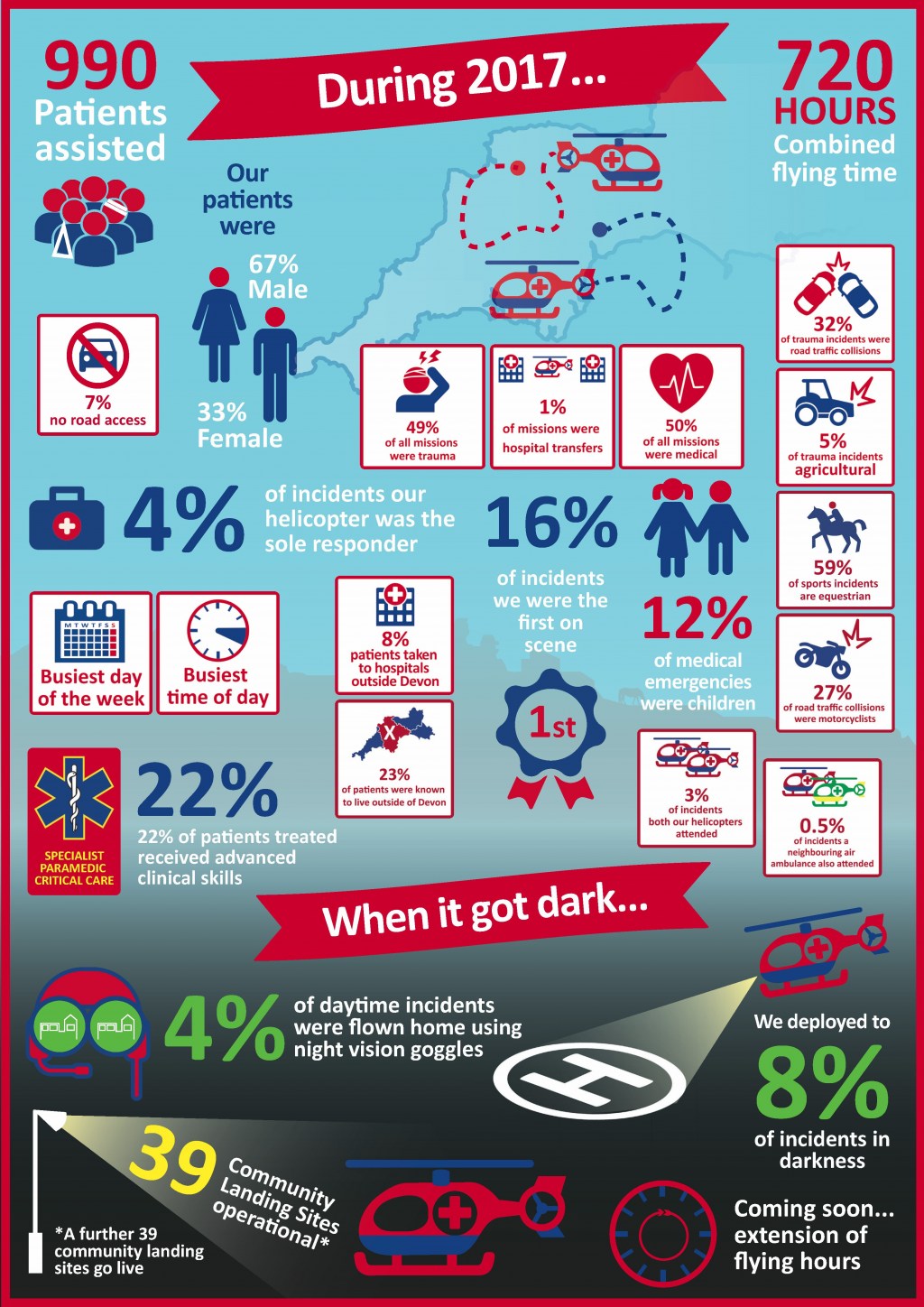
Sometimes graphics speak louder than words....
President's Review
| 08th March 2018 |
Newsletters
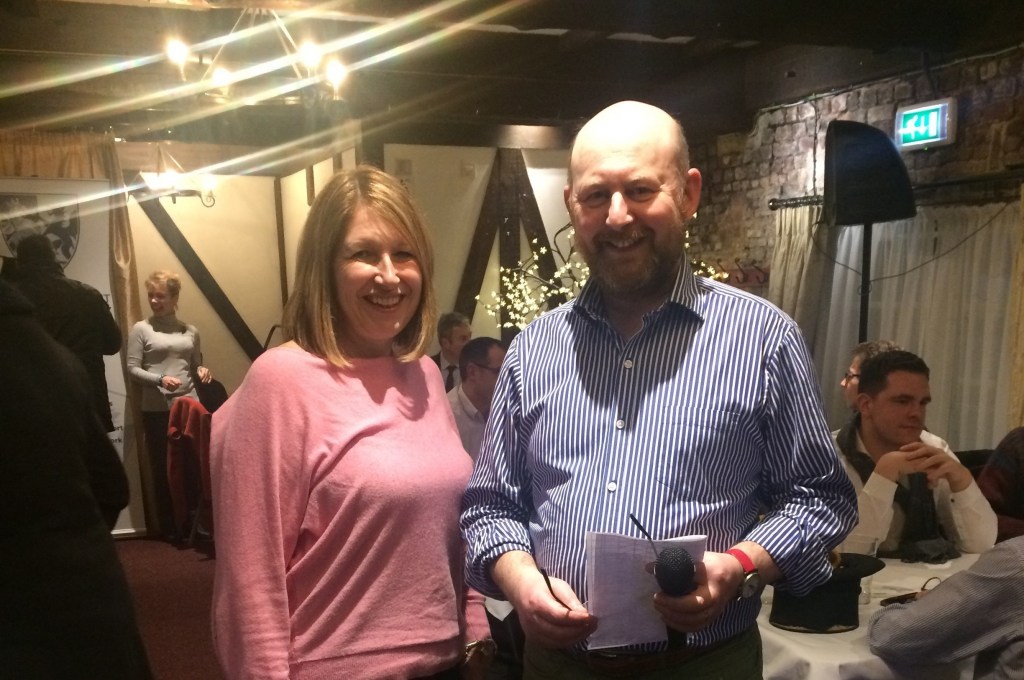
As I write this, my last review, I am also reflecting on my year in preparation for my report for the AGM. It has been a busy, stimulating and enriching year which has literally flown by! After a relatively quiet start to the year in terms of engagements, February was pretty full on and March looks set to continue that trend.
I attended a very enjoyable lunch with many Past Presidents of the Society at which consideration was given to the nomination of our next Deputy Vice President. This is the day on which I can take a deep breath and hand over to our next President at the AGM in April. I was recently asked what I would do with my “spare” time when my year comes to an end. I have been disappointed that I haven’t had as much time as I had hoped to devote to fundraising for my nominated charity, the Air Ambulance. Vice President, Stephen Mahoney and I wanted to choose charities which covered the whole of Devon and Somerset and agreed that our fundraising for our respective years would be split between Devon; and Somerset & Dorset Air Ambulance Trusts. Fundraising is crucial - each rescue “mission” costs upwards of £2,500 and between them the two trusts have flown around 36,000 missions. These fantastic charities save lives and we never know when it might be ours or someone we care deeply about. I therefore intend to devote some more time fundraising to swell the coffers of those two very worthy causes.
Arrangements for our Annual Awards and Dinner are continuing to secure a new date** as soon as possible following the decision to postpone the event due to the adverse weather at the beginning of March. I am sure that the renewed preparations will ensure a spectacular evening with plenty of celebrations for the worthy winners. Thank you to all who have been involved, in particular our media partners for the third year running, Trinity Mirror. Trinity Mirror have been through significant strategic change during this year and it is a tribu...
Interview with Vice President Stephen Mahoney
| 08th March 2018 |
Newsletters

What have been the highlights of your involvement with DASLS to date?
One of the undoubted highlights was taking part in the Exeter Legal Sunday Service last June and hosting the dinner for our International guests the night before. There were lawyers from Belgium, Germany, Holland, Italy and Poland. Some had taken part in the service several times before while, for others, it was the first time, but they all loved the ceremony and the history of the occasion. The fact we processed for the first time from Exeter Castle to the Cathedral and back for the High Sheriff’s Reception just added the crowning touch.
This year the service is taking place on Sunday 10th June and it would be great to see more DASLS Members taking part and making what could prove to be useful connections with other European lawyers.Another really memorable event was my first experience of a Twin Bars Meeting, also in June, hosted by the Bilbao Bar. Their hospitality was fantastic and it was a great opportunity to mix with representatives from all our Twin Bars. Talking to lawyers from other European countries, you learn they all face similar if not worse challenges to us, such as cuts to publicly funded legal services and increasing political pressure on the independence of the profession.
Has your year as Vice President been all about hosting or attending social events?
I wish! On the first day of the Twin Bars Meeting in Bilbao, all the Bars had to make presentations on the impact of the abolition of mobile phone roaming charges in their jurisdictions, a subject about which I knew precisely zero. A few anxious days were spent pulling information together from various sources and colleagues before International Relations Sub-Committee Chair Emma Mitcham and I faced the international audience with our offering. My next Twin Bars Meeting is at Leuven in Belgium. I am hoping their topic for presentation is one I know more about.
Of more immediate relevance to...
Managing Regulatory Relationships - 5 steps to an effective compliance strategy
| 08th March 2018 |
Newsletters
I was recently asked to speak at a national risk and compliance conference and asked to share my experiences of managing regulatory relationships. Whilst planning what to say, I reflected on my experience of good management and the fact that most lawyers and compliance professionals I meet are striving to achieve a common goal; to stay regulated and to be part of a well-run business. With time to reflect on how this can be
achieved, I thought I would share with you – as I did with the Conference delegates – my thoughts on how to stay regulated.
Effective management of the regulatory relationship creates a situation which is unsurprising for both you and your regulator. It’s good to be dull in regulatory terms! It’s good to be low maintenance and work in an environment where events are anticipated and actively planned. It’s a situation where fire-fighting and chaos is avoided and regulatory reactions are well-rehearsed. It’s timely, you are not caught unawares, it’s supported by effective communication (internally and externally), and you have the means of being able to prove you do what you say.
It seems to me that there are five components to rolling out an effective compliance strategy:
Step 1 – understanding and agreeing to the concept of regulation
Of course, I hear negative views about how we are regulated and I do understand why there are frustrations. However, my starting point is this: do we support the reasons why the law is heavily regulated and do we want to be part of this industry?
Regulation ensures that both we and our clients are protected from those who may try to undermine what we can do with our knowledge and skills. A good reference point for this is always the wise words of Sir Thomas Bingham who, in the landmark regulatory case of Bolton v Law Society, expressed it by saying that lawyers should act with “integrity, probity and complete trustworthiness” before adding “a profession’s most v...
Restorative Justice
| 08th March 2018 |
Newsletters
My turn to write an article for the DASLS Newsletter soon comes around and I am always on the lookout for some thought provoking mediation content to share with you.
Some years ago I attended a course on Restorative Justice based on the model being used in the USA and I could see the benefits, where victims of crime and/or their families requested it, of criminals having to meet and face their victims to atone for what they had done and for both parties to try and come to terms with what more often than not was a totally senseless act.
At the time I felt that we were many years behind the States, where even civil mediation was receiving little press coverage or time afforded to the education of its benefits within the English legal system.
It was with great interest then that I came across an article in Saturday’s edition of The Guardian about how mediation is being utilised within prisons and in one of our Devon Prisons no less.
Under the direction of Maria Arpa, one of the country’s leading Mediators, prisoners are being introduced to the benefits and skills of mediation and as a direct consequence are able to consider alternative ways of settling conflict in their confined surroundings without resorting to physical remedy.
Maria kindly agreed to discuss this further with me:
L Maria, thank you for taking time out to talk with me for the purposes of putting together some further information on the work you do into our DASLS Newsletter.
Prior to introducing mediation skills in Prison environments, what other types of Mediation did you undertake?
M I started out many years ago as a Voluntary Community Mediator in London, dealing with neighbour disputes in the main. I have carried out over 1,000 community mediations which I refer to as being ‘at the coal face’ and since then I have worked in Civil, Family, Workplace and threat to life.
L What inspired you to try and put together a process th...
DASLS Abroad - a JLD Review of the International Relations Sub-Committee
| 08th March 2018 |
Newsletters

"World peace cannot be safeguarded without the making of creative efforts proportionate to the dangers which threaten it", was the opening line of the Schuman Declaration in 1950. This is the origin of what we now call the European Union. So, having spent the last year acting as a JLD observer at the many IRSC meetings and events, it is an opportune time to share some reflection of the experiences, insights and knowledge that comes with the IRSC.
Of particular note is DASLS membership of the Fédération des Barreaux d’Europe / Federation of European Bars (FBE), which is led by the IRSC. The IRSC represents all DASLS members abroad and raises the DASLS profile across some 250 members bars and approximately 800,000 lawyers within the 47 member states of the Council of Europe.
On my first trip with the IRSC last June, we headed to the FBE General Assembly in The Hague, with particular focus on the role of the International Criminal Court (pictured below).
The core themes being the role of ethics, complex cases and courtroom conduct, the management of legal aid, managing e-file trials and the role of local and national bars in ensuring transparency, professionalism and best practice. If you are wondering how this all fits in practice, it is something that only a few months later would be tested in the very same building during the infamous ruling and aftermath involving Slobodan Praljak at the International Criminal Tribunal for the former Yugoslavia (ICTY).
There was also much more to the General Assembly in The Hague. A significant amount of time, and hard work, went into raising greater international awareness and dialogue of current legal issues which affect us nationally and internationally. The ongoing erosion of the independence of judiciary, lawyers and the administration of justice in fellow EU countries, such as Poland and Romania, was passionately debated between attendees.
Having had some time out to visit the si...
John Matthew Close 1927-2018
| 08th March 2018 |
Newsletters

John Close, who was President of the Somerset Law Society in 1990 and a former senior partner of Clarke Willmott & Clarke (as it then was) died on 1 January 2018 aged 90.
He was born in Bristol and obtained a scholarship to Colstons School. He was offered a place at Oxford to read history but chose instead to read law at Bristol University.
He was a keen sportsman, playing rugby for Bristol and being a member of the Westbury Harriers under-19 4 x one mile relay team which broke the world record in 1946. His interest in sport continued into his retirement and he was often seen watching his grandsons play rugby and offering advice to referees.
After obtaining honours in his Law Society finals and doing his national service, he was articled to a firm in Bristol. A chance meeting with Freddie Willmott led to a job offer on qualification with CWC and he joined them in 1952.
He became the seventh partner in 1957. By the mid-1980s CWC had become, in the number of partners, the largest firm outside of London with 11 offices in Somerset as well as offices in Bristol and London. His vision, drive and enthusiasm were major contributing factors to that expansion.
Initially employed as a court advocate, he subsequently established a reputation as one of the leading planning and land development lawyers in the South West and chaired the Somerset Rent Tribunal for many years.
His reputation and his ambition were instrumental in changing CW from a very successful High Street practice to a national law firm.
He is remembered with affection by his former partners and his many professional contacts....
Invitation to the 2018 International Lawyers' Meeting in Leuven - 17-19 May
| 08th March 2018 |
Newsletters

DASLS is twinned with the Bars of Bilbao, Erlangen, Gdańsk, Leuven, Rennes and Verona. This year’s annual meeting will be hosted by the Young Bar of Leuven. They have issued the open invitation reproduced below.
Members are invited to put their names forward if they wish to be included in DASLS delegation by 31 March.
Please register your interest with Monique at DASLS office - monique@dasls.com - to receive details of the full programme, case study and other practical information....
Keeping on the straight and narrow by Sponsor Aon
| 08th March 2018 |
Newsletters
They may not be universally welcomed by fee earners, but the COLP in a well-managed practice knows that effective matter acceptance procedures are essential. They ensure that clients are properly vetted and that only work within the firm’s expertise is taken on. A sound approach protects the firm from the hassle faced by firms whose procedures are less rigorous and goes a long way towards preventing the claims that can arise from sloppy procedures. Even the best take-on procedures, however, won’t always keep you on the straight and narrow. This is due to the risks that arise during the retainer.
The risks are many and varied although some, such as missing a critical time limit, are now better managed than in the past. Accordingly, this article will focus on ongoing risks in two key areas, the retainer and communication.
Clarity around your retainer is essential. All too often, the client care letter has become a lengthy compliance document, produced by the firm with more than half an eye on its compliance obligations and little thought about meeting the client’s needs.
Next time you audit one of your firm’s files, before you do anything else, try to put yourself in the client’s shoes. Then read the client care letter and draw your own conclusions. As research published last year revealed, the client care letter tends to have very limited value to most clients. Particularly if they give up part way down page two because it is seen as largely irrelevant. In some firms, fee earners only become involved once the client care letter has been sent out by the admin team.
If your client care letter barely touches on the detail of the retainer, perhaps covering it superficially in just one or two sentences, then fee earners must ensure that the retainer is clarified. The work covered by it should be clearly set out. One of the matters arising from the spate of property fraud cases in 2016 was the lack of clarity in the retainer about all of the step...
Capital Allowances: Tax Relief for Fixtures in Buildings by Sponsor Francis Clark
| 08th March 2018 |
Newsletters
There is often scope to obtain significant tax relief for fixtures in commercial buildings. Recent key changes with regard to fixtures impact on the sale or purchase of property. This highlights the significance of ensuring that information on fixtures is available and that you enter into the transaction well-advised. We are able to review your position to ensure these valuable reliefs are claimed.
If you own a commercial property and have not claimed capital allowances on all relevant fixtures then it may be possible to make a substantial claim.
Purchasers of commercial property need to ensure that:
The vendor has allocated the fixtures expenditure to capital allowance pool, and
Both parties agree the value attributable to fixtures is to pass on sale.
If the above requirements are not met then the ability to claim capital allowances on these fixtures will be lost to the purchaser and any future owners.
Vendors also need to take advice to ensure they are not exposed to an unexpected tax charge.
Fixtures claims
It is possible to claim capital allowances on fixtures within a building. This includes plant and machinery (e.g. fitted kitchens, sanitary ware, alarm systems and data cabling), as well as integral features (e.g. hot and cold water systems, lighting, electrical systems and air conditioning).
If the previous owners of a building were unable to make a claim on capital allowances then an opportunity may exist for you to claim based on the unrestricted market value of plant and machinery. We can undertake a review, in conjunction with qualified surveyors, to identify qualifying expenditure and reduce your tax liability or obtain a tax refund.
Is it applicable to me?
Properties where capital allowances have the greatest potential to add value include hotels, holiday parks, furnished holiday lets, nursing homes, medical premises, pubs and modern offices.
The value of fixtures is often in the region of 10% - 30% o...
Your Conveyancer's Guide to the CON29DW - Request your free copy from Sponsor Wessex Searches
| 08th March 2018 |
Newsletters

Request your free copy of Your Conveyancer’s Guide to the CON29DW Drainage and Water Enquiry Second Edition
At Wessex Searches, we know that the results of their drainage and water search is unlikely to be at the forefront of your client’s mind when they instruct you to carry out the conveyancing on their dream home.
Nevertheless, the Law Society’s CON29DW Drainage and Water Enquiry is an essential part of the residential conveyancing process.
It plays a critical role in helping you to ensure that you identify any drainage and water matters that may impact on your client’s costs or future liabilities. It also helps you identify any drainage and water constraints that could restrict or impact your client’s freedom to extend or alter their property.
The results of a CON29DW could elicit potentially deal-breaking information.
In our work with property professionals, we have been repeatedly told of a desire to be better equipped in the understanding and interpretation of the CON29DW.
You want to understand how and why the questions and answers in the CON29DW Enquiry are important to you and your clients.
That’s why we’ve created this Conveyancer’s Guide to the CON29DW.
Our guide will:
Help you understand and interpret the CON29DW Drainage and Water Enquiry questions
Illustrate where helpful the context and reasoning behind the questions
Explain the implications of answers you may receive
Provide examples of important details to look out for
Highlight certain risk areas
Provide a guide to commonly used water and sewerage industry terminology.
In our opinion, the CON29DW is the most comprehensive and reliable way for conveyancing professionals to protect homebuyers from a range of drainage and water risks, which could impact on the value, title and future maintenance costs of a property. It offers a clear trail of responsibility back to the water company and gives you and your client peace of mind.
...
What is Disaster Recovery Planning? by Sponsor Alchemy Systems
| 08th March 2018 |
Newsletters

Unusually for IT, the title is actually self-explanatory! To rephrase though, it’s the process a company goes through to get into a position where they can come back from a catastrophe, in a reasonable period of time, having suffered no major data loss as a result of the event.
Disaster Recovery Planning, or DRP, is the first step towards achieving this highly desirable state of system robustness. The Business Continuity (or BC, for those in the know) refers to a firm’s ability to keep running, to some degree or another, during a disaster.
The Basics – Data Backups
As you might expect, the cornerstone of any sort of DRP will be backups. These can take many forms depending on data type, volume of data, and the speed with which restoration might be necessary. The absolute most important thing about backups though, is that they are;
performed on a regular basis
periodically checked to ensure that you are actually backing up what you need to back up (and nothing else)
subject to test restores, to ensure that backed up data can be brought back following a failure
located securely on-site and also, off-site, so that they are not at risk in the event of fire / flood or similar
versioned, so that there are multiple backup sets to choose from. This is key when recovering from ransomware attacks, as the particularly nasty ones can encrypt backups too.
The Basics – Prevention is still better than Cure
Aside from taking backups of data, there are a number of other steps that can be taken to mitigate risk and to maximise up-time;
RAID (Redundant Array of Inexpensive Disks)
If you have a server, ensure it’s running a RAID-1 or RAID-5 Array, which provides some protection against physical drive failure.
Previous Versions Are Cool
Windows 7, 10 and Server 2008 / 2012 / 2016 have a feature called “Previous Versions”. It’s basically a snapshot service that Windows runs to enable you to quickly restore a file fro...
Professional Services 2018 Outlook by sponsor Barclays
| 08th March 2018 |
Newsletters

Barclays Professional Services 2018 Outlook
Paul Jarrett, Relationship Director Professional Services at Barclays Corporate shares his thoughts on what will be the key trends and issues affecting professional services in 2018. Paul highlights the key challenges and opportunities on what the focus will be in developing people and practices.
Reflecting on 2017, it was a good but tough year for the professional services sector. A lot of practices delivered headline growth turnover, but when you look at this, much of the turnover was inflated by foreign exchange movements and not a lot came to the bottom-line in terms of underlying profit. Brexit was also key a focus as many firms found it difficult to navigate their way through this and firms also had general concerns on the health of the UK economy.
Challenges
2018 has seen many firms start to re-think how they attract and serve clients with technology factors such as, automation and AI and the client experience being a key area of focus. We are already seeing some firms well advanced in using technology and others not and this needs to be on the forefront of all firms’ minds to improve the speed and efficiency of their operations, and to create a more convenient interface for customers and clients.
Another challenge firms need to be mindful of is increasing levels of cyber-crime which is having a greater financial impact on firms and clients alike. Focusing on this will allow professional firms reduce attacks that can result in major financial losses and data breaches.
The professional services market will continue to face challenges. The market will still be over-crowded, firms will still be navigating their way through Brexit and there will be continued pressure on firms to retain their top talent.
Opportunities
Looking ahead into 2018, there will be a number of opportunities professional firms can maximise their growth on.
Invest in technology from a cost-based perspective an...
News from the Devon & Somerset Junior Lawyers' Division: Dodge, Duck, Dip, Dive
| 08th March 2018 |
Newsletters

The new JLD committee held their first social on 12 December: a drinks evening with a Christmas jumper theme at Las Iguanas in Exeter. JLD members saw in the festive period with plenty of prosecco and merriment.
More recently, the JLD also held their first sporting event of the year. In a bid to get young lawyers involved in slightly alternative sports, iBounce trampoline park in Exeter was the venue for an evening of trampoline dodgeball. JLD members were given freedom of the park for the evening; allowing them to fly onto air mattresses, walk tightropes across foam shapes (which were surprisingly difficult to escape from after falling in) and enjoy a wide range of trampolines with other obstacles between them.
The highlight of the evening was the dodgeball competition. JLD members were split into mixed-firm teams which were shuffled between matches to ensure everyone had a chance to socialise with other members. Speed and reaction games added extra variety to the evening of trampoline-based might-be-sport which left most members feeling thoroughly exhausted. The JLD would like to extend its thanks to the team at iBounce for being so welcoming and helpful throughout the evening.
Our recent seminar run with DASLS looking at Commercial Acumen was very well received and we are looking forward to further educational events shortly: the next one will be in March and details will be sent out closer to the time.
26 January 2018
Ben Thomson (Chair) and Ben Butterworth (Sports Representative)...
Dorset and Somerset Air Ambulance Aircraft 'Pegasus' formally unveiled at naming ceremony
Monique Bertoni | 08th March 2018 |
Newsletters

We would once again like to thank the Devon and Somerset Law Society (DASLS) for their continued support. We are delighted to have been selected as the president’s chosen charity from 2017-2019 alongside Devon Air Ambulance Trust.
The start of 2018 has already been packed full of activity for Dorset and Somerset Air Ambulance, so we thought that we would share some recent news regarding the official naming of our aircraft, and a view from our Unit Chief Pilot, Mario Carretta who flies it.
Having announced that our AW169 helicopter was to be named ‘Pegasus’ following a competition last year, we were delighted to be able to hold an event in January, where the name of the aircraft was formally unveiled.
Kindly hosted by Leonardo Helicopters in Yeovil, the event gave the Charity an opportunity to showcase the aircraft and inform guests of its vision and mission both from a clinical and aviation point of view.
Geoff Munday, Managing Director of Leonardo Helicopters began proceedings by welcoming the audience, before Roger Morgan, Chairman of Trustees for Dorset and Somerset Air Ambulance responded by thanking all those who support the Charity and have helped make it so successful.
The ‘unveiling’ was handed to the Charity’s Patrons, Annie Maw (Lord Lieutenant of Somerset) and Angus Campbell (Lord Lieutenant of Somerset). They were joined by Angela Andrews, Deborah Fear and Poppy Holt who were three of the winners of a competition which was launched to find a suitable name.
Also in attendance were the young winners of an art competition which the Charity ran alongside the naming competition. Each of them were extremely proud and excited to have their photograph taken standing next to an enlarged version of their winning entry.
Bill Sivewright, Dorset and Somerset Air Ambulance Chief Executive Officer took to the stage and congratulated the winners before giving a review of the Charity’s vision and the ...
LawCare - Coping with Bereavement
| 08th March 2018 |
Newsletters

We will all experience bereavement at some point in our lives. Very few of us are adequately prepared or understand how to cope. Often callers to the LawCare helpline will mention a bereavement in passing without fully realising that it may well be contributing to their state of mind, inability to work at full capacity or a feeling of heaviness.
Bereavement brings with it a slew of emotions, behaviours and symptoms. Compassionate leave in some law firms can just be one day off for the funeral/memorial service yet the grieving may last a lifetime. Not one of us knows how we are going to cope with the death of someone.
When we are bereaved we enter into a state of grief, which will be different for each of us. For some this may be postponed or denied as work takes precedence, for others they may get stuck in their grief unable to fully function. No-one grieves according to a set pattern and it is not a linear process. If you try to bury grief, it can return - triggered perhaps by a scent, voice, or a piece of music. So how can you try and work through grief and attempt to move on?
Professor William Worden identifies four ‘tasks’ of mourning.
The first is accepting the reality of the loss. There are many basic ways of doing this and events such as funerals and memorials naturally help us to do this. Thinking and speaking about the deceased in the past tense is another example.
The second task is working through the pain of grief. We will each have different emotions that are important for us to feel and recognise – some of these may include anger, loneliness, guilt, even relief. It is vital to acknowledge, talk about and try to understand all of these feelings in an attempt to process them.
Task three is adjusting to the environment in which the deceased is missing. This can mean a variety of different things ranging from new practical responsibilities such as paying bills, cooking, parenting, to redefining yourself w...
President's Letter - Sue Aggett
| 10th January 2018 |
Newsletters

Welcome to 2018. I hope that you all had an enjoyable festive break and I wish you all a happy New Year. I hope that you all managed to spend some valuable time away from the office and resting from the constant flow of emails and various other reminders that our break is perhaps just a little too short!
Sue Aggett with Stephen Mahoney at theSomerset Dinner
I certainly welcomed the break as November was a particularly busy month. On 3rd November I attended our Society’s dinner at the Somerset County Cricket ground. This was attended by over 100 of our members. We also welcomed guests from the judiciary and our all-important sponsors. We were joined by representatives from Devon and Dorset & Somerset Air Ambulance trusts and raised an amazing figure in excess of £800 to be shared between the two. There was a “surprise” star prize donated by Dorset & Somerset Air Ambulance – many congratulations to the winner of the bespoke electric guitar. Special thanks go to Past Presidents Rebecca Parkman and Tony Mason for donating prizes for the draw and helping to raise such a significant amount of money for such a worthwhile cause. Special thanks also go to Richard Adams for the excellent Toastmaster role he performed.
L-R: Jon Pitt (Kent Law Society), Tony Steiner, MarkHarrison (Newcastle Law Society) , Sue Aggett,Stephen Mahoney, James Scozzi (Surrey Law Society),Chris Hart at the County Societies Group Meeting,November 2017
Towards the middle of November, together with VP Stephen Mahoney, Hon Sec Chris Hart and Tony Steiner we found ourselves in the hallowed environment of Westminster & Holborn Law Society (literally right next door to the Houses of Parliament) who kindly provided a venue for our County Societies meeting. We spent valuable time with colleagues from Kent, Newcastle and Surrey Law Societies. Support for the CSG (which also includes Cheshire and North Wales, and Leicestershire) from both the SRA and The Law Society has be...
Tax Matters and Compliance
| 10th January 2018 |
Newsletters

One of my favourite principles from the current cache we have at our disposal is Principle 8. By way of reminder:
“You must run your business or carry out your role in the business effectively and in accordance with proper governance and sound financial and risk management principles”
I describe it as the management principle. It says it all as far as what managers, and compliance professionals must achieve. It gives us the foundation stone with which to build our compliance structure and it makes everyone a builder of the culture with its catch-all phraseology and inclusivity.
It’s a reminder to all managers/owners of what’s expected of them as the proprietors of the business with its tone from the top message. It delivers the entity regulation message; ‘hey guys, we are all in this together”. It’s an important day one induction message to all people joining the firm.
Principle 8 also provides us with clues about the need for continual contemplation of the nature of the firm’s practice. The key thoughts to reflect on are these: what’s risky about what we do and is what we described as proper governance and risk management in 2011 still relevant in 2017?
Compliance topics are dynamic and a firm which demonstrates a sophisticated response will be constantly revaluating what measures are needed to ensure that a good business environment, in which clients receive a safe legal service, is facilitated. So much has changed since 2011, that I would challenge any firm which has not reviewed its risk assessments and management responses since then. After all, we are currently working with version 19 of the 2011 Handbook, cybercrime is becoming one of the most virulent external threats we are facing, and we are in the spotlight like never before in terms of our response to data protection and anti-money laundering legislation. None of this was the case when the Handbook was launched. No firm should be resting on its corporate laurels.
...
How early is too early for mediation?
| 10th January 2018 |
Newsletters
After reading various articles about the likelihood of compulsory mediation and observing the costs decisions that are made when mediation has not been taken up, what has become apparent is: mediation is something that is often thought about or embarked upon in the process when it is too late.
We, as Mediators have something to learn in persuading other lawyers of the positive benefits of the mediation process. I will try and assist with that below.
Mediation is not about giving up control over the outcome of your case, or compromising your client’s position. Mediation is about taking control and determining the outcome. Exploring, without fear, stances or positions that the opponent is taking, and obtaining a better understanding of where they are coming from – all prove to be invaluable if the case does not settle at mediation.
I introduce the idea of mediation at the very outset of most new client appointments. Firstly, to make them aware of the process available and also to help clients to understand what the Courts expect of them should the matter end up at trial.
Whilst I do understand the need sometimes for expert’s reports to be obtained and evidence to be gathered; sometimes you do not need all of this for mediation to have prospects of success.
Finally, all clients are concerned about costs. The earlier that mediation is considered, the fewer costs they have incurred. What that then means is that it is less likely that costs are going to stop parties from being sensible and attempting to reach a solution when only one of them will be a “winner” if they continue to Court. So my view is it’s never too early to consider mediation as a real alternative to Court.
I hope I have helped you understand the benefits of mediation. However, if I or any other of your Devon and Somerset Panel of Mediators can assist please do not hesitate to call us.
Kathy Trist
Chair Mediation Sub-Committee...
Homeworking and Tax Relief for Employees by Sponsor Francis Clark
| 10th January 2018 |
Newsletters

Over the last ten years technology has advanced massively. It was not so long ago that mobile phones were the size of a brick. Now emails and the internet can be accessed on the move. However, whilst technology has moved on, travelling has become more and more difficult. Homeworking has become the answer for many but how have the tax rules kept up with these changes?
Your status is important
The tax rules differ considerably depending on whether you are self-employed, working as a sole trader or partner, or whether you are an employee, even if that is as an employee of your own company. One way or the other though, if you want to maximise the tax position, it is essential to keep good records. If not, HMRC may seek to rectify the tax position several years down the line. This can lead to unexpected bills, including several years’ worth of tax, interest and penalties.
General rules
Generally, any costs paid on behalf of, or reimbursed to, an employee by their employer will be taxable. The employee will then have to claim the personal tax relief themselves and prove that they incurred those costs ‘wholly, exclusively and necessarily’ in carrying out their job. The word ‘necessarily’ creates a much tighter test than that for the self-employed.
In addition, the way in which the services are provided can sometimes make a substantial difference to that tax cost. For example, if the employer provides something for the employee, the rules are often much more generous than if the employee bought it themselves and attempted to claim the tax relief. A bit of advice and forward planning can often prove to be fruitful.
An exemption
The rules for employees in relation to ‘use of home as office’ contains a specific
exemption from a tax charge. They allow payments made by employers to employees for additional household expenses to be tax free, where the employee incurs those costs in carrying out the duties of the employment under homewor...
Happy New Year from Aston Court
| 10th January 2018 |
Newsletters

Thank you to everyone who responded to the stakeholder survey that I circulated before Christmas in preparation for the DASLS strategic review. Congratulations to Deborah Baker, Toller Beattie who won the prize draw of a case of wine.
The review working party meet in February and so it is not too late to give us feedback about DASLS, what we do and how we do it. The survey is still available for returns (email me for a link) or you may wish to simply drop me a line with any thoughts you have.
Have you ever considered becoming more involved with DASLS? Our Sub-Committees are the lifeblood of what we do and they always welcome new members. They offer a great development opportunity for members to exchange ideas and thoughts about legal practice and get to know others across the region. Generally they meet around 3 or 4 times a year so the commitment is not huge but can be very rewarding. The Sub-Committees are: Contentious Business, Education & Training, In-house, International Relations, Mediation, Non-Contentious Business, Practice Management and Social. If this interests you please speak to me or Monique – 01392 366333.
You may have seen a new name at DASLS in the last month, Beth Adams. Beth has been doing an excellent job standing in as our Team Secretary whilst we seek a permanent recruit. I am pleased to report that we have just made an appointment and all being well they will start towards the end of January.
2018 promises to be as interesting as 2017 with continuing changes to practice, GDPR, artificial intelligence, client expectations and of course Brexit. DASLS will continue to represent you at a regional and national level bolstered by our recently formed County Societies Group. We will keep you up to date with developments as we hear about them through this Newsletter, Buzz and our programme of training events, meetings and conferences.
The next social event will be the Challenge Cup Quiz on Thursday 1st February. Please suppor...
Devon Air Ambulance thanks DASLS for their continued support as chosen Charity
| 10th January 2018 |
Newsletters

Devon Air Ambulance (DAA) would like to extend a huge heartfelt thank you to Devon & Somerset Law Society (DASLS) for their support throughout 2017. As the president’s chosen charity, alongside Dorset & Somerset Air Ambulance, DAA were presented with over £400 at DASLS’ annual dinner in November.
In 2017 DAA celebrated two significant milestones; 25 years of service in August and 1 year of night flying in November. The night flying has enabled DAA to extend their service to fly until midnight, meaning they can help even more people. Reaching these milestones has only been made possible due to the fantastic and generous support the Charity receives from the friends of Devon, including local businesses such as DASLS. Every penny raised is making a real difference.
DAA own 2 Eurocopter EC135 helicopters and are incredibly proud to be independent of Government and National Lottery funding, meaning they rely solely on generous donations to raise the £5.5million needed every year to keep DAA’s helicopters flying.
Fundraising Director Caroline Creer stated “Business support greatly contributes to our annual fundraising and we are extremely grateful to DASLS for choosing us as their chosen Charity, alongside Dorset and Somerset Air Ambulance, for the period 2017-19. We look forward to continuing to maintain and build on this fantastic relationship into 2018.”
DAA are looking forward to another successful year of fundraising in 2018. As well as a whole array of community fundraising events happening throughout Devon, DAA will be hosting their annual Motorbike Ride Out, Dragon Boat Festival and Commando Challenge in July, September and October respectively. Full details of all these events can be found on the DAA website at www.daat.org/our-events.
For further information please contact:
Peggie Clark at p.clark@daat.org or on 01392 466666 ext123
About DAA
Our mission is to relieve sickness and injury in the county of De...
John David Coulson 1943 - 2017
| 10th January 2018 |
Newsletters

John David Coulson, ex senior partner of Scott Richards solicitors, died on 7th November, aged 74. John was born in Leicester and, in 1962, attended the College of Law, Lancaster Gate, London, where he passed his law exams at the first attempt. He was articled to a firm in Leicester where he met his wife, Diana, who was then working as a temporary secretary at the firm. They married in 1966 and moved to Dawlish, where John joined Scott Richards and Hunt.
John became an equity partner, eventually becoming senior partner until his retirement in 1999. He practised a number of areas of law throughout his career but specialised in property and family law by the time he retired. His two children by then having grown up and long since left home, he and Diana moved to live in the Dordogne in France, where they ran a holiday property letting business. They returned to Dawlish in 2013, where they continued to enjoy their retirement.
John always had a lot of time for his immediate family, all of whom lived nearby. He was a very kind man, with a keen sense of fun. He was very active in and Chairman of Round Table, 41 Club and Rotary in Dawlish and also of Rotary in France. He was always very supportive of Dawlish and, in his retirement, worked for the newspaper for the blind reading the Dawlish Gazette and was one of the station’s gardeners.
John was a wine connoisseur and was very knowledgeable on the subject. He was an entertaining raconteur and fantastic host and he thoroughly enjoyed any social event. He was also an avid listener of The Archers.
John is survived by his wife, Diana, two sons and two granddaughters.
Paul Dyson – Senior Partner of Scott Richards and Past President of DASLS...
Annual Risk Management Review by Sponsor Aon
| 10th January 2018 |
Newsletters
Any business planning for the future needs clear objectives and an understanding of the obstacles that may prevent those objectives being achieved. Rarely do those threats, or risks, stand still. Even though they may have been identified when the objectives were agreed, and even entered in a risk register, it is important to keep risks under review.
An annual risk management review is an essential part of any risk management strategy but it is often overlooked or is paid only lip service. Done well, it enables you to assess your firm’s risk profile and to benchmark whether your performance is improving or deteriorating. Identifying whether those changes are in one particular team, department or office is particularly valuable. The effectiveness of your review is dependent on performance data.
The review makes sound business sense but it is worth reflecting on the regulatory context. The SRA does not impose any specific requirements but Principle 8 requires you to run your business in accordance with sound financial and risk management principles. Drilling down into its Handbook, the guidance note to Rule 8.2 of the Authorisation Rules, says that it would expect firms to have “a system for monitoring, reviewing and managing risks.” Lexcel, the Law Society’s practice management standard, is more prescriptive, with your obligations set out in the risk management section.
Section 5.16 of Lexcel, version 6, lists 8 types of data that must be included in the review which is quite helpful as some firms struggle to see beyond claims and complaints when it comes to reviewing risk. The matters listed do, of course, include claims and complaints, plus file review data, all compliance breaches, conflict of interest data and steps taken to address all risks identified in these areas, although there is no reason why other data should not be included.
Your complaints data can provide really useful intelligence. These clients are telling you where t...
Nominations invited for the Society’s Main Committee
| 10th January 2018 |
Newsletters
It is again the time of year when we invite members of the Society to help DASLS by seeking to join the main Committee and help with the Committee’s work.
The main Committee is at the heart of the work and decision making of the Society and also helps to co-ordinate the important work of the many Sub-Committees. As a result membership of the main Committee can make a real difference to the Society and to the working life of solicitors across our two counties.
The Committee is made up of the Officers of the Society together with (according to the Articles) “not less than 10 or more than 40 elected members”.
In order to continue the effective work of the Committee new members are needed, and therefore nominations are requested.
If you would like any further information please do not hesitate to contact me.
If you would like to either be nominated or nominate someone for election please complete the form below.
This form should please be returned to me by no later than 5.30pm on 31 January 2018. The election will take place at the 24th April 2018 AGM.
TO: Chris Hart
DASLS Honorary Secretary
Aston Court, Pynes Hill, Exeter EX2 5AZ [DX 8361 Exeter]
I wish to nominate
Full name ……………………………………………………………………
of ……………………………………………………………………
for election to the main Committee and I confirm that the nominee is willing for his/her name to go forward.
Signed ……………………………………………………………..
Address ……………………………………………………………
…………………………………………………………………………
Year of Admission of Nominee ………………………..
Please return this form by 31 January 2018....
Are We Secure? - Alchemy Systems
| 10th January 2018 |
Newsletters
At Alchemy Systems, this is without doubt the question we get asked most by our clients – which is good, as it does demonstrate that security is upper most on their minds. Luckily for our clients, if they have followed our advice then our answer is always yes…although there is no such thing as 100% security (be weary of companies that promise you 100% security). Security breaches should be looked upon in terms of when rather than if, and then ensuring you have the best practices in place to mitigate any problems. The dark types as we like to call them are a clever bunch and constantly develop sophisticated ways to bypass even the most robust security.
What we always advocate is a layered approach to security and this simply meanshttps://www.alchemysys.co.uk/ employing a number of precautionary measures to tackle the problem. The central idea behind layered security is the belief that the most effective way to protect IT systems from a broad range of attacks is by employing an array of counteracting strategies. Layered security efforts attempt to address problems with different kinds of hacking or phishing, denial of service attacks and other cyber attacks, as well as worms, viruses, malware and other kinds of more passive or indirect system invasions.
Our security mantra at Alchemy Systems is Reduce, Remove, Secure. Some of the strategies we employ include:
1. Physical Security – seems like an obvious one but it is amazing how many businesses still take this for granted! Physical security is an important layer in any layered approach. Guards, gates, locks and key cards all help keep people away from systems that they shouldn’t touch or alter.
2. Network Security – A key layer, good network security measures should include firewalls, intrusion detection and prevention systems (IDS/IPS), and general networking equipment such as switches and routers configured with their security features enabled. Establish trust domains for security access and sma...
Court of Protection: Five further top tips for estimating costs - bSquared Costs Law
| 10th January 2018 |
Newsletters

As you will no doubt be aware practitioners are now expected to inform the Office of the Public Guardian (OPG) with their estimated fees for the forthcoming general management year. Introduced in Spring 2016, the OPG105 provides the OPG with details of practitioner’s costs for the previous year and the estimated costs for the forthcoming deputyship year.
Regular readers of this article may recall that, back in the summer, we provided ten top tips with regard to costs estimates. We are now over eighteen months on from when these were first introduced, and whilst we had to wait a year to see what the impact of these would be, we are now some six or seven months down the line and have noted further trends and common mistakes that can be made.
We therefore have put together a further five top tips, which will hope will give you something to think about, but more importantly assist you when completing your estimate.
Five further top tips for completing the report
We would always encourage you to complete the “additional information” section on page 5 of the OPG105. This will assist your costs draftsman and the court, should your estimate be exceeded. If you are able to provide details upon which your estimate is based, should any further issue arise during the deputyship year, details of these issues can be conveyed to the court and help justify any additional costs over and above the 20% allowed by the court.
Further to the above point, it may be worthwhile putting in details of any potential issues that may arise. As covered in our top ten tips article, this will justify an “inflated” estimate, in the event matters settle down or certain issues are not progressed for whatever reason.
Do remember that you will need to lodge the previous year’s OPG105 prepared, as this will contain the estimated costs for the year for which the bill of costs has been prepared. For example, if we were preparing a bill for 2016/2017, we would need the ...
President's Letter
| 01st November 2017 |
Newsletters

President of Bristol Law Society,
Becky Moyce at their Annual Dinner
and Awards Ceremony
Since my last review, the shops are full of ghoulish masks, fireworks and Christmas cards. It is difficult to believe that I am now over halfway through my year as your President.
Business has certainly picked up a fast pace since the summer break and over the last few weeks the focus has been very much on the promotion of our 2018 Dinner and Legal Awards. We held our launch event at Somerset County Cricket Club which was attended by sponsors, and potential sponsors, nominators and nominees and our media partners Trinity Mirror South West. Mark Ollier, Partner at Beviss & Beckingsale, last year’s winners of the Law Firm of the Year Award (1-10 partners) spoke with passion and enthusiasm about the positive impact of their award on their firm, its staff and current and new clients. Following his hugely motivational words, I’m sure everyone in the room was inspired to submit an awards entry. Thank you Mark. The launch event was a great platform to highlight the extensive coverage that those associated with the Awards have received, and will continue to receive, in the run up to the evening on Thursday 1st March 2018. With a flood of high calibre entrants this year, I am sure the judges will face a challenging time in shortlisting those nominated. I wish you all success and am certain that those shortlisted will be thoroughly deserving of their selection.
As the Brexit talks and processes progress and continue to divide opinion, it remains important to show the rest of Europe that we are open for business. Whatever your view, the changing times we live in make our profession’s reputation, its integrity, fairness and independence as crucial as ever. I hope that the “Pride in the Profession” promoted by The Law Society will continue to be a key theme for you as we move towards our exit from the European Union and that our relationships with our European pr...
Nominations invited for the Society’s Main Committee
| 01st November 2017 |
Newsletters
It is again the time of year when we invite members of the Society to help DASLS by seeking to join the main Committee and help with the Committee’s work.
The main Committee is at the heart of the work and decision making of the Society and also helps to co-ordinate the important work of the many Sub-Committees. As a result membership of the main Committee can make a real difference to the Society and to the working life of solicitors across our two counties.
The Committee is made up of the Officers of the Society together with (according to the Articles) “not less than 10 or more than 40 elected members”.
In order to continue the effective work of the Committee new members are needed, and therefore nominations are requested.
If you would like any further information please do not hesitate to contact me.
If you would like to either be nominated or nominate someone for election please complete the form below.
This form should please be returned to me by no later than 5.30pm on 31 January 2018. The election will take place at the 24th April 2018 AGM.
TO: Chris Hart
DASLS Honorary Secretary
Aston Court, Pynes Hill, Exeter EX2 5AZ [DX 8361 Exeter]
I wish to nominate
Full name ……………………………………………………………………
of ……………………………………………………………………
for election to the main Committee and I confirm that the nominee is willing for his/her name to go forward.
Signed ……………………………………………………………..
Address ……………………………………………………………
…………………………………………………………………………
Year of Admission of Nominee ………………………..
Please return this form by 31 January 2018....
DASLS Admissions Ceremony 2017
| 01st November 2017 |
Newsletters

Photograph courtesy of Bridget Batchelor Photography, bridgetbatchelor.com
20 recently qualified solicitors were welcomed into the Solicitors’ Profession
on Monday 9 October at the Guildhall in Exeter....
Congratulations to Wollen Michelmore - Winner of The Law Society's Excellence in Private Client Practice Award
| 01st November 2017 |
Newsletters

...
Prestigious National Appointment for Exeter Lawyer
| 01st November 2017 |
Newsletters

Penny Scott of Cartridges Law
PENNY Scott, partner at Cartridges Law, has been appointed as Chair of The Law Society’s Family Law Committee.
Penny, who has served on the committee for five years, took up the position this month. The committee is made up of specialist family law solicitors from throughout England and Wales who advise The Law Society on family law policy and development.
She said: ‘It really is a great honour to chair this committee. As well as generally reviewing and ensuring high standards of practice in family law we undertake specific projects - such as examining how family law should look post Brexit, or the development of on-line courts. The role also involves helping to represent the views of family lawyers nationally to policymakers and government.’
Penny, who is a specialist lawyer representing children, professional guardians, parents and grandparents in all types of children law cases, including care proceedings and adoption, will hold the position for three years.
She added: ‘I am very excited about being that bit closer to the decision-making process and being able positively to influence the role of family lawyers in our legal system. At the end of the three years my aim is to ensure people have a sharper idea of what family lawyers can actually do for them, and within society.
‘The committee is currently very London-focused and I think it will benefit from becoming more aware of the activity of its members in the regions.’
Penny qualified as a solicitor in 1995 and she has been Managing Partner of Cartridges Law for the last six years.
The Law Society is the national body which represents, promotes and supports all solicitors, promoting the highest professional standards and the rule of law. Within The Law Society the role of the Family Law Committee is:
to keep under review, and to promote improvements in, family law, practice and procedure, including child care law and procedure
to re...
Sara Smith of Devon County Council talks about her experience of winning an award with DASLS
| 01st November 2017 |
Newsletters

Once I had got over the shock and pleasure of being nominated for the award of best in house lawyer category by private practice it seemed very quickly that I was at the awards evening at the Exeter Chiefs Rugby Ground.
Fortunately for me on the night of the awards I was very well supported with good friends and work colleagues who all very much wanted me to win the award and were all delighted when my name was announced.
When you work in child protection it is a job that only people that do the same type of work understand. It may not be the best paid job for a lawyer but it is very satisfying to get a good outcome for children and hope that you have made a real difference to their lives so to be appreciated for the job is brilliant.
Working for council and receiving such an accolade meant that the press office was quick in publicising it and I even got a mention in council’s chambers at one of their meetings.
Local Firms of solicitors were very forthcoming with their congratulations.
However after a few weeks it was soon back to normal until I then discovered I had been nominated for the national award too.
The award has not made a difference in my job from day to day but has been a good morale boost.
L-R - Host Joshua Rozenberg QC, Sponsor Conscious, Winner Sara Smith and DASLS President Mark Roome...
VAT Update
| 01st November 2017 |
Newsletters
Electronic search fees do not qualify as disbursements?
The cost of electronic property searches do not qualify as a disbursement for VAT purposes but should be treated as part of the consideration for the supply of legal services.
That was the result of a recent ruling in the first tier tribunal against North West law firm Brabners, resulting in an HMRC VAT assessment of £68,000 being upheld against them. This case should be of significant interest to all law firms providing conveyancing services and recharging fees incurred for property searches, but could also have wider repercussions.
The case revolved around the treatment of electronic property searches procured from provider Searchflow. It appears that Brabners were not being charged any input VAT on the electronic searches which they usually obtained through Searchflow. As a result of that they had no input Tax to offset HMRC’s claim for output Tax on the sale.
HMRC assessed Brabners on the basis that the searches formed only an incidental part of their overall service to their clients, and since the primary supply was taxable, the recharge of the search fees should follow the same treatment as their primary supply.
Brabners, who had applied their treatment based on the guidance provided in The Law Society’s Practice Note on the subject, appealed the decision with the backing of The Law Society.
A key argument put forward by Brabners and The Law Society was that a 1991 concession from HMRC confirmed that postal searches could be treated as disbursements as ‘the fee is charged for the supply of access to the official record and it is the solicitor rather than the client who receives that service’, therefore electronic searches should be treated in the same manner.
This argument was rejected on the basis that the appeal did not concern whether or not the concession for postal searches was right or wrong, and was only looking at the facts of the case. It is unclear as to whe...
Here today, gone tomorrow? by Sponsor Aon
| 01st November 2017 |
Newsletters
Here today, gone tomorrow? By Sponsor Aon
Some smaller firms still hold the mistaken belief that business continuity is only relevant when you die. Of course, if you have no succession plan in place, then dying will pose a serious business continuity issue for whoever you have lined up to handle your affairs but the vast majority of business continuity risks don’t involve death.
Business continuity is defined in ISO 22301.2012 as the “capability of a business to continue delivery of its services at acceptable predefined levels following a disruptive incident”. The standard is very comprehensive. After all, the standard is recognised in almost every country in the world. Whether it is appropriate for your firm will depend on all the circumstances. What is crucial is that you have a plan so that your practice will survive whatever life throws at it.
Your professional obligations are implied rather than explicit. For example, reading between the lines, Principle 4 requires you to act in the best interests of each client even if the ceilings at your offices have collapsed due to a burst pipe. Principle 5 requires you to provide a proper standard of service to your clients even if the person handling the matter is in hospital recovering from a triple heart by-pass. Principle 6 requires you to maintain the public’s trust even when your systems have been hacked by fraudsters.
More generally, Principle 8 requires you to run your business effectively and in accordance with proper governance and sound financial and risk management principles. If you haven’t implemented a plan that is appropriate to the size and nature of your practice, then it is hard to see how the SRA would think you are compliant.
Some of the Indicative Behaviours (IBs) in the SRA Code of Conduct give a clearer indication of what is required, even though they themselves are not mandatory. For example, if you can identify and monitor business continuity risks including ma...
Increasing Business Efficiencies with Online Connectivity by Alchemy Systems, DASLS Sponsor
| 01st November 2017 |
Newsletters

Unless you’ve been living under a rock for several years, you will have heard people you know speak about the “cloud”. Of course, we’re not speaking about big white fluffy things in the sky, but rather a world of online connectivity which, if used well, can help to increase your business efficiencies. Here are 3 of the best ways how you can use the cloud to your advantage, right now:
Microsoft Office 365
Picture the scene, you’re upscaling, new employees are joining your team and your IT department or support company are hit with a backlog of software installation requests to get them up and running. Sound familiar? With cloud-based Office 365, the days of installing physical software on an individual basis could be long-gone. Employees can simply sign into the Office 365 cloud via a browser and download the most up to date software directly onto their own device. Once signed-in, staff can access their documents across all devices where Office 365 is installed, and new versions download and install in the background, saving time and money.
There are too many benefits to Office 365 to list, but here are some of our favourites:
Real-time, synchronised data: With Office 365, all of your emails, documents and files can be stored across all of your devices in real-time. With the software being cloud-based, all data is backed-up to the cloud, meaning no matter where you are or which device you are on, you can be up and running quickly and easily, simply by signing in to your Office 365 account. Never before has working been so flexible!
Whether you’re working in your office or on the go, you get a familiar, top-of-the-line set of productivity tools. Office applications —always the latest versions—let you create, edit, and share from your PC/Mac or your iOS, Android™, or Windows device with anyone in real time.
Your IT department are set-free: Setting up Office 365 is as easy as signing-in, downloading software and go. No more Microsof...
Transparency
| 01st November 2017 |
Newsletters
At the risk of saturating everyone with yet more Government Consultation papers it is incumbent upon our Sub-Committee to remind you that the latest SRA consultation paper on the subject of “Transparency” opened on 27 September and expires on 20 December. Please click on this link to download and respond. Whilst most of us feel we may be bashing our heads against a brick wall with these exercises, if nobody sends in a response we will most certainly achieve nothing. Your Non- Contentious Business Sub-Committee, Property Working Group, sent in a detailed response recently to the Government Consultation Paper on “unfair leasehold practices”. And I also know that several of you sent in individual responses to that as well, which can only be good. We will continue to make an input on behalf of our members.
I think that this “transparency” paper is much more over-arching and is part of a wider review by the Competition and Marketing Authority- so not just with conveyancing in mind – your firms may wish to take a broader brush approach.
However, much has been recently discussed about price standardisation within the realm of conveyancing. Yet the SRA state that “they are looking at transparency and apparently not at price standardisation. They state they do not want to interfere in how prices themselves are set. Their approach so far seems to be that, whatever pricing model or approach a firm uses to price its services, the firm will have to publish on line for consumers to look at. The new rules will likely be minimum standards, so firms will be free to add more information and context to differentiate themselves from other solicitor firms and providers. They do not have plans to standardise costs.”*
With this in mind our Sub-Committee are inviting Michael Lonergan to give a presentation early 2018 at Exeter Racecourse to the profession to expand on the SRA’s intentions and The Law Society’s input regarding this initiative. This should i...
Mediation in High Profile cases
| 01st November 2017 |
Newsletters
There isn’t anyone I know who wasn’t touched by the incredible sadness of little Charlie Gard’s devastating situation some months ago.
Can any one of us with children of our own even begin to contemplate what it must have been like for Charlie’s parents to have had to endure, beyond the very fact of Charlie’s illness, the endless Court battles that ensued? The answer must be a resounding no. Conversely, those doctors and nurses working in the intensive care unit of Great Ormond Street, painstakingly looking after the sickest of children, could never have contemplated the wrath and anger targeted towards them by the general public after the sad passing of Charlie.
Mr Justice Francis gave his Judgment on the 11th April this year which ends with his procedural note “I have already expressed the opinion that I believe that it would, in all cases like this, be helpful for there to be some form of Issues Resolution Hearing or other form of mediation where the parties can have confidential conversations to see what common ground can be reached between them. I believe that that type of hearing, be it Judge led or some other form of private mediation, would have led to a greater understanding between the parents and the clinical team in this case. I am not saying that it would necessarily have led to a resolution, but I think in many such cases it would and I would like to think that in future cases like this such attempts can be made.”
Whether or not mediation would have been taken up if offered in this case remains unknown, as does the question of whether or not mediation would have assisted the parties had it been offered.
In any litigation however, it is the offering which is vitally important. As lawyers, aren’t we depriving our Clients of ultimate Client care if we don’t always consider whether mediation would assist the parties in settlement of a litigious matter?
Liz Kendall
Vice Chair, Mediation Sub-Committee, Devon & So...
Training that isn’t taxing: the Apprenticeship Levy opportunity by Sponsor Barclays
| 01st November 2017 |
Newsletters
The Apprenticeship Levy: a new tax or an opportunity to find and nurture talent? For professional services firms, the consideration will be whether this is an operational burden or a chance to broaden their training programmes for future prosperity.
Since the Levy came into force in England in April 2017, all employers with a pay bill exceeding £3m a year (on all earnings that are liable to Class 1 NICs) must now invest 0.5% of that figure in apprenticeships. However, as a sweetener, the scheme comes with a £15,000 offset allowance every tax year, so some firms will effectively pay nothing and receive funding for training.
Use it or lose it
The scheme funding for firms is managed through the Digital Apprenticeship Service online account, with the Levy calculated, reported and paid on a monthly basis to HMRC through the PAYE process (alongside tax and NICs). This money, paid into the account by firms, can then be spent on any qualifying apprenticeship training. But with this money having a 24-month shelf-life, firms are forced to ‘use it or lose it’.
However, there is a rapidly growing roster of official apprenticeship schemes (over 200) covering a wide range of sectors to choose from – although, naturally, there are rules about how the Levy funding can be spent:
It must be spent on apprenticeship training (not apprentice salaries)
Apprenticeships must be real jobs, lasting for a full year (or more), with 20% of time spent on training and including a programme of learning measured against an agreed standard
Training must be delivered by a registered training provider, with apprentices assessed by a registered accreditor
Apprenticeships can be at any level (from basic to postgraduate level), for employees of any age, and at any career stage
Apprenticeships are governed by standards (usually employer-led).
Accounting for success
The Government has a target to reach three million new apprenticeships by 2020. It also wants to impr...
Richard Morgan Obituary
| 01st November 2017 |
Newsletters

Richard Morgan a Past President of the Somerset Law Society died on the 10th September aged 71. Richard was born in Taunton where his father was the Second Master at Kings College. Richard went to Radley where he played in the 1st XV Rugby team and also rowed for his school and then onto Bristol University to obtain a Law Degree. At Bristol he continued to play rugger both for the University and the English under 19s as well as rowing there. Sadly his athletic career was to end when he broke his back in an accident involving an armoured car whilst in the Army Officers Training Corps.
On leaving the University he joined the firm of Clarke Willmott & Clarke at Taunton where he was articled to Mr John Close. After studying at Gibson and Weldon at Guildford he passed his qualifying examinations remaining with his firm and later becoming a Partner. He dealt with private client work including commercial conveyancing. He was a keen member of the Somerset Law Society which then had a thriving young members group.
After nearly twelve years suffering health problems, with which he reacted in his unfailing cheerfulness and good humour, he was diagnosed with a large benign brain tumour. This was removed after a 14 hour operation and Richard returned to work later deciding to retire as a Partner and work as a locum for firms in the Taunton area until he was 60.
In his retirement he continued with his interest in the Army Cadet Force rising to the rank of Lt-Colonel. He also played a strong part in local affairs being a Member and later Chairman of his local Parish Council. He was also a very capable singer and sang not only in his Church Choir but also the Taunton Male Voice Choir. Richard leaves behind a widow and two daughters.
Michael Rose
Past President of Somerset Law Society...
Calling All Civil Practitioners - Re Fast Track Directions
| 01st November 2017 |
Newsletters
Dear civil practitioners,
On behalf of HHJ Gore QC, DCJ for Devon and Cornwall, I am writing to let you know that some changes have been made to the directions provided for cases allocated to the Fast Track. These changes have been introduced by the DCJ in order to improve timeliness of these cases. The details will be provided in new allocation orders as of 17th October 2017, but one of the most significant changes will be that cases will be listed at allocation (in the same way the Small Claims cases are).
No changes to allocation directions from Small Claims or Multi Track is being made.
Regards, Johnny Walker
Civil, Family, Tribunals Delivery Manager HMCTS | Exeter and Barnstaple County Courts...
The lasting appeal of Powers of Attorney – safeguarding the vulnerable by Sponsor Brewin Dolphin
| 01st November 2017 |
Newsletters

For some the summer months can be a relatively quiet time often interspersed with well-needed holidays whether in sunshine or the rain. By contrast it isn’t traditionally the season for contentious legal pronouncements, which made the surge in commentary (see The Law Society’s Gazette and elsewhere) concerning powers of attorney all the more unexpected, but interesting. Certainly the commentary is worthy of reflection by anyone - solicitors, related professional bodies, or members of the general public interested in the circumstances where individuals can be granted the authority to manage the affairs of others.
The spark to the Summer’s interest were comments made by retired Senior Judge Denzil Lush on the merits of Lasting Powers of Attorney (2.5m of which are currently registered), subsequently picked up by the BBC and other major news-outlets (http://www.bbc.co.uk/news/uk-40887323). These in turn prompted responses from a number of solicitors (for instance see Solicitors for the Elderly Director Karon Walton speaking to the BBC http://www.sfe.legal/industry/media).
What is a power of attorney?
As many readers will already know, a Power of Attorney is a legal document that lets an individual (the ‘donor’) appoint one or more people (known as ‘attorneys’) to make decisions on his or her behalf. According to the Office of the Public Guardian, the purpose of the appointment is to give donors “more control over what happens to you if you have an accident or an illness and can’t make your own decisions” https://www.gov.uk/government/organisations/office-of-the-public-guardian.
Whilst powers of attorney are not exclusive to old age, age is clearly a crucial factor in the rise in related appointments. At the time of the 2011 consensus, individuals aged 65 and above made up 16.4% of the UK population. By 2014 this had increased to 17.7%, whilst by 2024 it is forecast to increase to 19.9% and rising (Source ONS). We are all tending t...
Latest JLD News
| 01st November 2017 |
Newsletters
Our role within the committee is to promote diversity in the legal profession by supporting and encouraging young people to consider joining the profession regardless of their background. For the past two years, the JLD has been working closely with law firms and schools in Devon and Somerset to break down the typical barriers to pursuing a career in law. This was done partly by offering the opportunity to final year GCSE and A-level students to undertake legal work experience with three law firms in Exeter.
How did we promote diversity?
This year the JLD ran an essay competition in local schools in Devon and Somerset. The essay topic was "Should governments be allowed to regulate the internet?” a popular topic in the general press and one which we hoped the students would be able to relate to.
The essays were marked on style, understanding and independent thinking. The whole JLD committee participated in assessing and reviewing the essays. Three winners were selected and offered a work experience placement at Ashfords LLP, Michelmores LLP and Tozers LLP in Exeter.
The work experience placements took place over the student's holidays. We have received some really positive experience from the students:
The first candidate joined Tozers' Property team for a week and was able to experience a broad range of commercial property work.
The second essay competition winner, from Bridgwater, joined Ashfords in Exeter and thoroughly enjoyed his day:
"I profoundly enjoyed the work experience and the variety of departments I had the chance to visit on the day truly proved insightful.
In particular, the visible distinction between the contentious and non-contentious kinds of work conducted by the commercial and planning departments gave me an opportunity to not only see certain areas of law not present in my A level studies (which focus mainly on criminal law) but also to discover what type of legal work fascinates me the most."
The third essay...
The Collaborative Legal Network - Preventing losing clients to a competitor
| 01st November 2017 |
Newsletters

The Collaborative Legal Network (CLN) is a referrals and support network for law firms across the South West. The network is run by Michelmores, a Top 100 law firm with headquarters in Exeter and offices in Bristol and London. CLN currently has over 40 members.
The network is designed to benefit firms who are asked by clients to undertake work that they either do not cover or are unable to take on due to a conflict of interest. Rather than the client taking their work to a competitor and then remaining with the other firm in the future, the network enables a firm to refer the client to Michelmores with the confidence that Michelmores will not actively market that client or accept any further work from the client without the referring firm's written consent.
Membership to the network is free, and brings a number of benefits, including:
a specific Service Level Agreement
no lock-in period
a non-poaching agreement
a fee sharing arrangement
a free enquiry line service
free seminars
discounted Mediation fees.
In return for referring work through CLN, a firm receives a fee share of the work billed and paid during the matter.
Michelmores provides an assurance that the referral firm or the referred client will be contacted on the day the referral is made for an initial discussion. Michelmores, within 48 hours, will confirm whether the matter can be taken on. If, for some reason, Michelmores is unable to deal with the matter then we will discuss with you referring the matter to another member firm (the fee share arrangement will then not apply).
Membership of the network enables member firms to access the resources and support of a larger firm. Michelmores offers member firms a free enquiry line service giving access to an experienced specialist lawyer for perhaps a second opinion on a complicated transaction, or in respect of a tricky HR issue that you may be facing internally. We aim to contact a member firm on the day the enquiry is made to...
Understanding Financial Services Matters
| 01st November 2017 |
Newsletters
On one level, outcome (7.5) of the current SRA Code seems easily manageable; you must comply with all legislation relevant to your business. Of course you must! Of course we do, no need to be overly concerned about monitoring achievement of this professional duty. The truth is different. This outcome is labour intensive and requires us to be vigilant about new legislation which must be accommodated in compliance and risk management strategies.
Since 2011 there have been several new laws including this year’s Money Laundering Regulations and the Criminal Finances Act in 2017. And of course, we should all be planning for the GDPR which will be implemented without any honeymoon period next year.
In the midst of constant change, what about the legislation which has always been there and always a concern. What about, for example, financial services law? My message about this is simple: understanding financial services matters, ignore at your peril.
The Financial Services and Markets Act 2000 (FSMA), stipulates that no one may carry on financial services regulated activities without being authorised (by the Prudential Regulation Authority or the Financial Conduct Authority) or being able to rely on an exemption. Breach of this requirement can result in criminal offences being committed. The double-whammy for solicitors, or anyone working in an authorised law firm, is the impact that breaking the law will have on their relationship with the SRA.
It is a fact that all but a handful of law firms, which are directly authorised by the FCA, rely on a legislative concession to carry on exempt regulated activities for their clients. This creates a minefield of risk considerations for the compliance team which starts with the need to ensure compliance with the SRA Financial Services (Scope) Rules 2001. Don’t be fooled into thinking this is light touch regulation. The SRA has responsibilities to ensure that their supervision of this area is adequate to ma...
LawCare Making Mental Health Matter
| 01st November 2017 |
Newsletters

LawCare is celebrating its 20th anniversary this year, and marked the occasion with an afternoon conference in London on 10 October, World Mental Health Day. LawCare has witnessed significant growth and change in the legal profession over those two decades, as organisations start to embrace the mental health agenda and recognise the need to look after those who need support with mental health issues.
We have played our part, moving from being a charity that supported lawyers who had difficulties with alcohol, to one that offers help with issues ranging from stress to depression to anxiety to bullying at work, right across the profession in the UK and Ireland.
Over the last twenty years it has become more acceptable to talk about mental health. When LawCare was set up in 1997 it was difficult for people to get support, or sympathy, and it seemed as if no-one wanted to know. It was felt that those lawyers who had difficulties with alcohol for example, were the authors of their own misfortune, and members of the profession were getting lost as a result.
While there has been a gradual sea change, this has accelerated over the past two years. In the legal profession, this has gone hand-in-hand with what we have seen more widely in society, where celebrities and sportspeople have been talking openly about their mental health issues, the Royal Family joined the Heads Together campaign, and the Government has pledged more support. We have also had campaigns such as This is Me and Time to Change reaching into our profession, as well as the formation of the City Mental Health Alliance, which is currently chaired by Nigel Jones, a partner in London firm Linklaters.
It is very encouraging to see across the profession, from large corporate firms where client pressures and long hours can take their toll, to legal aid practices where cuts and working with vulnerable clients can be difficult, that the mental health agenda is being taken onboard. Particularly timely...
What's On - Challenge Cup | Torquay & District Medical Society | DASLS Christmas Hours
| 01st November 2017 |
Newsletters
Challenge Cup News
5 a side Football:
It all came down to the final deciding game between Tozers and Michelmores, both teams who had won all of their previous matches. However, it was Michelmores that continued their winning streak and won the match 7-3, making sure that they stay well and truly in the running for winning the Challenge Cup again this year. Close second came Tozers, with Pennon coming a respectable third, followed by Trowers & Hamlins in fourth and Wollen Michelmore coming fifth.
Bowling:
Next up is Bowling on Thursday 16th November at 7pm at Ten Pin Bowling Exeter! Teams of 3 cost £30 incl. VAT to include 2 rounds of bowling, a sharing platter and a drink. Email mail@dasls.com to book a team or for more information.
Torquay and District Medical Society
DASLS 2018 Joint meeting with T&DMS will be held on
Thursday 22nd March 2018
at The Imperial Hotel, Park Hill Road, Torquay
with speaker David Southall
Click here for full details including how to reserve a place.
DASLS Christmas Hours
We will be closing at 1pm on Friday 22nd December and reopening at 9am on Monday 2nd January.
We hope all of our members have a lovely Christmas and New Year!...
President's Review
new user | 10th October 2017 |
Newsletters

President's Review
Sue Aggett
I hope you have all had a good summer break, and were successful in seeking out some warm, sunny weather either on our shores or further afield.
Whilst a little quieter than the previous couple of months, we have continued with our work to represent, promote and support our membership through the main Committee, Sub-Committees, training opportunities and a number of other meetings and engagements.
The conversation we started at our inaugural meeting with the Law Societies for the Counties of Kent, Leicestershire, Newcastle, Surrey and Cheshire and North Wales will shortly be promoted as we seek to develop, collectively, strong representation at a local and national level. The group plan to meet three times a year and will liaise on an ongoing basis sharing knowledge, expertise and best practice. Our next meeting is planned to take place at the Local Law Societies Conference in London in November.
At the beginning of July, I attended the Garden Party of the Vice-Chancellor of Exeter University, Sir Steve Smith, at Redcot. It was particularly pleasing to receive this invitation as I understand it was a “first” for DASLS to be invited. It was a spectacular setting and the sun shone, as the band played and the Pimms flowed. I spent a thoroughly enjoyable afternoon meeting colleagues from the Devon business world, alumni/ae and staff past and present.
I was delighted to have been invited to attend the Monmouthshire Incorporated Law Society Summer Ball as a guest of its President Andrew Twomlow. I had a fabulous evening, sharing a table with the Presidents of Bristol and Plymouth Law Societies.
Having travelled to Derby for the County Societies Group meeting I travelled to London for the final dinner of The Law Society President Robert Bourns, the evening before he handed over the reins to our new President Joe Egan. I was privileged to be sitting next to Joe at the dinner and we shared some thoughts over dinner a...
Clarke Willmott wins Law Firm of the Year (11 + Partners)
| 06th October 2017 |
Newsletters

Taunton law firm Clarke Willmott LLP was named Law Firm of the Year (11+ Partners) at the Devon and Somerset Law Society Legal Awards earlier this year.
The awards recognised a total of 12 firms and individuals for their outstanding services to clients in the region. Other categories included the Innovation Award, Team of the Year and the Client Service Award.
Clarke Willmott, with offices at Blackbrook Gate, Taunton, provides legal services on a number of specialist areas including agriculture, private client, debt recovery, clinical negligence, family law, commercial property, banking and finance, corporate, employment and HR.
The glittering ceremony was held at Sandy Park in Exeter and was the second annual Devon & Somerset Law Society Legal Awards, following on from a successful first year in 2016.
Kate Gardner, head of the Taunton office, commented: “We are delighted to have won Law Firm of the Year at these prestigious awards. This is a wonderful acknowledgment of the brilliant service provided by the great people in our office so I’d like to say thank you to every one of them.”
“As a firm we are totally committed to the South West and it’s great to be recognised for this continuing investment in the region. Since January, the office has experienced a high increase in staff in response to growing demand for our services and a return of confidence in the economy.”
“Winning the awards has not only supported us with our recent expansion, but has helped assist with the growth within our corporate and commercial services across the county as well as raising staff morale”.
The office decided to enter the awards following the success of the first awards ceremony, and is extremely pleased they did. Kate Gardner continued, “We decided to enter the ‘Law Firm of the Year Award’ as we felt that category best defined a lot of the work we do as a firm. We have grown a strong reputation within Somerset by working clos...
Why should you enter the DASLS Legal Awards?
| 06th October 2017 |
Newsletters
The nominations for the DASLS Legal Awards 2018 are now open! If you’re not sure whether to apply, read how winning a DASLS Legal Award can benefit your firm.
Free Marketing and Publicity
We have all heard the phrase, ‘any publicity is good publicity’ – but one of the best kinds of publicity for your firm is surely winning or being shortlisted for a legal award! As you’ll have seen from previous years, shortlisted applicants have huge media coverage through our partnership with DC Media, including when applicants are first shortlisted, as well as again after the awards evening across printed and digital media such as the Western Morning News, Devon Live and Somerset Live. This free coverage and publicity means that potential clients can see your successes and opens up your firm to new audiences.
Reputational Benefit
With a DASLS legal award sitting on your desk, proudly on display in reception or even on your email signature, it reminds people of what you have achieved from your hard work and dedication. The Family Law Company, winners of Team of the Year in 2016 and Solicitor of the Year, Leader/Law Manager of the Year and Support Team Member of the Year in 2017, said how “The feedback has been tremendous, with clients coming into our offices to congratulate us on our success. Everyone in the company was thrilled with the success, and our awards are proudly on display”.
Employee Motivation
Happy staff means happy clients! Recognition for hard work will have a massive boost in staff morale, motivation and improves staff retention. Beviss & Beckingsale, winners of Law Firm of the Year (1-10 Partners) in 2017, claimed that “Our staff have said how proud they feel to have won the award and how pleased they are that our firm has been recognised for its good work”. On top of this, it will attract new talent to your firm as it will be seen as a successful and rewarding place to work.
Evaluation of your firm
DASLS’s Legal Awards are about ...
The Language of Compliance and Ethics
new user | 06th October 2017 |
Newsletters
The Language of Compliance and Ethics
Tracey Calvert
Oakalls Consultancy Limited
tcalvert@oakallsconsultancy.co.uk
www.oakallsconsultancy.co.uk
17 August 2017
I am learning to sail. It’s complicated and – if I’m being honest – a little bit of a mystery. There is unfamiliar language; ropes are described as sheets (sometimes), sails have unusual names like genoa, and there is a constant need to trim and reef. It requires teamwork; the yacht needs a competent crew who must pull together (sometimes literally) and understand the part they play in keeping the boat afloat. Knowing that the boat can tilt at peculiar angles without capsizing takes a lot of trust. It’s interesting but scary at the same time.
Many of you will know this and probably wonder why I am making such a fuss. Here’s the point. Experiencing this new world makes me think about law firms and how strange this must seem to someone joining a legal business for the first time. Whether that person is a trainee or newly qualified solicitor, a paralegal, or someone joining the business to provide non-legal skills such as marketing or IT services, they must quickly acquire the language of the industry if they want to be part of the team and they want that team to be successful.
I have often thought that the regulatory and legal acronyms we use would provide enough materials for a pub quiz round. We have in our legal language such abbreviations as SRA, TLS, OFR, RBR, COLP, COFA, NCA, SARs….. The list is endless. We expect everyone to understand these but, quite honestly, why should they if they are new to our world?
The same is true of regulatory and ethical standards. Most employees will want to be good colleagues but will non-lawyers understand that in a law firm this includes the need to sign up to and demonstrate professional behaviours. Actually, why should we assume that they would understand this? Why should we expect non-lawyers to appreciate the enormous ...
Court Mediation is back to stay?
| 06th October 2017 |
Newsletters
Court Mediation is back to stay?
Jeremy Ferguson
Many will recall that in 2002 we were involved in running a small claims mediation scheme for the Exeter Group of Courts that then expanded to include a main court mediation scheme carrying fees for the mediators. The main court scheme ran for about 18 months and the Society’s mediators achieved settlement rates in excess of 75% for the main court scheme and 60% for the small claims scheme.
Lord Justice Briggs has now recommended in his final report that our scheme should be reinstated on a private basis. The Exeter Judges have responded enthusiastically and the new schemes will start mid July in Exeter and Barnstaple.
Why should we care?
The small claims scheme is a particularly specialised form of mediation and is not likely to involve work that our members do deal with (in the small claims court anyway) but it does actually provide the mediators with very effective time management issues and bring us up to speed.
Main Court Scheme
This is something in which practitioners may well find themselves being asked to participate for clients who have been directed by the court to mediation, (but it will be an opt out rather than an opt in scheme) this being vigorously supported by the judiciary so all of us involved in litigation are likely to come across this scheme from time to time.
Mediation as everyone knows is the management by a third party of a dispute with a view to trying to guide the parties into finding a suitable settlement. Those who are trained mediators can be expected to know the rules, those of us who are not trained mediators will be doing an extra service to their clients if they gain some practical knowledge as to the process of mediation and some guidance as to how to make the best result for your respective clients.
Question: How long will mediation take?
Answer: Three or four hours.
Question: How much will it cost?
Answer:
Size of Claim
Length...
The Capital Funding Strategy and Succession by Sponsor Francis Clark
| 06th October 2017 |
Newsletters
The Capital Funding Strategy and Succession
Francis Clark LLP
Succession can present numerous challenges in a legal practice but in this article we look at how the capital funding structure can play a vital role in managing the succession strategy and the related financial aspects.
How can principal succession affect the firm’s finances?
Principal succession within in a law firm can affect the business finances in several areas. However, from a financial viewpoint one of the main factors will be at the point where a principal, for example, decides it is time to retire. This principal may have a significant level of financial capital investment in their practice which, on departure, will need to be released back to them.
As capital is repaid to the outgoing principal that may place a strain on the law firm’s working capital (funds needed to operate day-to-day and financing of capital assets, i.e. business properties). Those funds may need to be replaced in part or in full.
Where those funds cannot easily be replaced it can present a real challenge to a practice in managing its finances.
Capital structure
The capital funding structure of a law firm could warrant its own full article. However, in the context of this feature we will only consider how the capital funding strategy could present a barrier to an incoming and exiting principal for succession purposes.
All businesses require some form of capital funding to provide financial resources to allow it to operate. This capital requirement can change on a daily basis.
If we look at a law firm structure in a partnership or LLP model, typically partners or members will have individual capital accounts combined with current accounts, tax reserves etc which contribute to the overall capital funding requirement.
Some firms have prescriptive models of how capital account levels are set, where others have no formal policy. Having a prescriptive model does, however, provide clarity not onl...
Dorset and Somerset Air Ambulance delighted to be chosen as the President's Charity
new user | 06th October 2017 |
Newsletters
Dorset and Somerset Air Ambulance delighted to be chosen as the President's Charity
Dorset and Somerset Air Ambulance was formed in March 2000. Since then we have flown over 12,000 missions. With no direct Government or National Lottery funding, we rely on the generosity of the public for support.
Our operational costs are over £2 million a year and the approximate cost per mission is £2,500. It is inevitable that these costs will rise significantly in the coming year as our clinical team has almost doubled in size due to an increase in our operating hours, our new aircraft is bigger and uses more fuel per hour and we have invested in a great deal of new clinical equipment and training activities.
We operate an AgustaWestland 169 (AW169) helicopter from our airbase situated at Henstridge Airfield on the Dorset/Somerset border. From there, we can be at any point in the two counties in less than 20 minutes. More importantly, the helicopter can, if required, then take a patient to the nearest Major Trauma Centre in the South West within a further 20 minutes.
Our cohort of clinicians include a mixture of Senior Emergency Physicians, Intensive Care Consultants and Anaesthetists, Specialist Paramedics (Critical Care) and a small number of Paramedics and a Nurse who are working towards the ‘specialist’ qualification. We aim to provide a Critical Care Team, consisting of at least a Doctor and Specialist Paramedic, for each mission and operate 19 hours a day (7.00am – 2.00am) using two vital resources which include our AW169 helicopter and Critical Care Car.
Last year (1 April 2016 – 31 March 2017) we flew a total of 886 missions; an increase of 31% on the previous year. Of these missions, 648 (73%) patients were assessed and treated by our Critical Care Team. As part of their emergency treatment, 82 patients required an out of hospital general anaesthetic, of which 11 of these were children. Twenty five patients requir...
Early Neutral Evaluation: An Alternative Approach to the Resolution of Financial Remedy Cases
| 06th October 2017 |
Newsletters
Early Neutral Evaluation: An Alternative Approach to the Resolution of Financial Remedy Cases
by Paul Waterworth
One of the fascinations of the practice of family law is the way in which the law itself and the procedures involved in its application, evolve to suit changing social needs and the constant search for more (cost) effective processes. On some issues, it is clear that parliament has been ahead of general public sentiment and on others, the ever flexible common law has often found ways of finding solutions outside legislation. The adoption of marriage for same sex couples is one example of the former. The latter is exemplified by the partial relief of the plight of unmarried couples in the resolution of property disputes by constructive use of the law of trusts, such as was seen in the case of Stack v Dowden [2007] UKHL 17 in which Lady Hale found that “many factors other than financial contributions may be relevant to divining the parties' true intentions”.
In the practice of financial remedy applications (still then called applications for “ancillary relief” - even the nomenclature evolves), it is now nearly twenty years since the introduction of Financial Dispute Resolution (FDR) hearings as part of the formal court process. It is easy to forget how revolutionary such a development appeared at the time. By and large, FDRs have been successful with many cases settling at or soon after such hearings.
It has to be accepted, however, that formal court FDRs are not without their problems. There is generally acknowledged to be a lack of adequate court time for each hearing. The number of cases listed and the late production by practitioners of case summaries and copies of offers usually means that there is insufficient time for adequate preparation and consideration by the judge. The inappropriate listing of some cases before part time judges with little or no experience of this area of the law renders some FDRs of little value, at least i...
Court of Protection - Costs, Estimates and Top Tips by Sponsor bSquared
new user | 06th October 2017 |
Newsletters

Court of Protection - Costs, Estimates and Top Tips
by Sponsor bSquared
Costs estimates are nothing new in civil legal matters, although with the implementation of costs budgeting back in April 2013, they have become somewhat of a rarity in litigation claims.
This is not the case within Court of Protection matters, where practitioners are now expected to inform the Office of the Public Guardian (OPG) with their estimated fees for the forthcoming general management year. Introduced in Spring 2016, the OPG105 provides the OPG with details of practitioners' costs for the previous year and the estimated costs for the forthcoming deputyship year.
It is only now that we are starting to see the initial estimates provided by practitioners (the year for which the original estimates were provided are now concluding). Here we share some early observations, and provide some top tips as to how you can ensure you can accurately estimate your costs, and what can happen if you underestimate.
The OPG was charged by the Ministry of Justice (MoJ) to review professional deputyship costs and, in particular, look at how such costs are reviewed and monitored. This was amidst the plethora of changes that were being implemented throughout the civil legal landscape following the Jackson report. Whilst they stopped short of introducing fixed fees or tariffs for CoP matters, the result was that costs would be looked at by the OPG more closely and the need to estimate one’s costs was introduced.
Practitioners are now required to provide the following information within the OPG105:-
1. Details of whether the previous year’s costs were fixed or assessed
2. The amounts paid to the professional deputy
3. Reasons why a previous costs estimate has been exceeded by more than 20%
4. Whether fixed costs or assessed costs will be utilised for the forthcoming management year
5. Details of fee earner hourly rates to be used
6. Estimated costs for ...
Worry-Free Computing with Alchemy Systems by Sponsor Alchemy
| 06th October 2017 |
Newsletters

Worry- Free computing with
Alchemy Systems
Managed services makes your IT costs more predictable and reliable, reduces risk to your data and IT assets, and frees up your resources so you can focus entirely on your core business activities.
Experience worry-free business computing, control IT costs, and get the most out of your IT investments with managed services.
What are Managed Services?
Managed services refer to IT services delivered in a defined manner with a predictable expense. Typically, managed services are delivered with a remote monitoring and management (RMM) system that allows an IT solution provider to monitor the health and performance of customer IT assets 24/7. RMM means that we can perform proactive maintenance efficiently to stabilise your IT, and respond with rapid remote remediation when things go wrong.
Business Before and After Managed Services
Business without managed services is more reactive, costly, and unpredictable. Consider the impact of unscheduled downtime, caused by a virus or technical failure. The average costs to small and midsized businesses can be staggering. A Gartner study revealed that each unmanaged desktop costs businesses an average of £4000 a year in emergency services, lost productivity and opportunity costs, with an annual total cost of ownership (TCO) that is typically 42% higher than for managed PCs and 29% higher for unmanaged laptops.
With Alchemy Systems, you can expect to experience a dramatic reduction of unscheduled downtime and lower IT costs because problems will be detected and resolved faster—often before you’re even aware of them. Managed services also help you reduce and optimize your IT spending, keep more of your internal resources focused on core business activities, and arm you with accurate data about the health and performance of your IT assets.
Reduce Downtime, Reduce IT Costs
Industry experts and comprehensive studies from third-party research groups consistently conclude that m...
Starting Conversations - Talking about Mental Health
| 06th October 2017 |
Newsletters
Starting Conversations – Talking about Mental Health
We all have mental health, just like we have physical health. Mental health includes our emotional, psychological, and social well-being. It affects how we think, feel, and act, and it also helps determine how we handle stress, relate to others, and make choices.
Mental health problems range from the worries we all experience as part of everyday life to serious long-term conditions. Research shows that 1 in 4 of us will experience them each year, and the legal community is no exception. Many legal professionals are reluctant to talk about mental health in the workplace, for fear they may be perceived as weak or not coping.
Spotting the Signs
It’s not always easy to recognise the signs of poor mental health or stress. Stress is the most common cause of workplace distress: these are the signs to look out for:
Out-of-character behaviour such as irritability, mood swings, anger or short temper
Lack of energy, concentration and motivation
Frequent bouts of illness
Problems with sleeping
Panic attacks, which can include feeling sick, short of breath, shaking, sweating
Failure to achieve targets
Overconfidence despite making mistakes
Withdrawal from usual social interaction and hobbies
Deteriorating relationships with managers and/or colleagues
Neglect of personal dress and hygiene
Increasing use of alcohol/coming into the workplace smelling of alcohol
Overreacting when challenged
A combination of these behaviours could mean the person is experiencing mental health issues, and could signal that it’s time to think about seeking information, support and reassurance.
Talking about mental health at work can be difficult. People can find it helps to be open, and can feel relieved that things are not hidden any more, but they may also experience negative reactions. It’s important for people to remember they are not alone, ...
News from the Devon & Somerset Junior Lawyers' Division
| 06th October 2017 |
Newsletters
Devon and Somerset Junior Lawyer's Division – News
This month's article is written by Benjamin Thomson, Education Secretary on the JLD Committee.
JLD Article September 2017
My role as education secretary is to provide JLD members with advice and guidance to help them improve their understanding of aspects of the law, as well developing their abilities. This year, my focus has been on providing updates on the latest legal developments, helping members get to grips with things they are likely to come across in practice, such as CCMCS (hopefully before they encounter them!) and helping those in school to get into law, or at least understand what a lawyer does.
Past Events
Since starting the role in November, I have organised two events with Paragon Costs – CCMC training, with a mock hearing, in March and a costs update in August. Despite not currently being in litigation, I know that the information given - and the thorough and engaging manner in which Paragon Costs delivered it - would have helped me when I was in clinical negligence. The events were social as well as informative, going for a meal and drinks after the mock CCMC with the Paragon team that had come down.
Getting young people into law has been a focus of the committee throughout the year. The winners of our essay competition, organised by our diversity representatives Kyla and Lela, did their work experience at Michelmores, Tozers and Ashfords in July. I supervised the work experience student at Tozers. I am currently in my final seat, in property, and certainly had no qualms about getting the work experience student stuck into the same work I was doing – I believe that you learn by doing; there was no point her just reading a textbook as I remember doing on one of my work experiences!
Upcoming Events
On 8th November I will be speaking at Taunton School’s annual ‘Business, Law and Apprenticeships Careers Event’ to speak about my experience doing ...
Law Care - Working from home
| 11th September 2017 |
Newsletters

Law Care - Working from home
LAWCARE HELPLINE: 0800 279 6888Open 365 days a year from 9.00 a.m. to 7.30 p.m. on weekdays,10.00 a.m. to 4.00 p.m. weekends and bank holidays.help@lawcare.org.uk • www.lawcare.org.uk • Admin: 01268 771333
Studies have shown that 80% of employees consider working from home a job perk[1] , one in four people would accept a reduction in salary if it meant we could work from home[2] , and remote workers are 13% more productive and take fewer sick days than their office-based workers[3] . Add in the benefits of saving time and money on the commute (for the employee) and freeing up office space (for the employer), it might seem surprising that only 14% of employees regularly work from home.
Part of the problem may be the issue of trust. Although 75% of managers claim they trust their employees to work from home[4] , it seems that partners and supervisors who have made the effort to come into the office expect their subordinates to do the same. Phil Flaxton, chief executive of Work Wise UK, says: "The fear factor for many managers is: 'If I can't see you how do I know you are working?' Managers need training on how to assess a home-worker on their output, not their input."
Working from home isn’t for everyone, however, even where it is possible in the legal profession (and in many client-facing high-street firms it isn’t). Drawbacks include not being able to consult and brainstorm with colleagues easily, and the temptation to work when you shouldn’t, blurring the lines between work and leisure. Those with young families should also be aware that homeworking is not an alternative to competent childcare.
Many employees also worry that if they work from home they’re out of sight, out of mind: if they’re not showing up daily in the office they could be passed over for promotion, or are seen as less committed. Others thrive on social contact and the water-cooler moments which keep them connected with colleagues.
Fo...
SPONSOR - PKF Francis Clark - Is your practice providing banking facilities whilst acting under a Lasting Power of Attorney / Court of Protection appointment?
| 11th September 2017 |
Newsletters
SPONSOR - PKF Francis Clark - Is your practice providing banking facilities whilst acting under a Lasting Power of Attorney / Court of Protection appointment?
Is your practice providing banking facilities whilst acting under a Lasting Power of Attorney / Court of Protection appointment?
In December 2014 the SRA issued a warning notice on the improper use of a legal firm’s client account as a banking facility.
The notice served as a reminder and provided additional clarification that a legal firm must not provide banking facilities through their client bank accounts. Whilst this requirement has in fact been in place for some time and is as stated in the SRA Accounts Rules 14.5, the issue of the warning notice generated a number of enquiries in the legal sector.
A common enquiry from the above related to firms, where a solicitor has for example been appointed under a Lasting Power of Attorney and the client has subsequently become mentally incapacitated. Alternatively the solicitor has been directly appointed as a deputy under a Court of Protection in their professional capacity.
One of the duties that can apply under these appointments through The Office of the Public Guardian for mentally incapacitated clients is to manage the client’s financial affairs to settle items such as household utility bills, etc. on their behalf.
This has led to a debate, on if it is considered acceptable for a solicitor in a law firm acting under these types of appointments, to hold the incapacitated client’s funds within the firm’s client bank accounts as part of the financial duties.
What is the proposed justification to use the firm’s client account to hold the clients funds under these appointments?
The main justification put forward, so that firms could hold such funds in their client bank account to manage the financial duties of a mentally incapacitated client, is by virtue the solicitor has been appointed to provide the service as a result of the...
SPONSOR - Alchemy Turns Ransomware into Solid Gold Security
| 11th September 2017 |
Newsletters
SPONSOR - Alchemy Turns Ransomware into Solid Gold Security
Antivirus is unable to stop advanced ‘zero-day’ Ransomware attacks so you and your clients need extra security.
Endpoint, Detection & Response Specialist IT Providers, Alchemy Systems would like to share a case study on a recent incident.
Situation
Every day you hear of a hospital, school, government department or business being attacked by Ransomware, disabling their networks by encrypting important files.
“No business is too big or too small to be targeted,” comments Nathan Mills of Alchemy Systems heading up our south east operation, “hackers will lock your network and hold your valuable data to ransom.”
Hackers no longer need to be technical whizz-kids, they can buy readymade Ransomware toolkits on the ‘dark-web’ for as little as £100, and this means more attackers and therefore more victims.
Small and Medium-sized Businesses (SMBs), who don’t have a dedicated IT Security person and sophisticated antivirus and backup solutions in place, are especially vulnerable.
This was the situation an award-winning building consultancy firm found itself in. Attacked by ransomware that their antivirus didn’t detect, it encrypted all the consultancies vital files.
The consultancy needed some specialist IT advice so they called upon Alchemy Systems, an IT solutions company who offer a full managed security service.
Solution
As the ransomware had bypassed the consultancies existing antivirus, Alchemy made use of Panda Cloud Cleaner to deep-clean the entire network and remove all traces of the infection.
“We greatly appreciate Panda Security’s channel strategy and portfolio, with their partner console
we can manage our entire client base from a single point, something no other vendor is able to provide”
While most likely that the ransomware attack was through a visit to a compromised website or an infected email, Alchemy wanted to ensure all network vulnerabilit...
SPONSOR - Aon - Cyber risks; protecting your firm and your clients
| 11th September 2017 |
Newsletters

SPONSOR - Aon - Cyber risks; protecting your firm and your clients
Cyber risks; protecting your firm and your clients
The media has recognised the newsworthiness of financial crime and, in particular, criminals’ attraction to law firms and their client accounts. As a consequence, TV time and column inches have been dedicated to the plight of solicitors falling victim to scams. Banks are also playing their part through prominent TV advertising campaigns alerting their customers to the risk of financial crime.Insurers welcome the increased awareness generated by this publicity but, unfortunately, ongoing claims notifications demonstrate that the profession is still firmly in the fraudsters crosshairs. It’s all too easy to assume that fraud is yesterday’s problem and that fraudsters will have moved on to different victims, perhaps even in different countries but this is not the case.
To put the enduring nature of this problem into context, one Participating Insurer has recently announced its exit from the Solicitors’ Professional Indemnity market citing client account fraud as one of its key motivators and predicting that this type of fraud is unlikely to abate.
One only has to look at the scale of cyber-crime in the UK to empathise with the pessimistic views that are being expressed. BBC’s Moneybox reported there were 7.6 million reports of cybercrime in the last 12 months. In the first 6 months of 2015, financial crime in the UK rose by 6% to £325m, with losses arising from telephone fraud rising by 95% to £14.4m in the same period according to Financial Fraud Action UK. Property-related man-in-the-middle attacks have cost firms and their clients £10m over recent months warns the Telegraph.Law firms hold significant sums of money in their client accounts, particularly if they handle property, estate administration, trusts or high value personal injury and clinical negligence claims. Those sums are very attractive to fraudsters.
Any suc...
President's Charity
| 11th September 2017 |
Newsletters

President's Charity
NORTH DEVON HOSPICE PROUD TO BE DASLS CHARITY OF THE YEAR
It is with great pride that North Devon Hospice has been named as charity of the year for the Devon & Somerset Law Society, as nominated by new President Mark Roome.
Mark is a big personal supporter of the charity and recently took part in their Mission:Unbreakable fundraising event, a grueling obstacle challenge in which he had to tackle 10km of mud, water, fire and ice! But he and the rest of the team at Toller Beattie pushed themselves through this in order to support a cause that he is passionate about.
North Devon Hospice’s Chief Executive, Stephen Roberts, says that many people have misconceptions about hospice care. “A lot of people hear the word ‘hospice’ and think that it’s the end, but in fact, we are all about living life to the full.” He said. “We believe that the important thing is the life that you have in your days, not the days you have in your life. So we do everything we can to help our patients and families deal with the impact of illnesses such as cancer, allowing them to live the fullest life possible.”
Stephen added that the hospice provides a multitude of care, all tailored to suit the needs of each individual. “We like to get involved from the moment someone is diagnosed with a life-limiting illness. When someone is diagnosed with a terminal illnesses, it’s not just their lives that change forever it’s also their loved ones. Hence we believe in being there for all of the family. Whilst Our Community Nurses Specialists offer care and expertise in patient’s own homes, we have a whole care team that look after the emotional well-being of the entire family including children. When symptoms become more complex we have a Hospice to Home team that provide care round the clock, plus a purpose-built Bedded Unit where our doctors and nurses are on hand 24/7. People often describe our care as like walking in to a big hug, and t...
What's on @DASLS
| 11th September 2017 |
Newsletters

What's on @DASLS
By Tony Steiner, DASLS Executive Director
There have been comings and goings at Aston Court. As many will already know our Executive Assistant Hetty Rizman left DASLS at the beginning of April to pursue a career in accountancy. We wish her every success. Fortunately with support from ETS (Education + Training Skills), Exeter we had already recruited our apprentice Zoey Ravensdale who has done a great job of getting up to speed with the admin for our training courses.
We have also recruited a second apprentice, Ella Baker, who will, by the time this newsletter has been published, have joined our team. This additional resource will allow more time for Monique and I to engage with the new PR and other activities that have grown in recent years.
Part of our PR strategy is to drive more public enquiries to our website where all member firms are listed. Every firm has its own page where some information about their services and logo can be displayed. So far only a few firms have taken up this opportunity. Please check your listing and, if you haven’t already, email me your logo and a brief summary of the services you offer.
Ella Baker
Behind the glamour of the new Newsletter and Buzz, our usual activities have continued as usual; most of our Sub-Committees have met and there has been a full programme of training and ongoing support for firms looking to recruit. The mediation panel has had a little flurry of activity with several mediations being booked. DASLS is accredited by the Civil Mediation Council and our mediators specialise in time limited mediation offering a cost effective form of ADR.
You may have spotted that DASLS website now includes summaries of The Law Society Council meetings as well as the CEO and President’s report. Click here if you want to keep up with events at Chancery Lane.
Looking ahead plans are in place for our annual Practice Management Conference in November. We are also planning an In-house lawyers’ Co...
Court support service launches in Exeter
| 11th September 2017 |
Newsletters

Court support service launches in Exeter
By District Judge John Collins
A new Exeter based support service for litigants was launched by a national charity on 19 April 2016.
The Personal Support Unit (PSU) is a charity with trained volunteers providing help to people who do not have legal representation, assisting in civil and family court cases. It operates in courts across England and Wales including its new base at Exeter Combined Court, in Southernhay Gardens. The life-changing issues PSU helps with include contact with children, divorce, eviction and money claims.
The work of the PSU is free and independent and in the last year it has helped thousands of people across England and Wales. The PSU cannot give legal advice but can help clients find out if they can get free legal advice from a solicitor.
The charity will benefit from the assistance of the University of Exeter Law School, with students signed up to volunteer their time and skills in order to help the PSU meet the demand. Student volunteers will be joined by volunteers recruited from the local community in South Devon to provide the service. Since opening on 11 January this year the charity has helped over 120 clients and it predicts these numbers will continue to rise as people find out what it does.
The Exeter office is also receiving requests for help from Barnstable, Torquay, and Plymouth, and is exploring options to make the service available across Devon. This may include offering phone and Skype appointments to help people who would otherwise face the court system alone.
PSU volunteers provide:
• quality information and support; • help people fill in court forms;• discuss settling issues without going to court;• organise court papers; • explain how the court works; • help people plan what they want to say when they go into court;• go into court with clients, • take notes and assist after hearings;• provide details of other specialist agencies.
The serv...
Public Meeting with Lord Justice Briggs
| 11th September 2017 |
Newsletters

Public Meeting with Lord Justice Briggs
on Friday 27th May 2016, Exeter Court Centre
Lord Justice Briggs published an interim report on 12th January 2016 concerning civil court structures and judicial processes as a whole.
Commissioned by the Lord Chief Justice and the Master of the Rolls in July 2015 to correspond with a courts reform programme, Briggs LJ’s initial report comes prior to a formal consultation which will be completed by the end of May this year. His review will be completed in July this year. It would not be an overstatement to suggest that the changes proposed would re-shape the landscape of civil litigation.
Lord Justice Briggs, the Deputy Head of Civil Justice will be visiting Exeter on Friday 27th May. Click on this link to his biography for your information. To read his interim report published in December 2015, click here.
His itinerary will include a Public meeting in Court 4 at Exeter Combined Court Centre between 4.30 - 6.00 p.m. Tea and coffee will be provided from 4.00 (kindly sponsored by Magdalen Chambers) and the meeting will start at 4.30 ending at 6.00 (note that there will not be much chance for over-run).
The meeting will be an opportunity for DASLS members to hear him speak and more importantly to raise issues with him and/or make representations about his proposals. It is a meeting designed for those with a civil practice; but all are welcome.
If there are any particular issues you would wish him to cover, please can these be emailed to the Exeter Operations Manager, Mandy Squire (see below).
So that the Court has an idea of numbers, please register your attendance with:- Mrs Mandy SquireOperations Manager, North and East Devon Magistrates Court, Barnstaple County Court andExeter Combined Court Centre (Crown and County)
EMAIL: mandy.squire5@hmcts.gsi.gov.uk...
Ethics Column: The importance of effective supervision in the workplace
| 11th September 2017 |
Newsletters
Ethics Column: The importance of effective supervision in the workplace
Oakalls Consultancy Limited
www.oakallsconsultancy.co.uk
tcalvert@oakallsconsultancy.co.uk
Two disciplinary investigations have been reported this month which have led me to consider the significance of supervision in law firms and the role of supervision in supporting an ethical and regulatory-compliant workplace.
In the first report a solicitor had been struck off the Roll of Solicitors by the Solicitors Disciplinary Tribunal on dishonesty charges. The solicitor had pretended to carry out litigation in circumstances where there were not any court proceedings and had provided her client with fictitious email updates on a case which did not exist. On leaving her job, the solicitor took steps to close the case by taking money from another client’s account, falsifying probate records in order to do so, and sending a cheque for the exact amount of the maximum damages the client had intended to claim and the court fees to the client.
In the second matter, a solicitor was rebuked and fined £2,000 by the SRA because her lack of supervision contributed to a decision that a trainee’s two years of work did not count towards her qualification. In this case the disciplined solicitor was an in-house legal consultant who had been authorised by the SRA as a training supervisor. In July 2011, a trainee was employed by the business and supervised by the solicitor. However, the supervising solicitor was on maternity leave from October 2011 to February 2013, during which time the trainee was unsupervised but continued to undertake legal work as a trainee solicitor. The wording of the regulatory settlement agreement records the finding that the supervising solicitor had not complied with her regulatory obligations.
The supervision role cannot be underestimated by law firms or those who assume the title, not least because it is frequently referenced by the SRA in their regulatory toolkit. ...
Speakers Corner - Helping the vulnerable
| 11th September 2017 |
Newsletters
Speakers Corner - Helping the vulnerable
By District Judge Paul Waterworth (Ret’d)
We are often told, except by those who believe they have suffered an injustice, that the British justice system is “the best in the world”. Lawyers equipped with enquiring and critical minds, essential tools to the proper professional practice of the law, whilst recognising the strengths of the delivery of justice in this country, know that there is no room for complacency.
No political point is made but it is the reality that the virtual elimination of legal aid for family and civil proceedings and the inability or unwillingness of individuals and many businesses to afford the perceived high costs of legal representation, are two of the catalysts that have led to the now well known phenomenon of the large increase in self-representation, both in court and in non-contentious legal business e.g. probate.
It is no coincidence that the judiciary, the legal professions and administrators and help organisations, particularly from the charity sector, have turned their attention to how the provision of legal services can be improved to make the system more accessible and user friendly to those not represented by a lawyer. From being seen as an irritant, a presence which does nothing but slow the progress of justice, the apparent unstoppable rise of those without legal representation in many legal transactions, is now viewed as a factor that must be addressed if justice is still to be achieved and viewed as being fair to all.
The justice system in a democracy espousing the primacy of the rule of law must be fit for that purpose. Any such system which is shrouded in incomprehension in its procedures and which too often results in anxiety and apprehension in its use, is a system which has failed and which will soon lose respect.
Therein, of course, lies the rub. The law is often complicated. Even those parts of the law with which people come into contact the most freq...
DASLS Officers 2016 / 2017
| 11th September 2017 |
Newsletters

DASLS Officers 2016 / 2017
At the Society’s AGM on 26 April, Officers were elected as follows:
President: Mark Roome, Toller Beattie, Barnstaple
Vice-President and Local Government Representative: Sue Aggett, Teignbridge District Council
Deputy Vice-President: Stephen Mahoney, Porter Dodson, Wellington
Honorary Secretary: Chris Hart, Wollen Michelmore, Torquay
Honorary Treasurer: Richard Adams, Crosse & Crosse, Exeter
Immediate Past President: Will Michelmore, Michelmores, Exeter
Law Society Council Member: Rod Mole, Wollen Michelmore, Bideford
Sub-Committees Chairs of:
Contentious Business - Christopher Tagg, Cartridges Law, Exeter
In-house Lawyers - TBA
International Relations - Rebecca Parkman, Wards, Weston-super-Mare
Mediation - Kathy Trist, Dunn & Baker, Exeter
Non Contentious Business - Steven Came, Dunn & Baker, Exeter
Practice Management - Adrian Richards, Trowers & Hamlins incorporating Stones, Exeter
Social - Sam Thompson, WBW, Newton Abbot
Education & Training - Tony Steiner, DASLS Executive Director (Acting Chair)
Crown Prosecution Service Representative – vacant
SBA The Solicitors’ Charity Representatives – for Devon Jeremy Lee, Gilbert Stephens, Creditonfor Somerset Rebecca Parkman, Wards, Weston-super-Mare
Co-opted / Elected Members
Patricia Durham Hall, Taunton
Kenneth Woodier, Pennon Group Plc, Exeter
Paul Dyson, Scott Richards, Teignmouth
Tony Mason, Ashfords, Taunton
Michael Cosgrave, Wollen Michelmore, Newton Abbot
From left to right:
Sue Aggett, Vice President
Mark Roome, President
Stephen Mahoney, Deputy Vice President...
The President's Review
| 11th September 2017 |
Newsletters

The President's Review
First, thank you for electing me as your President! It is truly an honour.
In my presidential year I will do my very best to support, represent and promote the members in both counties, and to continue the fantastic work that is already undertaken by the DASLS team.
During the time I have been involved with DASLS, I have been struck by the enthusiasm and commitment of the various Committees, and the staff at Pynes Hill, and their desire to do the very best for the membership. It is no wonder that our Society is so well regarding nationally, and internationally.
The standing of our Society, and its membership, is certainly on the rise, and this is in no small part due to the efforts of my predecessor, Will Michelmore. He has given his time unwaveringly and has guided DASLS through a busy year, which saw the Magna Carta celebrations, and our truly fantastic inaugural Legal Awards Dinner in March, to name but two events.It has been a great pleasure to work with Will over the past two years, and I would like to thank him for all his support and guidance, which has always been delivered with dignity and humour.
I hope to emulate the enthusiasm and hard work that has guided DASLS on to a path that sees membership numbers up, and exciting times ahead with the involvement of our new marketing partner, Wall to Wall Sunshine, and the continuing collaboration with DC Media for next year’s Dinner and Awards, which is sure to be another spectacular event.
You will see the new and improved Newsletter, and the contribution that Wall to Wall Sunshine have already made. We will see their further input in the months to come through the promotion of the solicitor brand throughout Devon and Somerset, which should enhance the profile of members generally, and compliment the wider campaign of The Law Society.
I plan to attend as many events as possible during my presidential year, including those involving the younger members o...
President's Charity
| 11th September 2017 |
Newsletters
President's Charity
FREEFALL FROM 15,000FT TO HELP
LOCAL HOSPICE PATIENTS AND FAMILIES
North Devon Hospice has been named as
charity of the year for the Devon & Somerset Law Society, as nominated by President Mark Roome.
On Friday 10th March 2017 everyone connected with the Society is invited to take the ultimate leap and join in a skydive in aid of the President’s charity.
The 15,000ft freefall will take place at Dunkeswell Airfield near Honiton and your President Mark Roome will be leading from the front by taking part himself!
Stephen Roberts, Chief Executive of North Devon Hospice, said that he hoped to see as many people as possible sign up. “We have arranged a dedicated day at the airfield for DASLS members to skydive together and, in the nicest possible way, we hope to see lots of you falling from the sky on Friday 10th March!”
Stephen said that skydiving is an unparalleled experience, and a great way to raise funds for the cause. “Everyone who has done a parachute jump will tell you it is one of the most exhilarating things you could ever do. There is no feeling like freefalling from 15,000ft, it is an unbelievable rush that is sharply contrasted by the tranquility you experience when the parachute opens. As you glide back to earth, you appreciate the beautiful landscape around you from a completely new perspective. Skydiving is a popular way of raising funds for North Devon Hospice, because people are always willing to sponsor you for doing something as challenging as this.”
All funds raised from the DASLS skydive day will help North Devon Hospice care for local people affected by cancer and other life-limiting illnesses. “We care for people through the toughest of times,” said Stephen. “When someone is diagnosed with a life-limiting illness like cancer, their whole world changes. But the impact is also felt greatly by their loved ones, which is why we pride ourselves on being there for all the famil...
LawCare - Caring for your Colleagues
| 11th September 2017 |
Newsletters
LawCare - Caring for your Colleagues
LawCare Helpline: 0800 279 6888
Open 365 days a year from 9.00 a.m. to 7.30 p.m. on weekdays,
10.00 a.m. to 4.00 p.m. weekends and bank holidays.
help@lawcare.org.uk • www.lawcare.org.uk • Admin: 01268 771333
Caring for your Colleagues
Lawyers are kind, considerate people.
They work very hard for their clients, and are diligent and dedicated.
They tend to be highly intelligent, ambitious and driven people.
They do not find delegation easy, believing honestly that no one else could ever do a job as well as they can.
They see their work as a fascinating intellectual challenge, and perfectionism is the norm.
When it comes to getting work done to a high standard these qualities are of real value, but the downside is that stress levels tend to be very high. There is also a very real tendency to take on too much work. Clients cannot be allowed to go elsewhere: they might never come back.
Many lawyers are robust enough to take this in their stride, but some end up calling LawCare for help. The caller will often have endured enormous pressure for months. His or her health may have been damaged and home life and work quality will almost certainly have suffered. The irony is that the departmental head may well be wondering whether the caller is up to the job, whilst completely failing to realise that the real problem, in fact, rests on the departmental head’s shoulders. Firms simply cannot ignore issues such as risk management, and employing stressed lawyers is a sure-fire way to wreck a good indemnity claims record and risk the reputation of the firm. Colleagues, managers, heads of department and partners, need to care enough about stressed lawyers to speak up and offer help.
Older lawyers sometimes self-medicate. Many of them tell LawCare that they were driven to drink by stress, a stiff drink being the quickest fix after a hard day. Lunchtime drinking follows, and their work will deteriorate steadi...
How to maximise your costs recovery - By SPONSOR bSquared costs law
| 11th September 2017 |
Newsletters
How to maximise your costs recovery By SPONSOR bSquared costs law
HOW TO MAXIMISE YOUR COSTS RECOVERY - HINTS AND TIPS
Our bSquared costs lawyers understand that your costs recovery is essential to your firm’s growth and profitability.
The following hints and tips will help you to maximise your recovery either through negotiations with your opponent or formal assessment by the Court:
Time recording is crucial, but not the only element that will help to achieve an excellent costs settlement or assessment.
Detailed attendance notes aid between the parties recovery and will remove doubt from a Costs Judge’s mind when carrying out an assessment.
Filing of all correspondence is extremely important; if correspondence is not there then it will not be recovered.
Evidence of the work carried out must be on file, it is important to keep a record of draft and superseded documents.
Expert reports and correspondence must also be on file, the Judge may want to see the evidence when considering how long to allow for the consideration of a report.
Ensure your file is neat and tidy. A Costs Judge is also likely to simply disallow an item claimed rather than spend a disproportionate amount of time searching for an attendance note.
When requesting a Provisional or Detailed Assessment, the guidance provided in respect of the documentation to be provided to the Court should be followed to the letter.
Transparency is important, particularly with regard to funding in pre-Jackson cases.
Ensure compliance with the relevant pre-action protocols and CPR at the outset of the matter in order to avoid sticky situations when it comes to costs recovery. “Failure to plan means you plan to fail” has never been so true following the Jackson Reforms.
The above is just a flavour of what you should be doing to maximise your costs recovery. For more information please request a free copy of our litigation costs recovery guide, which takes you t...
Minimising environmental risk by SPONSOR Wessex Searches
| 11th September 2017 |
Newsletters

Minimising environmental risk by SPONSOR Wessex Searches
At Wessex Searches we know it’s the story behind your client’s property transaction that really matters. Families making room for a new arrival. Businesses in need of space to grow. Or sometimes, sadly, when circumstances change and assets need to be sold quickly. We understand that for your clients their stories are what conveyancing is all about and they often want things done quickly. Our service is all about helping you to make your client’s property transactions easier.
One of the ways we do this is through sharing practical tips and ideas at our CPD training sessions, and for allthree speakers at our recent Devon and Somerset Law Society event there was one big question. How do you minimise environmental risks in property transactions? Here are our highlights.
Failed environmental search? What next?
Environmental law specialist Keith Davidson gave a useful explanation of the options available following a negative environmental search.
Keith has a wealth of experience. He’s the founder of ELM Law, a specialist environmental law firm that provides support in transactions.
As a property lawyer you know the frustration of a negative desktop report. A property found “in need of further assessment” usually results in the lender being reluctant to proceed. This can impact property value and delay a transaction. So, what are the options following a negative report?
Regulatory enquiries
Regulatory enquiries usually help switch a negative report to a positive one. However, with it taking up to 20 days for results from sources including local authorities and the Environment Agency, many clients simply can’t afford to wait.
Phase 1 site inspection
Adding a site visit to regulatory enquiries adds cost, but will increase confidence in the overall result. Unfortunately, that wait of up to 20 days for the relevant authorities to reply still stands.
Indemnity insurance
Indemnit...
Not IF ... but WHEN! by SPONSOR - Alchemy
| 11th September 2017 |
Newsletters
Not IF ... but WHEN! by SPONSOR - Alchemy
These days it’s no longer a case of IFyour firm will be the target of a cyber attack but WHEN. The cyber threat to firms is increasing daily with attacks becoming ever more sophisticated targeting people, networks and devices.
In 2015 the UK government published the results of a survey into information security breaches:
74% of small businesses reported a security breach
63% of businesses provide security awareness training to their staff. Unsurprisingly 72% of the companies where the security policy was poorly understood had staff-related breaches.
Only 27% of small businesses and 39% of large organisations have insurance that would cover them in the event of a breach.
32% of firms hadn’t carried out any form of security risk assessment.
The NCA Strategic Cyber Industry Group warned in their Cyber Crime Assessment 2016 that “the accelerating pace of technology and criminal cyber capability development currently outpaces the U.K.'s collective response to cybercrime. […]it is a major and growing threat to UK businesses.”
The long-term impacts of a cyber attack include substantial loss of revenue, data and other company assets; the impact of litigation costs and potential fines that new regulations could impose as well as the loss of confidence from reputational damage. These would all seriously impact the trading performance of a business. The report also reminds us that firms have an important role in educating and encouraging their customers and suppliers to improve their own cyber security since vulnerabilities within supply chains can be exploited and targeted by criminals.
Firms need to understand the risks and take appropriate action in order to demonstrate that threats have been assessed and it has policies and procedures in place to mitigate and manage those risks
The starting point for developing a cyber strategy and producing policies and procedures is a risk assessme...
Common Breaches of SRA Accounts Rules - By SPONSOR PKF Francis Clark LLP
| 11th September 2017 |
Newsletters
Common Breaches of SRA Accounts Rules - By SPONSOR PKF Francis Clark LLP
COMMON BREACHES OF THE SRA ACCOUNTS RULES 2011
It has been a typical busy season for Reporting Accountants undertaking their work in completing the annual Accountant’s Report for law firms over recent months.
One of the key changes in the scope of the Accountant’s Report, is the underlying basis of the Reporting Accountant forming a qualified opinion within the report. Under the updated SRA guidelines a qualified opinion should arise where there has been a material breach of the SRA Accounts Rules 2011 (SRA AR 2011) or a weakness / failure has been identified in the firm’s systems and procedures which could put client money at risk.
Whilst this was by no means a relaxation of the application of the SRA AR 2011, the change in basis of a qualified report was anticipated to reduce the number of qualified reports previously submitted to the SRA under the previous definitions / guidelines.
General feedback from the sector has been indicative that the level of qualified Accountant’s Reports submitted to the SRA have reduced under the new requirements. In general however there are still a number of key SRA AR 2011 breach areas arising which are helpful to highlight that may assist firms in maintaining a secure control environment in safeguarding client money.
The below is not comprehensive but highlights some key areas of the SRA AR 2011 where there has been common breaches arising across legal practices, which may lead to a qualified Accountant’s Report.
Residual Client Balances
SRA AR 2011 – 14.3 and the supporting accounting system notes and procedures in the appendix of the rules, specify that a law firm must ensure that once a client matter has completed or substantially completed any residual client balance must be returned to the client. In addition a firm should ensure that they have controls and procedures in place to ensure for the timely closure of m...
Perhaps the lawyers need to believe first ...
| 11th September 2017 |
Newsletters
Perhaps the lawyers need to believe first ...
By Sarah Randall, Trainee Solicitor, QualitySolicitors Dunn & Baker
As a trainee solicitor I have heard the word ‘mediation’ thrown around throughout my studies so opted to study ADR as a module at degree level. Until becoming a trainee in my firm’s Civil Litigation Department I had never experienced being part of a ‘real life’ mediation.
During the course of my studies it was drummed into us that failing to mediate with no reasonable explanation can adversely affect your client’s costs position. We all know the importance of mediation but do we really appreciate the benefits? If we are not fully convinced ourselves, how do we educate and persuade our clients?
I am quite happy to put my hand up to say I was a non-believer. The first case I came across that was going to mediation I thought “what a waste of everyone's time” and not only that, a waste of the client’s money having to pay out for the mediation and our time of attending with them. I could clearly see from the file that the main point in dispute was a legal matter which required a Judge to say who was right and who was wrong. The client also felt this way and couldn’t see how any agreement would be able to be made at mediation unless the other party admitted they were at fault.
We started the mediation with a site visit which the mediator attended and discussed both parties’ concerns separately before heading back to the office where both parties were in separate rooms. I was still adamant that this was a pointless exercise, however there began to be some movement when both parties out forward some potential resolutions that would be acceptable to them. Some hours later our client had signed a settlement agreement and was going home happy that the matter had at last been brought to a conclusion, no longer having to worry about an ongoing legal battle and with an agreement that a court would not have been able to ord...
From the Non-Contentious Business Sub-Committee: a reminder of the extent of actions for negligent misstatements
| 11th September 2017 |
Newsletters
From the Non-Contentious Business Sub-Committee: a reminder of the extent of actions for negligent misstatements
By Alastair Teague, Member, Non-Contentious Business Sub-Committee
A reminder of the extent of actions for negligent misstatements
In this time of information overload, some members might be forgiven for having missed the decision of Hunt and others v Optima (Cambridge) Limited [2014] EWCA Civ 714, either in the professional media or when referred to within recent professional development update courses. The case provides buyers, and particularly their advisors, with a cautionary reminder about the extent to which reliance can be placed on a Professional Consultant’s Certificate (PCC) which is to be issued to a buyer covering the standard of construction of new builds (or conversions) as an alternative to the developer guaranteeing the construction within schemes such as NHBC or a New Homes Warranty. This case considered the extent to which buyers can rely, and possibly subsequently sue, on the statements contained within PCCs that later turn out to have been made negligently.
Briefly, Optima developed 2 blocks of flats which, during their construction, were regularly inspected by the supervising consultant who on completion of the works issued the PCCs. Subsequently it became clear that the buildings suffered serious defects in their construction. The buyers sued both the developer (who had gone into administration) and the firm of surveyors who had issued the PCCs. The defendant surveyors denied liability on the basis that there was no reliance by the buyers on the negligent misstatements made in the PCCs as, save in relation to one flat, the PCCs had not been issued before the buyers had contracted to purchase. At first instance, the timing of the issue of the PCCs was not considered a bar to the tortious claim of negligent misstatement against the surveyors, as the buyers had been told before contracting to purchase that a PCC would be ...
Ethics Column: Thinking about numbers - changes to the SRA Accounts Rules
| 11th September 2017 |
Newsletters
Ethics Column: Thinking about numbers - changes to the SRA Accounts Rules
Tracey Calvert
Oakalls Consultancy Limited
tcalvert@oakallsconsultancy.co.uk
www.oakallsconsultancy.co.uk
THINKING ABOUT NUMBERS – CHANGES TO THE SRA ACCOUNTS RULES
I spend a lot of time thinking about numbers which may seem a slightly odd confession for a regulatory compliance adviser to make. However, the truth is that anyone involved in law firm compliance and risk management cannot avoid doing this and, for my part, I discuss financial viability issues and, of course, the need to keep client money safe and demonstrate compliance with the SRA Accounts Rules with clients on a regular basis.
Most firms hold client money, yet for many years my conversations were mainly with reporting accountants or with firm managers or accounts staff querying the findings of reporting accountants, particularly if these had led to a qualified report. Until very recently, this was often as far as interest in the topic extended.
One of the consequences of the launch of the SRA Handbook in 2011 was the need to recast the assumption that responsibilities in respect of client money could be limited. Entity-based regulation, and the concept that the firm’s continuing authorisation rests in the hands of the weakest link in the business, has been a game changer in many firms. Add to this risk-based regulation, and the SRA’s expectation that we will manage hot spots and fall in line with their opinions about risk priorities, and keeping client money safe and understanding the Accounts Rules becomes a firm wide issue.
The COFA leads the response by wearing the hat of an internal auditor. Many COFAs have seized the opportunity to assess their colleagues’ knowledge, review internal systems for suitability, and introduce training and reviews to ensure that both they and the firm are in a good position to demonstrate a proper response. What many COFAS are finding is that there is a surpr...
Admissions Ceremony 2016
| 11th September 2017 |
Newsletters

Admissions Ceremony 2016
Group photo in Exeter Guildhall - copyright www.marionfrances.co.uk
19 recently qualified solicitors were welcomed into the Solicitors' Profession on Monday 7 November 2016 at the Guildhall in Exeter.
His Honour Judge Geoffrey Mercer QC warmly congratulated them on their achievement. District Judge Collins was also present. The function concluded with wine and canapes....
What's on @ DASLS!
| 11th September 2017 |
Newsletters
What's on @ DASLS!
By Tony Steiner, DASLS Executive Director
Public Relations
I hope that you will have seen some of the press coverage that our PR activity has been generating as we have been raising awareness about Housing Advice deserts, the need for SMEs to consult with their solicitors and an introduction to DASLS President and the Society’s activities.
This is an ongoing project and there is a role for members to get involved from time to time by being willing and available, sometimes at very short notice to comment on issues that the media are interested in. For this reason I am compiling a list of volunteers that we can draw on – if you are interested then please email ella@dasls.com with your details to include mobile contact number and areas of practice upon which you are able to comment.
DASLS Diary
The diary is as packed as ever with events including the Practice Management Conference on the 16th of this month. We are also arranging a Compliance & Regulation Conference for 16 March 2017 when Paul Philip CEO SRA will come and speak to us. This will be a key opportunity as there should be further consultation around this time about the future of the Solicitors’ Handbook. Another date for your diary is our first Family Law Conference on 23rd March 2017 when the headline speaker will be The President of the Family Division.
Consultations
I have already mentioned the recent SRA consultation about the Solicitors’ Handbook. DASLS hosted two briefings for members about the proposals, one from The Law Society and one from the SRA. Both meetings were lively and useful and those that attended the latter were able to give their views directly. The Practice Management Sub-Committee will be looking at the more detailed proposals when they are published.
You may recall that earlier in the year the SRA consulted about the routes to entry to the solicitors’ profession. Their initial proposals attracted a significant respon...
District Judges' Corner and other news from Exeter Court
| 11th September 2017 |
Newsletters
District Judges' Corner and other news from Exeter Court
Guidance from District Judge John Collins on communications with the Court
Would all parties please note this guidance. Compliance will ensure that precious court resources are not wasted.
If you send a communication to the court by email you will receive an immediate acknowledgement.
The court will endeavour to process or respond to your email within 10 working days. However, please note that if your document requires referral to a Judge you may not get a reply for up to 20 working days. If your email is regarding a complaint, please allow 10 working days for your concerns to be investigated and a response provided.
There is guidance on complaints in the document EX343 on the Justice websitewww.justice.gov.uk.
Would all parties please note that Court staff are not legally trained and cannot provide legal advice. If you are uncertain how to proceed the burden is upon you to consider, the Civil Procedure Rules and Family Procedure Rules available on the Ministry of Justice website see http://www.justice.gov.uk.
The court will advise litigants in person that it is best for people to seek professional legal advice from a solicitor, legal executive, legal advice agency or Citizens Advice Bureau. They will also be referred to Civil legal advice who can provide for free legal advice on 0845 345 4 345 or via their website at https://www.gov.uk/civil-legal-advice.
Litigants in person in Devon will also be referred to the Personal Support Unit based in Exeter Combined Court which is able to provide emotional and practical support (but is not able to give legal advice). See their website www.thepsu.org, or tel: 01392 415 335 or email exeter@thepsu.org.uk .
Would all parties please note:
1. Send your documents once and do not duplicate a copy in the Post/DX/Fax – the email acknowledgment is your confirmation that your email has been received.
2. Do not send documents electronically ...
President's Charity
| 11th September 2017 |
Newsletters
President's Charity
HOW A RAINBOW OF COLOUR CAN HELP THE HOSPICE PROVIDE CARE AT HOME
North Devon Hospice has been named as charity of the year for the Devon & Somerset Law Society, as nominated by new President Mark Roome.
One of the biggest challenges faced by the hospice is explaining to the public the scale of the care provided, and how much support is available to patients and their loved ones.
One of the hospice’s newest services is called Hospice to Home, which offers care in someone’s own home right around the clock. This can be in place for when symptoms become more severe and the person’s main carer may be struggling to cope.
Stephen Roberts, Chief Executive of North Devon Hospice, said it was care like this that goes on unseen, and is therefore difficult to communicate to the public. “So much of our care takes place in people’s own homes and that is quite rightly because that’s where most people want to be. Therefore, our aim over the last few years has been to take even more of our support out in to the community. It is so important to our patients and their families because we cover the largest geographical area of any hospice in the country.”
He added, “Hospice to Home is a great example of us doing this, and it has more benefits than people might initially think. As well as being cared for by a professional and experienced hospice nurse in your own home, this service also avoids unnecessary admissions to hospital, usually via A&E. Not only does this cost the NHS a fortune, but it is distressing for the patient and their family, while the discharge process can also take a long time. But thanks to the intervention of the Hospice to Home team, we are able to make sure the person is cared for in their own home without that unnecessary rigmarole.”
Services like Hospice to Home are only made possible thanks to the generosity of the local public, and Stephen Roberts encouraged all me...
News from the Devon & Somerset Junior Lawyers' Division
| 11th September 2017 |
Newsletters
News from the Devon & Somerset Junior Lawyers' Division
A sojourn to Strasbourg and the European Court of Human Rights
by Emilie Haine, Secretary of D&SJLD
A lot of people think that training at a South West firm must be a little, well... insular. Stuck down in Devon, with perhaps the chance to venture up as far as Bristol if you're lucky. This is certainly not true of my experience, with regular trips to London throughout my training contract, but a few weeks back I got the chance for a more European perspective with a trip across the Channel.
My destination was Strasbourg, to attend the General Congress of the European Bars Federation (the FBE) at the European Court of Human Rights. The FBE is a group of 250 member bars from cities across Europe, bringing together lawyers from across the EU to discuss the challenges affecting the profession and to share information and expertise. The Devon and Somerset Law Society is a member and, when they offered the chance for a junior lawyer to attend, I was delighted to get the chance to go.
The theme of the congress (unsurprisingly given the venue) was human rights. We heard from some intimidatingly accomplished people, including several former presidents of the ECHR and current judges of the court. A whole range of issues were discussed, including the right to legal representation while detained at a police station (Salduz), the role of the lawyer in ensuring a fair trial and considerations for lawyers when dealing with the media.
So, all very interesting you might say, but not especially relevant to life at a commercial firm? Before I went, I was chatting to someone who asked about the topic of the congress. When I said human rights, the response was raised eyebrows and a sarcastic 'hmmm.... well that will be useful for your future career at Michelmores....' I admit I could see their point, but on thinking over my (so far very short) legal career, I can already see how human rights have influe...
Erlangen May 2016 by Rob Newman
| 11th September 2017 |
Newsletters
Erlangen May 2016 by Rob Newman
It used to be “Don’t mention the War!” This time we assumed the watchword would be “don’t mention the Referendum!” And accordingly the DASLS team heading for the International Lawyers’ Meeting in Germany (Mark Roome, Claire Turner and Rob Newman) spent time and effort in scrutinising their presentation, with a view to removing all those inappropriate words or comments that might cause offence to our European friends and colleagues.
In the event of course we need not have worried. The Referendum was the very thing that everyone was keen to hear about. The general view was shocked disbelief at the possibility that any nation could possibly consider withdrawing from the club. And we for the most part were happy to reassure everyone that such an event could not conceivably happen; that we would naturally, when it came to it, draw back from the brink.
But let’s not dwell on that too much. Despite subsequent events back home, the-pan European lawyers group remains as united as it always was. And thoughts of Brexit were far from all our thoughts as we talked, ate and drank our way through a three day-long lawyers’ legal fiesta in Erlangen in mid-May.
These annual meetings have, over the last 25 years, developed a standard format, and the first day is always devoted to a specific (normally topical) legal topic, selected by the host Law Society, and structured around a case study. Each group must talk entertainingly and informatively for around twenty minutes, giving the audience an insight into the way in which a particular legal problem would be dealt with in their own jurisdiction.
This time our German hosts had asked us to focus on the dangers and risks we all face as a result of the internet, and in particular, social media. We were invited to select one of three cases where the use of the internet had impacted on people’s private lives; namely in their private life, their business life, o...
What's on @ DASLS
| 11th September 2017 |
Newsletters
What's on @ DASLS
By Tony Steiner, DASLS Executive Director
We are very excited about the second DASLS Annual Dinner and Legal Awards evening in 2017. The organising team are working hard to make the event even more stunning than the inaugural event earlier this year. There are twelve categories of award and nominations are already being accepted via the Awards website -http://www.daslslegalawards.co.uk/ We are especially keen to receive nominations from solicitors' clients for the Legal Hero award.
Our CPD training programme continues to be updated on a rolling basis and we intend this to continue. The Education & Training Sub-Committee believes that relevant courses at sensible prices will remain in demand. If there are topics that are not being included please do let us know.
Our marketing and PR programme continues. Wall to Wall Sunshine have lined up a PR specialist to get some relevant positive press coverage. A recent report by the national Law Society claimed that the public think that a ‘lawyer’ is in some way more qualified than a ‘solicitor’; we have much to do!
The SRA have now issued consultations about the new Code of Conduct and the Accounts Rules. DASLS Practice Management Sub-Committee will be looking at these but would welcome any views from other DASLS members.
The DASLS Practice Management Conference is confirmed for 16th November, the theme being planning for growth. Our headline speaker will be one of Barclay’s senior economists who will help delegates understand the economic environment against which business is being done – I am writing this on the day after the EU referendum and I expect that his commentary will be very helpful. Our other speakers will look at the key components of business development; marketing, client experience, staff engagement and retention, management and ownership structures. We are now taking bookings – members £70 + VAT / non-members £95 + VAT – includes lunch. Just let me...
LawCare - Happy Holidays
| 11th September 2017 |
Newsletters
LawCare - Happy Holidays
LawCare Helpline: 0800 279 6888
Open 365 days a year from 9.00 a.m. to 7.30 p.m. on weekdays,
10.00 a.m. to 4.00 p.m. weekends and bank holidays.
help@lawcare.org.uk • www.lawcare.org.uk • Admin: 01268 771333
A 2015 survey by insurance company LV= found that Britons consider holidays to be one of their top spending priorities, second only to smartphones, yet a survey by The Lawyer revealed that only 58% of lawyers take their full annual holiday entitlement. Penny de Valk of global HR services group, Penna, says "Evidence shows you become less productive without proper breaks. People … can't maintain the same intensity level." Lawyers are often driven and dedicated to the extent that they struggle with being away from the office. No one likes a martyr – give yourself permission to use your entitlementand to dream about sunny shores, culture, exploration, or whatever you’ll most look forward to.
Before
If you find you’re reluctant or anxious about taking a holiday, a little preparation can help. Discuss your workload and obligations with colleagues; find out who will be covering your work and how they plan to do so. You may like to inform clients that you will be away and let them know who they should ask for in your absence. (To avoid overloading colleagues, it’s best to pass your work over to several people.)
Plan and book your holiday as far in advance as possible. If you have children you might want to take your holiday during the school breaks and find yourself competing with every other parent on your team for those precious few weeks.
Use the last day or two before your holiday to clear the decks and put ongoing work into a holding pattern. Let your firm know whether you can be contacted, and under what circumstances. You might want to put a return date on your answerphone and out-of-office which is actually a day to two after you get back to give you time to catch up and ensure you’re not inun...
CON29DW: The Changes by SPONSOR Wessex Searches -
| 11th September 2017 |
Newsletters

CON29DW: The Changes by SPONSOR Wessex Searches -...
Oops there go my Principles!! by SPONSOR - Brighter Law:
| 11th September 2017 |
Newsletters

Oops there go my Principles!! by SPONSOR - Brighter Law:
Oops – there go my Principles!! New Codes of Conduct and Accounts Rules
by Trevor Hellawell
On 1 June the SRA announced its proposals for a new Code of Conduct, and with it, new arrangements for the Accounts Rules. Their consultation will last for 16 weeks (so plenty of time to comment before the closure date of 21 September).
The Codes have undergone a personality split, in that there are now two Codes – one for individual solicitors, and one for Firms. So, maybe we will know who “you” are under the new regime.
Both are subject to the overriding Principles which are now reduced (back) to 6 in number, and repeat in reordered form the old 6 that we used to have – upholding the rule of law, acting with independence, acting with honesty and integrity, upholding the reputation of the profession, encouraging diversity and acting in the interests of the client.
Beyond that, Outcomes and Indicative Behaviours are a thing of the past, as is much of the detailed guidance (such as it was) in the old Code, 45 pages being reduced to two Codes of around 6 pages each. The aim of the SRA is to increase the flexibility which they see the profession requires to compete in an open marketplace.
It was felt that firms should be allowed greater latitude in how to organise their commercial activities.
It would be easy (under the new rules) for a firm comprising entirely of solicitors to set up as a legal services provider and employ individuals who are all solicitors, and yet decide not to be SRA-regulated at all.
Such a step, though unusual, would come at a cost, however.
Only an SRA-regulated firm could undertake reserved activities.
Only an SRA-regulated firm would charge for SRA mandatory PII cover (though others may be available).
Only an SRA-regulated firm would be able to claim on the Compensation Fund.
Only an SRA-regulated firm would be able to take advantage of legal prof...
Going Fishing ... or being Phished? by SPONSOR - Alchemy
| 11th September 2017 |
Newsletters
Going Fishing ... or being Phished? by SPONSOR - Alchemy
It’s summertime – you’re off on a fishing holiday. Meanwhile someone could be about to engage in their own phishing trip – more precisely spear-phishing. This is a targeted phishing attack intended to look credible to its recipient.
No-one is immune. The more senior you are the
more likely you are to be targeted by a spear-phisher or
be used as bait to target a junior member of staff.
Usually the spear-phisher aims to obtain information such as password and banking details to steal money or hold a firm to ransom. They may also seek to install malware on your computer systems.
Malware, as many of you know to your cost, can cause computer systems to grind to a halt. In seconds your business could be non-operational and worse, company data and confidential client data compromised – possibly irrevocably. Law firms are especially attractive targets.
A Security Breaches Survey by HM Government in 2015 revealed that 74% of small businesses and 90% of large organisations suffered a security breach in 2015. Symantec has described attackers as: “bigger, bolder and faster.”
How the spear-phisher operates
To be successful a spear-phisher needs to gather information from a variety of sources so that he can send a communication that appears to be from a trustworthy source. This is the reconnaissance phase.
Let’s say you’re a partner in a law firm and the firm’s website has your photo, email address and some information about you. You might also be on LinkedIn and even Facebook where perhaps you haven’t blocked non-Friends from seeing your account or you comment on the Wall of a Friend who hasn’t secured their Wall. Such disparate information can be fodder for the cyber criminal.
Construction and delivery of a Spear-phishing attack
Armed with this information they can send a personalised email which could be as simple as “Are you at your desk?”
Beca...
Donation of Client Balances - Getting the Process Right - By SPONSOR PKF Francis Clark LLP
| 11th September 2017 |
Newsletters
Donation of Client Balances - Getting the Process Right - By SPONSOR PKF Francis Clark LLP
For a number of years now, the SRA Accounts Rules have permitted firms to donate residual client balances of less than £500 (historically £50) to charity without the need for specific SRA approval. As contained with SRA Accounts Rule 20.2.
We have however seen a surprising continued tendency for firms to assume that client fund balances of less than £500 can automatically be given to charity. However it is important firms remember the precise application of the rules when this can apply.
The Rules and Processes
Firstly it is important to highlight that SRA Accounts Rule 14.3 explains that any residual client balance, regardless of its size must be returned to the client.
As such in the first instance, firm’s should have solid controls to ensure residual client balances do not arise. However in practice inevitably situations occur where residual client funds do arise from time to time.
If the client is no longer traceable, attempts have been made to return the residual balance and the cost of tracing the rightful owner is deemed excessive in relation to the amount held, it can then be donated to charity if less than £500, ensuring the requirements of rule 20.2 are followed.
The key point here is that the firm needs to show the client is untraceable and that they have complied with the above procedures. It’s not allowable to simply donate the money to charity because it is an old or a small balance.
Historically where the threshold for donating client balances for untraceable clients was less than £50, in most situations the expense required to trace the client could be easily justified as being excessive.
However as this threshold is now £500, firms need to carefully consider what would be reasonable costs to incur by taking into account areas such as:
the age of the residual balance;
the amount held;
the client details available in ...
Cyber insurance: can you really live without it? by SPONSOR Aon -
| 11th September 2017 |
Newsletters
Cyber insurance: can you really live without it? by SPONSOR Aon -
Cyber insurance – can you really live without it?
Some of the world’s largest technology companies have been hacked to exploit them for financial or other gain, as a protest against the services they offer or to damage their reputation. Even these technological bastions have been unable to protect themselves from a concerted hostile attack. One might reason that high profile targets would attract a level of hacking resources that are unlikely to be brought to bear against a provincial solicitor but this might not be the case.
Sophisticated hacking tools are almost distributed as commodities these days through commercial websites and hackers’ clubs. Their availability, coupled with an expert human resource pool spread across the globe, perhaps even in jurisdictions that represent a haven for cyber criminals, means that it’s now cost effective for even the smallest commercial target to be subjected to sophisticated hacking techniques. Indeed, smaller organisations are now actively targeted by cyber criminals as they tend to be less secure and the hacking process can be automated allowing criminals to bulk hack.
The Solicitors Regulation Authority (SRA) has warned that "law firm client accounts are being targeted and solicitors and their clients are suffering disruption and potential loss. It is essential that firms understand the risks and take precautions to avoid falling victim to these attacks”.
“This is an issue that is not going away. This is obvious not just from the reports we are receiving direct from law firms and members of the public, but also in our discussions with local law societies."
The SRA has “warned repeatedly against the threat of cybercrime since it was first highlighted in its Risk Outlook spring update”.
“The risk has not eased, however, and criminals are using increasingly sophisticated methods to obtain money or sensitive information f...
From the Mediation Sub-Committee: Overcoming Objections to Mediation
| 06th September 2017 |
Newsletters
From the Mediation Sub-Committee: Overcoming Objections to Mediation
By Kathy Trist, Chair, Mediation Sub-Committee
Given the Court’s encouragement to use mediation, I find it surprising that I still have to persuade others of the benefits of mediation. As an advocate of mediation this is how I convince parties to mediate.
I want my day in Court – it is for a Judge to decide not a mediator
On this occasion it was my own client that needed persuasion as to why he should give mediation a try. My client was adverse to mediation because he was looking for the Court to make a determination one way or the other on one specific point of law so that both he and the opponent had a definitive answer. Understandably the client was reluctant to attend any form of mediation because, quite frankly, one of us is right and one of us is wrong. Here mediation is not going to give him the decision he is looking for. In this situation, I explained that whilst he might not have a definitive answer to his question he may be able to reach an agreement he is satisfied with which resolved the dispute without a Court hearing.
I also explained, that it may be the other side were requesting mediation because they were looking for a way out of this dispute but need a way to do that. Finally, even if the opponent were unsuccessful at trial they could use the client’s “refusal to mediate“ as a tool to persuade the Judge that he had “unreasonably refused to mediate” and therefore my client would have to suffer those cost consequences. The risks of an Adverse Costs Order and the possibility that the Court may consider that my client was an unreasonable party meant mediation was worth embarking upon.
How to ensure Mediation is at least considered as an option
It may be that it is your opponent refusing to mediate and I am sure you will have already set out in writing that the Courts consider mediation as a way forward and to be considered in all cases and the r...
Ethics Column: All Change for Compliance
| 06th September 2017 |
Newsletters
Ethics Column: All Change for Compliance
Tracey Calvert
Oakalls Consultancy Limited
tcalvert@oakallsconsultancy.co.uk
www.oakallsconsultancy.co.uk
It is easy to forget how striking and different the SRA Handbook seemed when it was published in October 2011. Antony Townsend, the Chief Executive of the SRA who oversaw its launch, described it at the time as a catalyst for a quiet revolution in the provision of legal services. The changes were indeed radical; a decrease in rigid rules, the ability to be flexible in response to outcomes and regulatory duties, the introduction of compliance officers and the expectation of active risk management, and of course the accommodation of alternative business structures. The legal profession has been on quite a ride in the past few years and accepted a number of challenges to what had been the status quo for a very long time prior to the publication of the Handbook.
It is clear that this has been a challenging learning curve for regulator and regulated alike. The defects and pinch points with the SRA Handbook were fairly quickly and publicly admitted by the former. At the time of writing, we are working with the sixteenth edition of the Handbook and we have witnessed some fundamental rewrites during its brief history with topics such as the regulation of overseas practice, training and education, and the relationship with external accountants all being areas of huge change since 2011. The theme of all such changes has largely been focused on achieving a more proportionate response to the risks attached to these matters.
This regulatory introspection takes another step forward this month with the publication of two major consultations (available to read at www.sra.org.uk). They are designed to continue the theme of proportionate and appropriate regulation with proposals for substantial revisions of those parts of the SRA toolkit which deal with professional conduct and the holding of client money and with s...
Mental Health Case Study: Angus McNicol
| 06th September 2017 |
Newsletters

Mental Health Case Study: Angus McNicol
This article was first published on 17 May 2016 and can be found on The Law Society website as part of the Mental Health Awareness Week 2016.
My life/work life in the lead up to developing a mental health issue
As I moved into my mid 50's, I felt less secure in my job, which I had (I now see wrongly) come to believe was the bedrock of my existence, despite having a happy marriage and great children and an enviable lifestyle living near the Topsham estuary, which involves a lot of sailing. I came to realize that my role in the firm was far from pivotal, despite the fact that I was invariably supportive and enthusiastic and perceived to be a good operator as a disputes resolution partner.
What happened to my wellbeing and mental health and how my mental health issue manifested – my diagnosis
Despite having no history of mental health difficulties, I became anxious and depressed and stopped sleeping. Despite this, I was adamant that I had to carry on working a 50-hour week, believing that the moment I showed any sign of weakness, my legal career would come to a halt and I would no longer be able to afford to maintain my family and our comfortable lifestyle and that everything would have to be sold. I also did not want anyone, including friends, parents and non-immediate family, to know what I was going through.
The treatment I received
Eventually, and after about nine months of trying to bottle up how I felt, I finally took my GP's advice and was signed off work. While that was the right decision, doing nothing had a bad effect on me and made me feel worse, despite doing 45-minute runs two or three times a week. I was capable of sitting in an armchair, staring into space for days on end.
Nevertheless, I was absolutely determined to work to get back to full-time employment as quickly as possible. I underwent private counselling, which was helpful, though the focus was to phase me back to my old role. ...
Interview of the Month with Deputy Vice President Stephen Mahoney
| 06th September 2017 |
Newsletters
Interview of the Month with Deputy Vice President Stephen Mahoney
What gets you up in the morning?
I am usually awake before the alarm goes off, so it must be the well developed instinct to click on the hot water for a bath and the kettle to bring my wife a cup of tea in bed.
What do you do in your spare time?
I have played hockey at school, university, law college and club for a combined total of 43 years, 31 of them for Chard Hockey Club. I find the camaraderie of team sport and the physical exercise a great way to work off the pressure of work, at least between September and March. In the summer I try to swim at least once a week, Friday evenings being my favourite – a great way to start the weekend.
What book are you reading at the moment?
I am an avid reader of most things written by Bill Bryson, whether they be his amusing travelogues or more academic stuff on such topics as the life of William Shakespeare or the history of the English language. I have also enjoyed Tim Moore, another entertaining writer of travelogues in a style which differs from Bryson. However, I am currently reading “A Lifetime in a Race”, the autobiography of Olympic gold medallist and world champion rower, Matthew Pinsent. It gives a fascinating insight into the emotional as well as physical aspects of becoming the best in the world and then maintaining the commitment and motivation to stay at the top.
What is your favourite restaurant?
When I first joined the Taunton office of my firm 29 years ago, I would occasionally go for lunch at “La Bonne Vie”, a restaurant at the top end of the High Street. When my eldest daughter was at sixth form college in Taunton, I would meet her there for lunch. Now my wife and I go there for dinner. Little about it has changed over all these years. The proprietor is the same and the young lunchtime waitress, as she then was, is still working there at weekends. The same film posters (mainly in French) are on the w...
LawCare - Am I the Only One?
| 06th September 2017 |
Newsletters
LawCare - Am I the Only One?
LawCare Helpline: 0800 279 6888
Open 365 days a year from 9.00 a.m. to 7.30 p.m. on weekdays,
10.00 a.m. to 4.00 p.m. weekends and bank holidays.
help@lawcare.org.uk • www.lawcare.org.uk • Admin: 01268 771333
Am I the Only One?
by Mary Jackson, Co-ordinator (Ireland), LawCare
Recently I watched The King’s Speech which I had missed when it first came out. What struck me most vividly was not the king’s speech impediment but his fear; fear of being constantly judged inadequate, of never quite being up to the mark, in the shadow of his older, more articulate brother, and under scrutiny from his father. That set me thinking about the voices staff and volunteers on the LawCare helpline listen to on a daily basis.
Many LawCare helpline callers are very much like the king in the film; afraid and lacking in confidence, often looking for someone else to blame, ashamed of their own perceived sense of inadequacy. Often callers ask “Am I the only one?” “Are there other people like me?” Lawyers often feel it’s important to appear competent and confident, whatever their personal insecurities and inadequacies. It can be reassuring to hear that many professionals feel like our callers – uncertain, anxious, and second-guessing themselves on a daily basis.
The LawCare helpline works because, like the therapist in the film, we endeavour to be non-judgmental, empathetic and keen to build trust.
The helpline is confidential: crucial when a caller is going through a very difficult time. Logue, the speech therapist, was not remotely fazed by his client’s status but keen to help him overcome barriers and progress. We on the helpline are in an extraordinary fiduciary position, not there as judge and jury but there to listen, give support, signpost try to hear what is not being said.
If you are going through a tough time, LawCare’s free and confidential helpline is available on 0800 279 6888 from 9 a.m. to ...
News from the Devon & Somerset Junior Lawyers' Division
| 06th September 2017 |
Newsletters
News from the Devon & Somerset Junior Lawyers' Division
Devon and Somerset Junior Lawyer's Division – 2016 AGM and elections
The Devon and Somerset JLD is many things – a networking group, a voice for junior lawyers in the region and a contributor to change. We bring young lawyers in the region together. We host events introducing junior lawyers to their counterparts in other professions. And we take the opinions of our members to the national JLD to be put to the Law Society, the SRA and the Ministry of Justice on a range of issues.
This year, one of our key areas for development has been diversity. We are keen to carry this through to the elections, and so we are having our biggest push to a range of junior lawyers from Devon and Somerset represented on the 2016/2017 Committee. We would like to invite anyone who falls into our membership criteria* who would like to be involved in the Devon and Somerset JLD to run for election at our AGM on Thursday 10 November 2016.
All positions are voluntary and can be held alongside a busy professional day-job: we all understand that work sometimes has to come first, and everyone will pitch in to keep the workload down. The following positions will be up for election:
Chair
Provide support and leadership to all members of the team and liaise with DASLS. The Chair will lead the Committee's meetings and manage the challenges of working with a group of lawyers!
Vice Chair
The main point of contact for sponsors of the JLD, the Vice Chair helps to steer projects and events. The Vice Chair will maintain existing relationships with supporters and sponsors and help to find and foster new ones.
Treasurer
Controlling the finances of the Committee and balancing sponsorship, membership fees and ticket prices to ensure our members get best value. This role requires fiscal responsibility!
General Secretary
Keeping the Committee on track by updating the membership records and liaising with law...
Are YOU the weakest link? by SPONSOR - Alchemy
| 06th September 2017 |
Newsletters
Are YOU the weakest link? by SPONSOR - Alchemy
Cyber security is a hot topic at the moment. Hardly surprising since we are seeing both a significant increase in the number of cyber attacks and an increase in the level of sophistication of how such attacks are perpetrated. Fortunately firms are slowly starting to wake up to the realities: that they could be a target and that they need to urgently become cyber resilient.
Law firms are especially vulnerable to cyber attacks since they hold large amounts of highly sensitive client data, yet few firms have a clear strategy to prevent attacks and mitigate their impacts. Even fewer have briefed their staff on the types of cyber attacks that could occur and how to avoid them.
People are a firm’s greatest asset but also the weakest links in its security strategy.
It only takes one click on a malicious link in a phishing email to jeopardise a firm’s security and the security of its client data. One ill-advised click is all it takes to put a firm out of action for hours or even for days.
Several law firms have been the victims of attacks during the past year however most keep silent about it. Whilst commercially understandable, this means their staff have less incentive to stay informed and take steps to avoid cyber attacks. They may even become complacent and think cyber attacks happen to other firms and not to theirs.
YOU could be your firm’s weakest link - whether you’re a senior partner or an unpaid intern.
Do YOU know the answer to any of these questions?
Does your firm have a clear strategy to prevent cyber attacks?
Do you know what that strategy is?
Are you regularly informed about the types of cyber attacks that are prevalent and how to avoid them?
Have you been advised on how to maintain cyber security?
Do you know how resilient your firm is to cyber attacks?
Can you recognise the symptoms of a cyber attack?
Becoming cyber resilient
The best way...
Build over agreement by SPONSOR Wessex Searches
| 06th September 2017 |
Newsletters

Build over agreement by SPONSOR Wessex Searches...
Funding the right path by Sponsor Barclays
| 06th September 2017 |
Newsletters

Funding the right path by Sponsor Barclays
Funding the right path
Manage key risks to make the most of a challenging market, say Andrea Delay and Paul Jarrett from Barclays
Law firms are facing a range of financial pressures as they strive to take on both accountancy firms and other alternative providers making impressive inroads into the profession today.
“We are seeing steady growth in line with the economy, but law firms are still challenged to be innovative and cost effective with clients demanding that they manage to deliver more for less,” says head of professional services at Barclays, Andrea Delay. “However, there’s also some aggressive momentum behind financial incentives for partners to move on from their current firm. The downward pressure on margins from clients, and upward pressure on cashflow to pay for funding future growth in the form of talent, feed in to quite a mix of cash requirements.”
Of course, firms also need to maintain levels of profitability to attract new talent – and all these forces combined demand a cautiously balanced investment strategy – for people, process and premises. “There may be opportunities to use technology to serve clients and add value in new ways, or to move certain activities to lower-cost locations in the UK or overseas,” adds industry director Paul Jarrett (pictured below). “As clients continue to move their own operations on cost grounds, it’s a good opportunity for law firms to review their own arrangements.
They could either reduce that space altogether, or replace traditional offices with increasingly popular open-plan alternatives.”
Investing in the apparatus of agile working for example – helping fee earners to work away from the desk, but around the clock – could well pay for itself through a combination of space savings and more flexible client service.
Risk and reward
The possibilities of lower overheads is something the so-called NewLaw players on th...
Managing Lock Up - By SPONSOR PKF Francis Clark LLP
| 06th September 2017 |
Newsletters
Managing Lock Up - By SPONSOR PKF Francis Clark LLP
FINANCIAL MANAGEMENT - MANAGING LOCK UP
Lock up within a law firm is an essential area in which a practice needs to maintain control to assist in generating cash resources and as part of maintaining their overall financial stability requirements.
What is lock up?
Lock up represents a working capital requirement in a law firm. This is derived from both office balances outstanding and unbilled amounts of time recorded in undertaking a matter to be charged to clients. In essence these are assets / resources due to the practice which will potentially be converted to cash over a period of time.
Office balances outstanding include amounts billed to your clients for fees and disbursements but also for disbursements in which the practice has funded but remain unbilled and not settled from funds held on account in the interim
Unbilled time is often referred to as accrued income or work in progress (WIP) and for lock up purposes should reflect the time recorded at the fee earner’s full charge out rate.
Why is managing lock up important?
In simplistic terms to demonstrate how lock up affects cash resources; a practice will undertake a matter where it may not be possible to bill the client for a lengthy period of time. Over this time frame the law firm will be incurring various related operating costs which are in turn being reflected in the underlying unbilled time generated as the matter progresses.
The operating costs need to be financed from the practice over the course of the matter but no cash is actually received from the client until the unbilled time is converted to a bill of cost and settled. Hence there is a time frame where outgoing cash exceeds incoming cash.
Multiply this scenario by several hundreds of matters and the absolute level of the interim cash requirement can soon become a significant amount. To finance this requirement, funding needs to be obtained which can be from ...
President's Charity
| 06th September 2017 |
Newsletters
President's Charity
GET MUDDY TO SUPPORT DASLS
CHARITY OF THE YEAR
North Devon Hospice has been named as
charity of the year for the Devon & Somerset Law Society, as nominated by President Mark Roome.
Having been chosen as charity of the year for the Devon & Somerset Law Society, North Devon Hospice is offering members across the two counties the perfect opportunity to show their support.
Mission:Unbreakable is this year’s most mud-tastic fundraising event, which returns in the autumn after a stunning sell-out debut in 2015. Taking place on Sunday 16th October, it is a commando-style obstacle course set over 10km of punishing terrain. Competitors will have to negotiate miles of mud, marshland, rivers, steep hills and dozens of gruelling obstacles before they reach the finish and can call themselves an ‘Unbreakable’.
The event is once again sponsored by Toller Beattie, the firm of DASLS President Mark Roome. Mark took part in the inaugural event in 2015 and will be back again to take up the challenge this autumn. He is encouraging others from the DASLS to join him. “Taking part in Mission:Unbreakable was an amazing experience,” he said. “We are very lucky to have an event of this calibre in the area, and I was so glad I took up the challenge as part of the Toller Beattie team. The fact we had to put ourselves through the pain and punishment meant we achieved something special together. To do this whilst raising money for North Devon Hospice made it a fantastic day out, and we were proud to have completed the course and helped such a worthy cause.”
The course has been designed with help from Commandos based at RMB Chivenor and will be a real test of the mind as well as the body. Some of the course highlights include an energy-sapping mud crawl under barbed wire, a leap of faith over a raging fire, and the infamous sheep-dip which sees competitors hold their breath through an underwater tunnel.
Stephen Roberts, Ch...
Ethics Column: Brexit, Compliance and Risk Management
| 06th September 2017 |
Newsletters
Ethics Column: Brexit, Compliance and Risk Management
Tracey Calvert
Oakalls Consultancy Limited
tcalvert@oakallsconsultancy.co.uk
www.oakallsconsultancy.co.uk
Just when we thought we had enough to contemplate with the SRA consultation on regulatory change, along comes Brexit and the legal profession is speculating about what changes will be triggered by the vote out decision. In the short-term I imagine life will continue as normal, but sooner or later, we will not be part of the European Union and that will have a number of consequences.
What does the SRA say? At the moment, it’s a ‘keep calm and carry on’ message. In a brief news release of 24 June, the regulator said: “We, like everyone else, will be looking at the implications of the Brexit vote in general and for the legal market in particular. Any transition will take time and it would be premature to draw any further conclusions at this point. There are of course European lawyers working in firms that we regulate throughout England and Wales who may have questions about their current role or an application to practise. As it stands there is no impact on your ability to practise or apply. We will keep you updated if this position changes in the future.”
But, this ought not be interpreted as a message to do nothing, rely on others to protect our position, or to adopt a head in sand response. The SRA is a risk-based regulator, and that ethos will continue despite the revision of their Handbook which is in the pipeline. This dictates the way in which we are expected to deal with changes; a risk-based response means that there is an expectation that solicitors and authorised firms will be dynamic and react to external influences such as the EU referendum.
So, whilst we do not have many answers as yet, the question is already clear and it is this: is anyone in your firm managing the risk of not being ready for Brexit and is anyone monitoring the legal and political landscape for sig...
District Judges' Corner - the Briggs Report
| 06th September 2017 |
Newsletters
District Judges' Corner - the Briggs Report
District Judge John Collins reviews the recommendations of the Briggs Report.
The Final Report of the Civil Courts Structure review (the Briggs Report) was published on 27 July 2016. It was commissioned by the Lord Chief Justice and the Master of the Rolls in July 2015 to coincide with a programme of reform of the courts by HMCTS which was looking at court structures and judicial processes more generally.
The report is the product of a series of meetings and consideration of written submissions from stakeholders, practitioners and users. The judiciary was also widely consulted and contributed to both the interim and final report.
The key recommendations are:
The creation of an online court designed to be used by ordinary people without assistance of lawyers. The court will have its own set of 'user-friendly' rules and the focus will be on open justice and transparency.
The court will deal with straight forward money claims up to £25,000 from inception. More complicated and complex cases will be transferred to higher courts.
The issue of process will require online access and the completion of data pages through a number of interrogatory stages. This date will be collated and upon completion will generate the creation of a claim form. Early disclosure electronically of documents in support will also be required at issue.
There will be a new cadre of case officers although their title has yet to be decided. (The re-establishment of Registrars for the over 50s amongst you!). They will be officials and senior court lawyers who will assist with functions currently carried out by judges. These will include administrative and non-contentious functions and possibly case management. The proposal is that they will be trained and supervised by judges. Their decisions will be subject to reconsideration by judges on request by a party or parties.
A singe streamlined court will be established to deal with ...
Legal Awards 2017
| 06th September 2017 |
Newsletters

Legal Awards 2017
THOUGHTS FROM SOME OF THE 2016 WINNERS
The Family Law Company: Janet Chanot's Team reaction to the inaugural Legal Awards
When the inaugural DASLS Awards were announced, we were determined to support them; The Family Law Company has long recognised the importance of having a local Law Society representing our profession in the south west.
Amongst all employees, whatever their role, there is a strong belief in The Family Law Company (TFLC) and the service it provides to clients in need of guidance in this area of law. It therefore felt important to seek recognition for the hard work that everyone at TFLC commits to in this often difficult and demanding area of law.
Jane Chanot’s team works at the grittier end of family law, in particular child abduction, domestic abuse and honour based violence. We believed the team deserved to have their work acknowledged, and should therefore enter the Team of the Year category. The process enabled us to stop and reflect on the importance of the work they carry out, and the commitment of everyone in the team.
TFLC’s overarching ethos is to find workable solutions that help families to overcome problems with the least stress possible, and the submission looked at the work of the team over the past year including specific initiatives undertaken in the Exeter and Plymouth branches requiring innovative ways of working. It also highlighted smaller – but equally important - initiatives implemented by individuals, such as learning sign language to offer the deaf community a better service.
The ability of the team to handle difficult cases, both in this country and overseas, was another important element of the submission. A lot of what this team does is based around protecting individuals, including children, and it can be very challenging work. However, this is a strong team and a cohesive one. Often the information they handle is so sensitive that no-one else in the company can know ...
President's Review
| 06th September 2017 |
Newsletters
President's Review
A warm welcome back after the summer break.
Although this review is a little shorter than for other months, that shouldn’t make you think that less is happening with DASLS.
We still remain active, and continue to represent, promote and support the membership, even though half the profession seems to have upped sticks and moved to warm climes for the summer months.
Most have now arrived back on native shores, with some having been hounded to return by our Euro cousins! The people from across the water, or those I have spoken to at least, still can’t believe we decided to leave – but there you go.
Brexit
Brexit remains high on the agenda, although the detail still has to filter down. No doubt Teresa May will give a clearer steer on Article 50 in the coming months, although there seems to be something of a constitutional wrangle over where it is for the Prime Minister/Government using royal prerogative to trigger Article 50, or if there is a need for full parliamentary approval from both Houses, meaning that a debate and vote would be required. Time will tell, but I can see the lawyers getting their teeth stuck in, even before the starter’s gun has gone off.
Olympics
In contrast to the uncertainty over Brexit, was the complete certainty of how fantastic the GB Olympics Team was in Rio. A truly remarkable feat to beat China into second place in the medals haul, and also surpass our tally from London 2012.
I know sport and law don’t always mix, but I think we can all take inspiration from the commitment shown by our athletes – a truly remarkable feat. And of course our esteemed Honorary Secretary, Chris Hart, was himself out in Rio performing an arbitration role. Welcome home Chris.
Awards
As you know, the 2017 Legal Awards and Annual Dinner takes place on 2nd March next year at Sandy Park, Exeter, and competition is likely to be high. So I urge you all to start preparing your entries early – we a...
LawCare - Resilience
| 06th September 2017 |
Newsletters
LawCare - Resilience
Resilience
Resilience is the ability to adapt and bounce back when things don't go as planned. Resilient people don't let failure bring them down; when things go wrong they forge ahead anyway.
In any workplace there will be people who thrive on challenges and difficulties while others panic and withdraw at the first hint of trouble. If you’re in the first group your work resilience is high and you probably deal more effectively with the stresses of your job and cope well under pressure. If you’re among those who haven’t been born with natural resilience, the good news is that anyone can learn how to develop resilience, and it’s not as difficult as you might think.
In his best-selling book, The Resiliency Advantage, Al Siebert writes that “highly resilient people are flexible, adapt to new circumstances quickly, and thrive in constant change. Most important, they expect to bounce back and feel confident that they will.” That expectation is closely linked to a general sense of optimism – not a quality lawyers are trained to develop – but it is nevertheless possible to develop the right mental attitudes to cope and even flourish when the going gets tough at home or in the office.
Learn to see challenges, mistakes and failures as valuable learning experiences.
Give yourself a pat on the back when things go well. Be kind to yourself, and forgive yourself when things go wrong. Treat yourself occasionally.
Don’t give in to negative thoughts. Challenge them, and ask whether those thoughts are true or realistic.
Use humour to defuse and downplay difficulties. Laugh at yourself, and situations. Siebert writes, “Playing with a situation makes a person more powerful than sheer determination. The person who toys with the situation creates an inner feeling of ‘This is my plaything; I am bigger than it . . . I won’t let it scare me.’”
Be flexible. Recognise that nothing stays the same, especially in work environ...
Challenge Cup 2016/17 - Final Event is Quiz Night
| 06th September 2017 |
Newsletters

Challenge Cup 2016/17 - Final Event is Quiz Night
Venue: The Globe Hotel, Topsham Teams of 5: £11.50 inc. VAT per person to include hot buffet.Contact us on 01392 366 333 or email tony@dasls.com if you wish to enter a teamwith the following details:Firm, Name of person to whom all future correspondenceshould be sent and email address...
Introducing the new Committee of the Junior Lawyers' Division, Devon & Somerset
| 06th September 2017 |
Newsletters

Introducing the new Committee of the Junior Lawyers' Division, Devon & Somerset...
President's Charity - Join in a Skydive
| 06th September 2017 |
Newsletters
President's Charity - Join in a Skydive
FREEFALL FROM 15,000FT TO HELP LOCAL HOSPICE PATIENTS AND FAMILIES
North Devon Hospice has been named as charity of the year for the Devon & Somerset Law Society, as nominated by President Mark Roome.
On Friday 10th March 2017 everyone connected with the Society is invited to take the ultimate leap and join in a skydive in aid of the President’s charity.
The 15,000ft freefall will take place at Dunkeswell Airfield near Honiton and your President Mark Roome will be leading from the front by taking part himself!Stephen Roberts, Chief Executive of North Devon Hospice, said that hehoped to see as many people as possible sign up.
“We have arranged adedicated day at the airfield for DASLS members to skydive together and,in the nicest possible way, we hope to see lots of you falling from the skyon Friday 10th March!”
Donations gratefully received at
http://uk.virginmoneygiving.com/MarkRoome
Stephen said that skydiving is an unparalleled experience, and a great way to raise funds for the cause. “Everyone who has done a parachute jump will tell you it is one of the most exhilarating things you could ever do. There is no feeling like freefalling from 15,000ft, it is an unbelievable rush that is sharply contrasted by the tranquility you experience when the parachute opens. As you glide back to earth, you appreciate the beautiful landscape around you from a completely new perspective. Skydiving is a popular way of raising funds for North Devon Hospice, because people are always willing to sponsor you for doing something as challenging as this.”
All funds raised from the DASLS skydive day will help North Devon Hospice care for local people affected by cancer and other life-limiting illnesses. “We care for people through the toughest of times,” said Stephen. “When someone is diagnosed with a life-limiting illness like cancer, their whole world changes. But the impact is also felt greatly by the...
How can you speed up Conveyancing Searches - by SPONSOR Wessex Searches
| 06th September 2017 |
Newsletters
How can you speed up Conveyancing Searches - by SPONSOR Wessex Searches
Wessex Searches understand that time is of the essence during property transactions, and any delays could lead to a break in the chain, mortgage offers expiring amongst other issues.
Here are five simple tips which can speed up your search results being returned to you.Tip 1: Location Plans
Along with the property address, the location plan is the most important information required to complete your search, and most providers cannot complete the search without it.It is recommend that you submit a land registry plan as they are reliable and make it easier to locate the property. If you are searching against a new development, the more plans the better! Sending us plot plans, land registry plans with the estimated location marked and grid references will speed up the search and will eliminate queries, saving you and your client time.Tip 2: Addresses
Providing a full address is always important, even for new developments with plot numbers. The same applies for flats - we always require their numbers or if they’re known by a specific floor as billing details can be different within the whole property, and without these specific numbers or floor levels we cannot supply the individual property connection details.Tip 3: Occupier Details
They are not always required; however they assist with locating the billing account details for the search. If you are unable to find occupier details due to the property being vacant, an old water bill will be just as useful.
Tip 4: Land and Developments
Informing the supplier if the request is a new development or land will save time querying yourselves trying to find out connection details. New developments do not have connection details as they won’t be added to our billing system until the new occupant moves in.Tip 5: Completion Dates
If the estimated return is after the set completion date, please inform us! All suppliers understand t...
Digital Transformation - how to get it right by SPONSOR Barclays
| 06th September 2017 |
Newsletters
Digital Transformation - how to get it right by SPONSOR Barclays
Digital Transformation - how to get it right
To utilise successfully digital transformation, businesses must reshape without losing sight of their core offering. Often, it is about thinking creatively and adding innovative services, say our two expert commentators.
The benefits of digital transformation transcend the banking and legal sectors, according to Ben Hession, Strategic Transformation Manager at Barclays.
“There has been massive cultural change in acceptance of new technology – not just in the UK, but globally,” he explains. “Digital transformation follows this new technology and its spread has been rapid and strategic.”
Customers remain the focus for Barclays, he says. But the bank is also proactively connecting with customers, clients and non-customers in a way that is beyond ‘being a bank’.
“Barclays has moved on from just providing banking and financial services; it now offers interactive engagement in different areas, including the use of digital technologies,” he highlights.
“We are still a bank on the face of it. But customers and non-customers can now talk to us about how to use digital technology and social media, and about the challenges facing their own businesses.” Helping digital to take flightDigital Eagles - Barclays employees who have a passion for online and social media and a desire to pass on their knowledge to others - have been a major transformational driver.
“The Digital Eagles campaign started a few years ago after Barclays sent out iPads to staff,” Hession continues. “The bank placed the largest corporate order for iPads at the time and sent 10,000 out to our employees across the country for work and personal use.”
It was soon clear that most of the iPad users were not as digitally savvy as was first thought. “That was a wake-up call,” Hession admits. “We realised that if our colleagues aren’t going to be digital, how ca...
Court of Protection Costs Update: keeping the OPG happy - By SPONSOR bSquared costs law
| 06th September 2017 |
Newsletters
Court of Protection Costs Update: keeping the OPG happy - By SPONSOR bSquared costs law
COURT OF PROTECTION COSTS UPDATE - KEEPING THE OPG HAPPY
As practitioners will no doubt be aware, over the past year or so the Office of the Public Guardian (OPG) has been working more closely with the Senior Courts Costs Office (SCCO) in order to maintain control of practitioners’ costs. This involves the deputy detailing their proposed work for the forthcoming general management year and providing the OPG with an estimate of costs.
Whilst this remains in its infancy (we will be submitting estimates within submitted bills of costs next year), we have noted during the course of the year the OPG are taking more of a keen interest in practitioners’ costs. Here, we examine the steps they are taking and what you can do on a practical level to keep them happy.
We have had a number of enquiries recently regarding requests from the OPG for final costs certificates, in order to back up the bills that have been raised. Our advice here is simple: once you have had your bill assessed and accepted it, make sure you request your final costs certificate as soon as possible. Whilst the assessment may be agreed, the court needs to rubber stamp the assessment and the final costs certificate is essential in evidencing the costs to which you have been allowed by the court.
It can take up to three months for the court to issue a certificate; such is their work load at present. Our advice is to always keep a copy of the assessed bill (complete with castings) to ensure that if the OPG require evidence before the certificate is received, you have it to hand. This also ensures that if the bill goes “missing” you have a backup copy as the court does not keep copies on their file.
Furthermore, once you have received your certificate, our advice is to write to the OPG and provide them with a copy of the final costs certificate and all the invoices/charges you have raised for th...
Getting Ready for the GDPR by SPONSOR - Alchemy
| 06th September 2017 |
Newsletters
Getting Ready for the GDPR by SPONSOR - Alchemy
UK businesses have less than 18 months to develop and update their processes, policies and systems in order to comply with the General Data Protection Regulation (GDPR) which the UK government has confirmed will be implemented. The GDPR applies not only if the data processor or the data subject is based in the EU but also to organisations based outside the EU that process the personal data of residents of any EU country.
Firms should start now to get geared up for implementing the GDPR.
Conduct an Audit
A good place to start is with a formal GDPR impact assessment. An audit will enable your firm to identify and document all the personal data it holds, where the data came from and who it’s shared with. Don’t forget to look for copies of documents containing personal information that could be held by vendors and subcontractors. An audit is an excellent opportunity to review existing processes for the collection, storage and tracking data and then making necessary adjustments.
Have Procedures and Policies
An audit is also a good time to review and update data protection policies and procedures. It’s important for firms to develop a culture of monitoring, reviewing and assessing its data processing procedures. Ideally the aim should be to minimise data processing and the retention of data. Staff should be trained to understand their obligations under the GDPR.
Privacy and Consent
Privacy should be embedded into any new processing developed by your firm (privacy by design).
Check whether the type(s) of profiling your firm conducts need explicit consent. If it does then review how consent is obtained and recorded. It should be freely given, specific, informed and unambiguous. It cannot be inferred.
As firms bear the burden of proof it’s vital to test and optimise data collection statements and ensure that your database can store proof of consent and multiple permissions.
Consent is...
A New Year: Are Firms Ready for Change? - By SPONSOR PKF Francis Clark LLP
| 06th September 2017 |
Newsletters
A New Year: Are Firms Ready for Change? - By SPONSOR PKF Francis Clark LLP
During 2016 we saw the third phase of the SRA consultations to undertake a full review of the SRA Accounts Rules. This phase of the consultation put forward some significant changes to the SRA Accounts Rules and in particular a change in the definition of what represents client money.
The SRA has now provided some interim feedback from 105 responses received under this phase of the consultation.
The elements that were contained within this consultation certainly have some key implications for firms The following covers the main areas within the consultation and what has been announced thus far.
So what are the proposed changes?
Full details of all the points that were consulted on can be found on the SRA’s website. However in summary the main areas are:
Simplification of the SRA Accounts Rules
Optional use of Third Party Managed Accounts
An alternative definition of what represents client money
Simplification of the SRA Accounts Rules
Over the years there have been a small number of gradual changes to the Accounts Rules in one form or another, with more recent changes arising from the 1st and 2nd phases of the recent current consultation process. These phases of the consultation resulted in certain exemptions on the requirements for firms to obtain an Accountants Report and changes in the way Reporting Accountants conduct their work from the previous prescriptive tests in place.
Under this 3rd consultation phase, this has included a comprehensive rewrite of the Accounts Rules removing their prescriptive and unnecessarily complex nature from a framework that has been fairly rigid for nearly 20 years.
The full proposed changes can be found within the SRA’s closed consultation documents but in summary there are far fewer rules (still with additional supporting guidance). Those rules that do remain will contain less detail and remove specific time limits i.e....
CPD - Goodbye to a familiar regime by SPONSOR Aon
| 06th September 2017 |
Newsletters
CPD - Goodbye to a familiar regime by SPONSOR Aon
CPD - Goodbye to a familiar regime
The demise of the Continuing Professional Development (CPD) regime has been signposted for over two years but not everyone will be ready for what replaces it. Most solicitors currently practising have not known any other system of professional development. This leaves plenty for firms to reflect on before the new requirements become compulsory on 1 November 2016.
The current CPD regime has not changed dramatically since it was introduced by the Law Society in 1985 (the Solicitors Regulation Authority (SRA) did not become the profession’s regulator until 2007, following reforms introduced by the Legal Services Act 2007). The current requirement that all solicitors should complete a minimum of 16 hours CPD activity every year will cease at the end of October.
The SRA has been concerned for some time that the current CPD regime is not fit for purpose. Its main concerns are that the regime is overly prescriptive, focuses on a set number of hours without any focus on how the training achieves competence and is difficult to enforce. One thing not mentioned specifically in its consultation was the abuse to which the regime was subject.
A common sight at seminars and conferences every September and October has been the delegate who is clearly only interested in clocking up CPD ‘hours’. Sitting at the back dealing with e-mails and slipping out to take calls, they pay no attention to the subject matter of the conference. Some of the worst abuses were from individuals who turned up at the start of the course, registered for CPD and then disappeared.
The regulatory context for the new rules stems from Principle 5 in the SRA Handbook 2011 which requires all solicitors to provide a proper standard of service to their clients. This principle is expanded on in the SRA Code of Conduct 2011 at Outcome 1.4 (solicitors must have the skills to carry out their clients’ i...
Mill Water recruiting School Governors
| 06th September 2017 |
Newsletters
Mill Water recruiting School Governors
Mill Water School is looking to strengthen its ties with the local community.
They are currently recruiting school governors and are specifically looking for individuals with experience in business with financial skills, or a background in HR.
Mill Water is a 3-19 special school educating pupils with severe and profound learning difficulties. In January 2015 it moved into a new purpose built school in the grounds of Bicton College. The Governors at Mill Water perform the most important voluntary role at the school and their full and diverse governing body is a source of enormous strength to the school. Working as a team, the governors support and challenge the senior leadership as they strive for the best possible education, learning environment and future prospects for the school's pupils.
To be a governor at Mill Water you do not need to have experience in teaching, or working in an educational setting, as training on these areas will be provided. Being a school governor is a big commitment, however, being involved in the progress made by our students is incredibly rewarding.
If you have knowledge and experience of business and would like to find out more about being a Governor please contact
Philippa CharltonClerk to GovernorsMill Water SchoolBictonEast Budleigh EX9 7BJT: 01395 568890E: pcharlton@millwater.devon.sch.ukW: www.millwater.devon.sch.uk...
Torquay Joint Medico-Legal Meeting 19 January 2017
| 06th September 2017 |
Newsletters
Torquay Joint Medico-Legal Meeting 19 January 2017
TORQUAY & DISTRICT MEDICAL SOCIETY
Established 1840
President: Mr Ian Fraser MD FRCS
A Joint meeting with Devon and Somerset Law Society will be held at
The Palace Hotel, Babbacombe Road, Torquay
PLEASE NOTE CHANGE OF DATE Thursday 19 January 2017
Speaker: Dr. Peter Moore – “A police surgeon’s lot”
Dr. Peter Moore is well known to many of you as a former Torquay GP. As well as the day job he was also a police surgeon, nowadays known as an “FME”. Amongst other delightful work this involved checking detainees in the Police Cells, taking blood from drink drivers, examining both victims and the accused in sexual offences and examining dead bodies, whether suspicious or not.
In the 1980s he attended a six modular course at Manchester University in clinical forensic medicine and the passed the Diploma of Medical Jurisprudence.
He is now a member of the Faculty of Forensic and Legal Medicine. Although no longer a “hands on” FME he is still the Independent Clinical Consultant to Devon and Cornwall Police giving advice, sitting on committees and giving lectures to custody sergeants.
This talk is designed to give an insight into the role with numerous anecdotes and some black humour. It looks at the world of crime which is not only in large cities but on your doorstep.
……………………………………………………………………………………………………………
To: T&DMS, c/o Jackie Barrett, 67 Steed Close, Paignton, TQ4 7SP
Telephone: 01803 842924 Mobile: 07968 317452 Email: jb.barrett@btinternet.com
I shall be attending the meeting on Thursday 23 February 2017 at the Palace Hotel, Babbacombe Road, Torquay – 7.00 pm for 7.30 pm.
The cost of the evening is £22 per person. Total…………people. Number of Vegetarian Meals……………...
Name:…………………………………………………….Contact te...
Desire to help after Exeter fire leads to art-inspired fundraising
| 06th September 2017 |
Newsletters

Desire to help after Exeter fire leads to art-inspired fundraising
Property Search Group has announced plans to help rally Exeter’s legal community to raise money for Devon Community Foundation’s Fire Fund, by launching an art inspired campaign with the potential for a lasting legacy.
PSG has commissioned Devon artist and illustrator Sara Nunan to create a painting of a day in the life of Southernhay, historically the city’s legal hub. The region’s law firms have the opportunity to support the fundraising effort by choosing one of their colleagues to feature in the street scene. The legal community will then be invited to a charity auction, in early spring, to bid on the painting and prints for their offices. The campaign has already gained support from Exeter City Council and the Devon and Somerset Law Society.
PSG is the leading independent provider of quality conveyancing searches in England and Wales, with local offices in Plymouth and Langport. Andy Towers of PSG explains more about the campaign:
“The idea behind Southernhay Life came about after talking to colleagues in Exeter keen to provide support following the devastating Royal Clarence fire. Many of the region’s law firms have been based in Southernhay, at one time or another, and have a real attachment to the city’s historic centre. The Devon and Somerset Law Society even had its first meeting at the Royal Clarence in 1808.”
Andy continues: “The artwork will commemorate this rich heritage, in an original and contemporary way, while creating a lasting legacy for Exeter’s historic buildings and members of the region’s legal community.”
The Fire Fund has already raised over £20,000 and helped staff and small businesses impacted by the fire. Devon Community Foundation, appointed by Exeter City Council to coordinate the fundraising, is now looking to contribute remaining funds to a relevant local cause, as voted for by the local community at the end of January. Th...
Ethics Column: Annual Reflections from the Compliance Corner
| 05th September 2017 |
Newsletters
Ethics Column: Annual Reflections from the Compliance Corner
Tracey Calvert
Oakalls Consultancy Limited
tcalvert@oakallsconsultancy.co.uk
www.oakallsconsultancy.co.uk
ANNUAL REFLECTIONS FROM THE COMPLIANCE CORNER
Part of my job description as a consultant is to be a scout for my clients, scanning the legal and compliance world on the look-out for changes, challenges and trends which may be relevant to them. We have certainly had more than our fair quota of these in 2016. I had thought at the start of the year that we may be entering a period of inactivity and bedding down and consequent calmness but it’s all been quite a whirlwind.
In terms of changes, we are of course now working with the 18th edition of the SRA Handbook. Whilst we now know that this style of Handbook is not going to survive for too much longer, we are expected to continue to respond and adapt as necessary so there is no excuse not to stay up to date simply because we know that the current materials will soon be defunct.
One of the biggest changes reflected by this year’s batch of Handbook revisions has been the switch from hours-based continuing professional development to continuing competency aligned with the Competence Statement issued by the SRA. This statement is very interesting reading for compliance professionals. The SRA uses a definition of competency first described by two academics, Eraut and du Boulay, in 2001 so that they are demanding of us: "the ability to perform the roles and tasks required by one's job to the expected standard".
Describing competency in this way suggests to me that we are not simply required to be good at the black letter law and we must develop or acquire new skills to demonstrate competency. Business skills, supervisory and people-orientated skills, and client care related skills all spring to mind when considering the various roles which an individual solicitor may need to perform depending on what they do and where they sit in t...
Delivering DASLS by Tony Steiner
| 05th September 2017 |
Newsletters

Delivering DASLS by Tony Steiner
Firstly some DASLS staff news – Our apprentices Zoey and Ella have now moved on to new pastures and we wish them every success. Following a review of our needs we decided to recruit an Executive Assistant and Rachel Glapinski joined us on 3rdJanuary. Rachel has a degree in event management from the University of Plymouth and will be helping us with our various training courses and other activities. She tells me she wants to travel the world and has made a start having flown a Cessna.
Rachel can be contacted by email Rach@dasls.com
There is much to shout about at DASLS for 2017. Almost every week it seems that someone says they have seen mention of our Legal Awards programme in the local press and with the shortlist published we are looking forward to the big Celebration at DASLS Annual Dinner on 2nd March. Please don’t wait to get your tickets; it promises to be a sell out this year – Legal Awards
We are aiming to deliver the very best opportunities, services and support that we possibly can and we continue to work hard to improve every aspect of what we do for you. Please give us feedback when we are getting it right and of course when we are not.
There are a number of events in the spring that I would like to draw your attention to:
Regulation & Compliance Conference on 16 March when our speakers include Paul Philip, SRA Chief Executive and Pearl Moses, The Law Society. With significant changes on the way to how Solicitors are regulated this promises to be a good opportunity to hear from and question those at the centres of influence and decision making.
Continuing this theme we are also looking forward to meeting with Neil Buckley, Chief Executive of the Legal Services Board on 27th March. There will be an open meeting for members – details to follow.
If that wasn’t enough we will be welcoming the President of the Family Law Division, Sir James Munby to our first Family Law Conference o...
Cook's & Hatchard's Law Prize 2017
| 05th September 2017 |
Newsletters

Cook's & Hatchard's Law Prize 2017
NOMINATION GUIDANCE
Introduction
To be eligible for The Prize the nominee must have completed their training contract or a substantial part thereof in the Somerset area in the past twelve months and have obtained honours at the academic stage and/or have (in the judgement of the Trustees) shown merit throughout their training.
The definition of Somerset for the purposes of the prize, includes Sherborne and the local government administrative areas of Bath and NE Somerset, North Somerset and, of course, Somerset.
The specific objects of the charity are available upon request from DASLS.
Personal Information
Please give full details of the person whom you are nominating and confirm that they are content for their details to be publicised by DASLS including photographs, should they be successful.
Please submit your name and work contact details, title and why you are nominating this person.
The Trustees are looking both for academic achievement prior to or during their training along with other examples of “merit”. This may include (by way of illustration only) distinctions at LPC, First Class Honours at Graduate level, initiative in the workplace or community/charity based projects and engagement that, for example, raises the positive profile of the profession, supports other young lawyers or the wider community.
Please give specific examples of how the nominee has exceeded the normal expectations of a trainee who is building their career. In short, the successful nominee will have shown real “merit” and not only achieved what is expected.
It would be helpful to the Trustees, when considering the nomination, to have as much information about the nominee’s achievements as appropriate.
Summary
The Trustees wish to encourage eligible nominees to have their names put forward as the award is prestigious and well recognised as an achievement in training.
The prize/s will ...
DASLS Annual General Meeting on 25 April 2017
| 05th September 2017 |
Newsletters
DASLS Annual General Meeting on 25 April 2017
Nominations invited for the Society’s main Committee and proposed changes to the Memorandum and Articles of Association
It is again the time of year when we invite members of the Society to help DASLS by seeking to join the main Committee and help with the Committee’s work.
The main Committee is at the heart of the work and decision making of the Society and also helps to co-ordinate the important work of the many Sub-Committees. As a result membership of the main Committee can make a real difference to the Society and to the working life of solicitors across our two counties.
The Committee is made up of the Officers of the Society together with (according to the Articles) “not less than 10 or more than 40 elected members”.
In order to continue the effective work of the Committee new members are needed, and therefore nominations are requested.
If you would like any further information please do not hesitate to contact me.
If you would like to either be nominated or nominate someone for election please complete the form below.
This form should please be returned to me by no later than 5.30pm on 31 January 2017. The election will take place at the 2017 AGM.
Whilst on the subject of the AGM you will recall that at the 2016 AGM a number of proposed changes to the Society’s Memorandum and Articles of Association were proposed and approved by the Society’s membership. There is one further area of change that is necessary in the context of tidying the definition for voting majorities and it is the Committee’s intention to present these changes at the 2017 AGM on Tuesday 25th April 2017.
Chris Hart, Honorary Secretary
TO: Chris Hart
DASLS Honorary Secretary
Aston Court, Pynes Hill, Exeter EX2 5AZ [DX 8361 Exeter]
I wish to nominate
Full name ……………………………………………………………
of …………………………………………………â€...
President's Review
| 05th September 2017 |
Newsletters

President's Review
First things first, Happy New Year to you all!
The first couple of days (or for some, weeks) back after the Christmas break is, I find, fairly challenging.
After just getting used to replacing emails and phone calls with the far more enjoyable gratuitous eating and drinking, you are then rudely brought back to reality with the chime or unnerving “buzz” of the message just received in the inbox or on the smart phone.
I am all one for technology, and in fact I positively embrace it, but our desire to fulfil, or even surpass, our clients’ expectations, means we are becoming slaves to our smart phones, which, as I keep telling my children, is not particularly healthy. I’m sure there are some of you out there – yes I’m talking to you my Corporate brethren - who will respond in like manner, “ahh, you just don’t get it”; maybe not, but receiving work emails on Christmas Day cannot be a good thing. Maybe like President Obama, I will use my last days in office to name and shame - Russian hackers and M&A solicitors watch out!
Enough of the post-Christmas rant, on to DASLS matters.
Awards and Judging Day
The end of November, and the month of December, was thankfully a slightly lighter period for me. I did, however, still have the pleasure of welcoming our panel of judges on 18thNovember to consider the entries received for the 2017 DASLS Awards.
The Judging Day was held at St. Olaves in Exeter, and I, along with a couple of the judges, had to endure the early flurry of snow on the Link Road. Seeing Michael Eavis turn up in a pair of shorts and trainers was a particular highlight though.
We received a far greater diversity of entrants this year, and this translated into a larger number of short-listed nominees. I know the judges were incredibly impressed with the calibre of the entries, which bodes particularly well for the Awards Evening on 2nd March, which is now fast approaching.
Tickets are on s...
LawCare - Keeping Fit in a Sedentary Job
| 05th September 2017 |
Newsletters
LawCare - Keeping Fit in a Sedentary Job
Keeping Fit in a Sedentary Job
Physical inactivity currently costs the NHS in England around £1.8 billion per year, and around £8.3 billion to the wider economy in sick days and premature deaths 1. For lawyers working long hours in a job which essentially involves sitting at a desk all day, being active and keeping fit can be a challenge.
Walking is one of the easiest ways to meet your physical activity recommendations; it’s cheap, requires no special equipment, and has a low risk of injury. Walking regularly at any speed can help to manage weight, boost the immune system and even reduce the risk of some cancers as well as osteoporosis. Brisk walking has even more benefits, including lowering blood pressure, improving heart and lung health, and raising mood.
The rise in popularity of wearable fitness trackers means that there’s probably someone in your workplace who is trying to get in their recommended 10,000 steps per day (including 250 per hour). Even if that’s not you, walking as much as possible throughout the day isn’t as difficult as you might imagine. The standard advice to take the stairs not the lift, and get off the bus/tube/tram a stop early or park further away has been oft-repeated, but once you’re at your desk, how can you factor those extra steps into your day?
Always volunteer for the coffee run. Then collect up the dirty cups afterwards and take them to the kitchen.
Set your default printer to one on a different floor.
Drink plenty of water (which has its own health benefits), and use a toilet on the other side of the building.
Stand up and walk around when on the phone. Not only will it help with your step count, but standing when you speak can make you sound more confident and authoritative.
Go for a walk in your lunch break.
Make the most of your fitness tracker. Many prompt you to move each hour. If yours doesn’t or you don’t have one, set an alarm on Google or an app to...
News from the Devon & Somerset Junior Lawyers' Division
| 05th September 2017 |
Newsletters
News from the Devon & Somerset Junior Lawyers' Division
This month's article has been written by the JLD's National Representative, Georgia Wookey.As National Representative of the Devon and Somerset JLD, I provide a voice to our members at National JLD level by meeting my counterparts from JLDs across England and Wales at the Law Society, London, three times a year. We last met at the end of January 2017 and as expected at the top of the agenda for discussion was the SRA's proposal for the introduction of the solicitors qualifying exam (SQE). 6 January marked the close of the SRA's second consultation into the introduction of the SQE and I understand that there may be a third consultation on its way later this year. The JLD encourage everyone to take part and respond either as firms or as individuals as the introduction of the SQE will mark a huge change to entry in to the legal profession. Should you wish to see the full consultation paper please visit https://www.sra.org.uk/sra/consultations/solicitors-qualifying-examination.page
In general, the JLD is supportive of the idea of a centralised solicitors qualifying exam regulated by the SRA - at present each academic provider delivers its own program for the LPC which means there is variation and no consistency in the academic stage of training undertaken by current trainee solicitors. However there are a few concerns and suggestions which the JLD raises in its response to the consultation, three of which are:-
1) Work experience element - , the JLD would like to see a minimum of two years 'work experience' which should be split across no more than four separate placements, comparative to the current training contract system.
The time spent in each placement should be of a sufficient standard to actually equip junior lawyers with the necessary legal skills for when they qualify as solicitors and not merely give them 'the opportunity' to gain legal skills.
2) Preparatory study - the S...
President's Charity - Thanks for amazing support
| 05th September 2017 |
Newsletters
President's Charity - Thanks for amazing support
THANKS FOR AMAZING SUPPORT THROUGHOUT CHARITABLE PARTNERSHIP
North Devon Hospice has been named as
charity of the year for the Devon & Somerset Law Society,
as nominated by President Mark Roome.
We are coming to the end of a fantastic year-long partnership between North Devon Hospice and the Devon and Somerset Law Society.
Society President, Mark Roome, chose the hospice as his charity of the year having seen at close quarters just what a different their care makes to local patients and families, all of whom are affected by life-limiting illnesses such as cancer.
Chief Executive of North Devon Hospice, Stephen Roberts, thanked members of DASLS for their tremendous support throughout the year. “This has been a very fruitful partnership, where some really fun opportunities have been taken up by members, and in turn, vital funds have been raised for the hospice. We’ve seen Society members get down and dirty by taking part in our Mission:Unbreakable commando challenge event, and also donate generously at the annual Somerset dinner. It was an honour to attend this year and speak to you all about how your support allows us to care for local people going through the toughest of times.”
Mark Roome said of the charity of the year partnership, “I’m very proud of the way that members of DASLS have taken this cause to their hearts and shown such generous support. North Devon Hospice is very dear to me, being based in the same town as my own practice. The care they provide is absolutely second to none, and there are few families in this area who have not been touched by their loving support down the years. It has been a pleasure to have the hospice as my charity of the year, and my thanks go out to all members who have shown such fantastic support.”
Stephen Roberts added, that to mark the end of the partnership, there was one more notable fundraising activity happening… 10,0...
Challenge Cup 2016/17 - and the winner is ....
| 05th September 2017 |
Newsletters
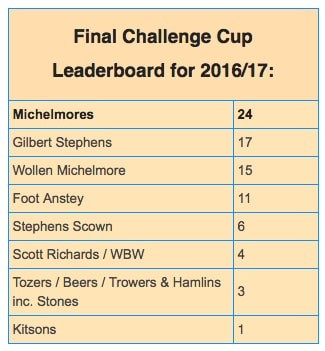
Challenge Cup 2016/17 - and the winner is ....
Congratulations to Michelmores Solicitors who have won the Devon & Somerset Law Society Challenge Cup for 2016/17.
The DASLS Challenge Cup is a fun tournament of six competitive events held over a twelve month period commencing March of each year.
Law Firms or other groups of DASLS members may enter as many events as they choose, and different people may enter each event, depending on individual preferences.
This year teams have enjoyed events including Skittles, Footgolf, 5-a-Side Football, Pitch & Putt Golf, Ten Pin Bowling and a Quiz Night.
The Challenge Cup was presented at the Society's Annual Dinner & Legal Awards at Sandy Park, Exeter on 2nd March 2017.
Challenge Cup Quiz Night Report - well done Wollen Michelmore
For those who like their general knowledge tested you can’t beat a good old fashioned Pub Quiz.
DASLS Annual Challenge Cup Quiz on 26th January 2017 saw entrants agonise over which London landmark was designed so that it could act, albeit unsuccessfully as a giant telescope and from which country did different Coca Cola bottles originate from.
In the end it was the collective brains of Wollen Michelmore that took the title of DASLS Challenge Cup Quiz Champions 2017 – prestige that money can’t buy!
Congratulations also to Gilbert Stephens in second and WBW in third.
Everyone seemed to enjoy themselves, even if they didn’t know you sit in a Sulky when Harness Racing or that Megadeth were the trash metal band that released the album Dystopia. In fairness most didn’t actually know what trash metal is but did know that flamingos derived their colour from their diet of brine shrimp.
Thanks go to the Globe at Topsham which proved, once again, to be an excellent venue and to all the teams that entered and helped us raise £58 for DASLS President’s Charity; The North Devon Hospice....
Self Hacking aka Pen Testing by SPONSOR - Alchemy
| 05th September 2017 |
Newsletters
Self Hacking aka Pen Testing by SPONSOR - Alchemy
Self Hacking aka Pen Testing
Businesses are being exposed to an exponential number of potential threats, each of which could severely damage their reputation and their bottom line. But what can a firm do? Of course they can (and should) conduct regular risk assessments, adopt a multi-layer approach to cyber resilience, train their staff and keep them constantly updated on potential threats. But they should also use techniques such as Penetration (or Pen) Testing to determine how far a hacker could get into their business and then rapidly take steps to remedy any identified shortcomings.
Put simply Penetration Testing is a controlled way of trying to hack into your company’s systems to detect vulnerabilities.
Penetration testing goes further than vulnerability testing which simply aims to identify areas that are vulnerable to an attack - it seeks to gain as much access as possible to a company’s infrastructure, operating systems, applications, processes and people. It’s an extremely effective way for a firm to test the effectiveness of the policies, procedures and processes they’ve put in place to make their business as cyber resilient as possible.
How does Penetration Testing work?
Specialist firms are hired to legitimately attempt to breach an organisation’s defences, testing infrastructure, applications, networks, software, servers, firewalls, telephone equipment, VOIP, smartphones, tablets, printers. Yes, even printers can be a weak spot.
A combination of manual and automated technologies are used to systematically compromise servers, endpoints, web applications, wireless networks, network devices, and other potential points of exposure.
Penetration testing should be conducted internally and externally. External testing will identify avenues cyber criminals might take to access to your network and systems. An internal test looks for ways that information could ‘leak’ out, d...
Merger-mania by SPONSOR Barclays
| 05th September 2017 |
Newsletters
Merger-mania by SPONSOR Barclays
Merger-mania: the truth behind the trends
As law firms face increased competition, pressure to lower fees and wider economic uncertainty, Andrea Delay, Head of Professional Services at Barclays, explores the potential behind the growing trend for consolidation and mergers.
The re-emergence of the legal community’s ‘mega-merger’ – in the form of the three-way tie-up between CMS, Nabarro and Olswang – has served to refocus attention on consolidation in a competitive sector facing downward pressure on fee income.
But in reality, despite these occasional unions, the legal landscape has not changed too dramatically in the past decade or so – notwithstanding the arrival in England and Wales of the ABS newcomers, the Alternative Business Structures that came in under the Legal Services Act of 2007.
However, anecdotal evidence suggests many firms across the sector are currently involved in merger discussions.
The market drivers
As Brexit and the political and economic changes in the US and Europe unfold over the coming months and years, ‘uncertainty’ remains the watchword. This has made it very difficult for a number of law firms to forecast and budget. But for the fleet of foot, opportunity knocks.
Many larger firms are either looking to expand their existing international reach or are considering building out an overseas presence and will turn a merger to their advantage. This, I believe, stems from the need to better service clients, where the trend, demonstrated by Barclays’ own procurement of legal services, is to achieve greater efficiency and focus on improving relationships.
In this context, a merger can help maintain a firm’s position. Not only does it remove one competitor, it can also provide economies of scale. Perhaps most importantly though, it facilitates the filling of any geographic or service gaps.
A warning
The obvious caveat in all this is that mergers are compl...
FRS 102 - Recognising income in law firms - is our firm doing it right? By SPONSOR PKF Francis Clark LLP
| 05th September 2017 |
Newsletters
FRS 102 - Recognising income in law firms - is our firm doing it right? By SPONSOR PKF Francis Clark LLP
Many partners in law firms will have the terms FRS 5 and UITF40 etched in their memories and will immediately recollect the cash flow horrors and transitional accounting complications of moving from a cash basis of accounting to a full accruals basis in respect on income.
Whilst we all thought this issue was closed unfortunately more recent interpretations of a new accounting standard have called a specific, but important, part of income recognition in law firms into question again.
Briefly, in terms of background, FRS 102 is an accounting standard that has now replaced FRS 5, UITF 40 and all other accounting standards. So FRS 102 becomes the relevant basis on which most law firms will prepare their accounts – certainly for tax purposes and where relevant for statutory reporting purposes.
The area where FRS 102 changes the position compared to FRS 5 / UITF 40 is in respect of conditional fee agreements.
Position under FRS 5 / UITF 40
At the balance sheet date if the matter contingency was met e.g. liability was admitted then the best estimate of the matter value at that time would be included in the accounts.
For the purposes of valuing such matters post balance sheet events up to the point of signing off the accounts remain relevant.
If the matter contingency was not met at the balance sheet date law firms had the option to include the unbilled time at either nil or cost.
Post balance sheet events for matters where liability is not admitted at the balance sheet date were not relevant.
Interpretation of position under FRS 102
Sector interpretation here has been evolving over the last year; the following summarises current common thinking:-
The significance of the balance sheet date has been removed. The relevant point for assessing contingent fees is now the date the accounts are signed off.
At this date if the contingency is ...
Fixed Costs – Civil Procedure Rules Amendments
| 05th September 2017 |
Newsletters
Fixed Costs – Civil Procedure Rules Amendments
The forthcoming amendments to the Civil Procedure Rules, which will be effective from 6 April 2017, include some significant amendments to the recovery of fixed costs in personal injury cases.
The particular rule in question is CPR 45.29, which sets out the amount of fixed costs that are recoverable in personal injury cases which have left the MOJ Portal. Although not expressly clear, the rules currently state that fixed costs will apply to cases with a value of less than £25,000. However, if the claim is valued at more than £25,000 then a Claimant is able to escape the fixed costs regime and recover costs on the standard basis.
However, following the Court of Appeal’s recent decision in Qader & Others v Esure Ltd & Khan v McGee [2016] EWCA Civ 1109, 16 November 2016, the Civil Procedure Rules Committee has sought to provide clarification as to when fixed costs do and do not apply.
From 6 April 2017, rule 45.29 will now read “subject to rules 45.29F, 45.29G, 45.29H and 45.29J,
and for as long as the case is not allocated to the multi-track,
if, in a claim started under the RTA Protocol, the Claim Notification Form is submitted on or after 31st July 2013, the only costs allowed are…”
Furthermore, all references to the upper limit of £25,000 as set out in Tables 6B and 6C are to be removed.
The practical effect of this is that if you have a claim that exceeds £25,000 in value, but you reach a settlement before the case is allocated, then you will not be able to recover anything other than fixed costs.
This obviously raises a number of issues, not least that this will surely discourage early settlement as Claimants are likely to hold off negotiating until they secure an allocation to the multi-track. However, on the flip side, we may see Defendant’s making early, and realistic, Part 36 offers in order to try and avoid such a scenario.
bSquared costs law ...
Client due diligence by SPONSOR Aon
| 05th September 2017 |
Newsletters
Client due diligence by SPONSOR Aon
The way that a firm handles new matters is absolutely key to the long-term success and viability of the firm. Client Due Diligence (CDD) is one important aspect of handling new instructions. If you don’t meet all your compliance obligations, it is likely that there will be shortcomings in other areas of your service. Poor practices will be replicated across the firm. If corners are cut, claims and complaints may result. Sometimes corners are cut with the intention of filling in the gaps later but that rarely happens. If such practices are picked up by the Solicitors Regulation Authority (SRA), then there may also be regulatory consequences.
By contrast, where matters have been started on the right foot, it’s much less likely that things will go off the rails later. In most cases, well-managed files do not give rise to negligence claims.
Effective CDD helps firms to identify and avoid suspicious transactions, making it a very potent weapon in the fight against money laundering. When determining the potential for criminal activity, a risk-based approach is required.
There’s a lot of attention at the moment, from the Government down, on professional enablers, of which there are four main types: the first two types are those actively complicit or negligently involved in the transfer of money through client accounts. Then there are those who cut corners, perhaps running matters on miscellaneous files to avoid file opening requirements and those who are unwittingly involved.
The SRA published its thematic review of money laundering in May 2016. Many of the 252 firms involved reviewed their processes as a result of the visit. After all, there’s nothing like a knock on the door from the regulator to make you dust off your procedures manual. Of course, the vast majority of firms haven’t received such a wake up call. 640 money laundering incidents involving firms have been reported to the SRA over the last four years...
Legal Update - The Third Parties (Rights Against Insurers) Act 2010
| 05th September 2017 |
Newsletters
Legal Update - The Third Parties (Rights Against Insurers) Act 2010
By Ian Peacock and Nicholas Saunders, Professional Indemnity Insurance Specialists at Bond Dickinson LLP.
Bringing claims against insured defendants – the new regime
The Third Parties (Rights Against Insurers) Act 2010 (the 2010 Act) came into force on 1 August 2016 and is intended to simplify how claims are brought against defendants who have (or may have) insurance cover. In this article Ian Peacock and Nicholas Saunders of Bond Dickinson LLP explain the implications of the 2010 Act, and why practitioners need to be alive to this legislative development.
The Third Parties (Rights Against Insurers) Act 2010 (the 2010 Act) modernises and simplifies the Third Parties (Rights Against Insurers Act) 1930 (the 1930 Act).
The old regime - the 1930 Act
The 1930 Act was introduced to provide claimants who were seeking to establish a liability against an insolvent person or corporate entity with a direct route of recovery against any relevant insurance cover (such as professional indemnity or employer's liability), thereby addressing the problems previously created for claimants by the English law principal of privity of contract.
Previously, this principal meant that any insurance claim and responsive indemnity fell within the insolvency (there being no contractual relationship between the claimant and the insurer and the insolvent entity providing the requisite nexus). The practical effect was that competing claims to the funds could arise, serving to reduce or extinguish a claimant's recovery.
The 1930 Act was largely successful in terms of meeting its objectives. However, it also gave rise to a number of practical problems from a claimant's perspective including that:
Before a claimant could bring a claim against an insurer, it was first necessary to establish liability against the insolvent defendant. In the case of a dissolved corporate entity, this required restorat...
DASLS Autumn 2017 Diary Dates
| 05th September 2017 |
Newsletters
DASLS Autumn 2017 Diary Dates
DASLS 6TH ADMISSIONS CEREMONY
on Monday 9 October 2017
from 5.30 p.m. at the Guildhall in Exeter
If you qualified, or will qualify, between 1st September 2016
and 30 September 2017, please contact Monique Bertoni at
DASLS office to make sure you receive your personal invitation
nearer the time.
monique@dasls.com
DASLS DINNER IN TAUNTON
on Friday 3 November 2017
at the Somerset County Cricket Club.
All DASLS members and their guests are warmly invited.
Watch out for details nearer the time....
Lord Justice Briggs - Taking the "A" out of ADR
| 05th September 2017 |
Newsletters

Lord Justice Briggs - Taking the "A" out of ADR
Frances Macdonald
Member of DASLS Mediation Sub-Committee
LORD JUSTICE BRIGGS - MEDIATION TO BECOME PART OF THE CULTURE OF LITIGATION
TAKING THE "A" OUT OF ADR
Last summer Lord Justice Briggs completed a review of Civil Litigation including the use of Mediation to resolve disputes. Following his review LJ Briggs gave a speech to the Chartered Institute of Arbitrators in September 2016 upon which this article is based, concentrating on his review of Mediation.
LJ Briggs Review of Mediation showed that the real gap in Mediation and ADR use was in cases of a value of £10 to £200 thousand in particular in personal injury and clinical negligence cases. The review found that (unsurprisingly) there had in fact been a rise in mediation following the recent substantial court fee rises.
LJ Briggs concluded that there needed to be a litigation system that was accessible to litigants in person or with minimal help from lawyers in cases up to the value of £25 thousand. This would include rules being kept simple.
LJ Briggs proposed 3 main stages:
1. Stage 1 – in which details of the case would be inputted onto the online system explaining the case and with the opportunity to upload key documents and evidence. The online system will prompt them to explain the case in such a way that the Court can ascertain the key points.
2. A resolution stage – This would be led by a Court office who could be a “Case Officer” or a legally qualified ‘Case Lawyer”. The Case Lawyer would not be a Judge.
The Case officer of Case Lawyer would suggest one of the following options as appropriate:
a. Short telephone or online mediation in simple cases – including newly emerging forms such as automated bidding
b. An Early Neutral Evaluation (ENE) by a District Judge
c. Arrange a modest cost private mediation in a Court centre
d. A full day private mediation in higher value, difficult or emotionally ...
Raising the Profile
| 05th September 2017 |
Newsletters
Raising the Profile
By Tony Steiner, DASLS Executive Director
One of the aims of DASLS is to promote the solicitors’ profession. To this end there has been an ongoing marketing and PR campaign that, in conjunction with the Legal awards, has significantly increased the profile of DASLS and its members.
We are now looking to build on this success and are putting in place a new marketing plan for the next twelve months.
One of our ambitions is to become the ‘go to’ organisation for legal comment. We will be engaging with local editors and media to raise their awareness of DASLS and its role with an invitation for them to contact us regarding any news stories with a legal perspective.
To help us achieve this we need a directory of members from all areas of practice and locations who are, from time to time, willing to speak to journalists and able to comment on the Society’s behalf. Part of the role would be to assist us cultivate the links to the media.
Please let me know if you would be interested in this opportunity and if so which areas of practice you would be able to comment on.
tony@dasls.com or 01392 366444...
Cook's & Hatchard's Law Prize 2017 Nominations Invited
| 05th September 2017 |
Newsletters
Cook's & Hatchard's Law Prize 2017 Nominations Invited
NOMINATIONS INVITED!
The Prize - Guidance
To be eligible for The Prize the nominee must have completed their training contract or a substantial part thereof in the Somerset area in the past twelve months and have obtained honours at the academic stage and/or have (in the judgement of the Trustees) shown merit throughout their training.
The definition of Somerset for the purposes of the prize, includes Sherborne and the local government administrative areas of Bath and NE Somerset, North Somerset and, of course, Somerset.
The specific objects of the charity are available upon request from DASLS.
Nominee's Personal Information
Please give full details of the person whom you are nominating and confirm that they are content for their details to be publicised by DASLS including photographs, should they be successful.
Please submit your name and work contact details, title and why you are nominating this person.
The Trustees are looking both for academic achievement prior to or during their training along with other examples of “merit”. This may include (by way of illustration only) distinctions at LPC, First Class Honours at Graduate level, initiative in the workplace or community/charity based projects and engagement that, for example, raises the positive profile of the profession, supports other young lawyers or the wider community.
Please give specific examples of how the nominee has exceeded the normal expectations of a trainee who is building their career. In short, the successful nominee will have shown real “merit” and not only achieved what is expected.
It would be helpful to the Trustees, when considering the nomination, to have as much information about the nominee’s achievements as appropriate.
Summary
The Trustees wish to encourage eligible nominees to have their names put forward as the award is prestigious and well recognised as an achieve...
Ethics Column: Ensuring Ethics is included in the Compliance Agenda
| 05th September 2017 |
Newsletters
Ethics Column: Ensuring Ethics is included in the Compliance Agenda
Tracey Calvert
Oakalls Consultancy Limited
tcalvert@oakallsconsultancy.co.uk
www.oakallsconsultancy.co.uk
ENSURING ETHICS IS INCLUDED IN THE COMPLIANCE AGENDA
Compliance professionals are familiar with the concept of continuous assessment to evaluate how successfully they have addressed the various regulatory demands made of them and their firms by the SRA. They look at their breaches records, complaints data, dealings with the SRA and Legal Ombudsman and similar. The idea behind their introspection is to consider which, if any, of their systems and policies need fine-tuning, where their risk pinch points are, how to remedy hotspots, and how to develop areas of proven success. Compliance never stands still!
This is of course very sensible. The SRA likes to see evidence of this; the Handbook is littered with clues in words and phrases such as ‘evaluation’ and ‘monitoring’ and ‘continuous improvement’ which begs an answer to the following question: what have we learnt about ourselves and what could we do better or differently?
This year I would suggest an area of contemplation which should be added to this assessment process is a consideration of the ethical complexion of the firm. This is useful to ensure consistent and safe individual and firm wide professional behaviour and to facilitate ethical thinking in internal compliance schemes. There may be a temptation to think that compliance controls are all that are needed to create an ethical culture; in my view, this is a dangerous assumption and it is prudent for firm owners and compliance officers to understand the behaviours of their colleagues and, more specifically, be able to have confidence that their colleagues will make the right ethical choices.
It is perhaps understandable that basic ethics has been on the backburner in recent times. The changes in our relationship with our regulator have been colossal ...
Legal Awards Winners 2017 Gallery
| 05th September 2017 |
Newsletters

Legal Awards Winners 2017 Gallery
Congratulations to our
Legal Awards Winners 2017!
Team Awards
INNOVATION
Trowers & Hamlins incorporating Stones
Sponsored by Solicitors Own Software Headline Partner
CORPORATE & SOCIAL RESPONSIBILITY
TozersSponsored by PSG
LAW FIRM OF THE YEAR (1-10 Partners)
Beviss & BeckingsaleSponsored by Aon
LAW FIRM OF THE YEAR (11+ Partners)
Clarke WillmottSponsored by Aon
TEAM OF THE YEAR
Ashfords (Public Sector)Sponsored by Magdalen Chambers
CLIENT SERVICE
Bartons (Maritime Litigation)Sponsored by Exeter A Jockey Club Racecourse
Individual Awards
SOLICITOR OF THE YEAR
Grace Bradley, The Family Law CompanySponsored by PKF Francis Clark
LEGAL 'HERO' OF THE YEAR
Tim Hook, Toller BeattieSponsored by Burcher Jennings
IN-HOUSE / PUBLIC SECTOR LAWYER OF THE YEAR
Sara Smith, Devon County Council
Sponsored by Conscious Solutions Limited
SUPPORT TEAM MEMBER OF THE YEAR
Gemma Sparks, The Family Law Company
Sponsored byThe University of Exeter
LEADER / LAW MANAGER OF THE YEAR
Rachel Buckley, The Family Law Company
Sponsored by Brewin Dolphin
LIFETIME ACHIEVEMENT AWARD
Michael Cosgrave, Wollen Michelmore
Sponsored by The Law Society
ALL PHOTOS by Pyramid Torbay Photography http://www.pyramidtorbay.co.uk/...
President's Review
| 05th September 2017 |
Newsletters
President's Review
By the time you read this, my last Review, I’ll have jumped out of a plane (probably), experienced the splendour of the second Legal Awards and Dinner (definitely), and been and gone to Barcelona without incident (hopefully).
My Presidential year has flown by, and I am a better, but more exhausted, man for it. But before I get into my final update, I should mercilessly plug my chosen Charity of the year, the North Devon Hospice, because it’s probably the last chance I’ll get!
I’m sure we all know someone who has been affected by terminal illness, in one way or another, and the support that the Hospice provides for patients and their families is absolutely phenomenal, but as you’d expect, it does come at a price. The Hospice has to raise over £4.5m every year, from scratch, and every penny raised really makes a difference.
I’ve been trying to contribute in numerous ways throughout the year: from taking part in quizzes, running across Exmoor on a freezing cold November morning, to stupidly agreeing to throw myself out of a plane. If you haven’t done so already, can you please all put your hands in your pockets one last time and help me support the Hospice; either that, or your generous donations will go towards my rehabilitation, if I’ve managed to break my arm/leg/dignity.
Hopefully you won’t mind me posting the link to my Virgin Giving page: http://uk.virginmoneygiving.com/MarkRoome.
If you can, please give something; and if you can’t, go and have a word with the partner in charge of your department, as they’re clearly not paying you enough.
The last couple of months have been fairly busy, but March will be something of a pinch-point for me with numerous engagements and events all coming together, but you’ll have to wait and hear about most of them from your new President in May’s Review. I’ll try and be brief, as you’ll also have to endure separately my President’s Report for the AGM papers â€...
Exeter Family Court Clinic Opening Soon!
| 05th September 2017 |
Newsletters
Exeter Family Court Clinic Opening Soon!
A clinic has been created to provide limited free support to LiPs and we are looking for volunteers to help with this new initiative. Opening in May, the clinic will run monthly at Exeter Combined Court. The clinic aims to help prepare LiPs for hearings and raise awareness of how the Family Court works. We will provide this support service to LiPs involved in child arrangements or domestic violence proceedings by means of short pre-booked appointments. It is not extended to cover LiPs in financial remedy or care proceedings.
The development of the clinic has been driven by barristers and solicitors, who will work in partnership with the Personal Support Unit (PSU) in Exeter and the Bar Pro Bono Unit. The PSU, who give practical and emotional support to LiPs, will manage the booking processes and provide clinic volunteers with details of clients for conflict checking. More than 15 lawyers have signed up, volunteering at least a half-day a year to the scheme.
Solicitors will need to arrange to operate under their firm’s indemnity insurance and a detailed protocol covering the operation of the clinic has been created, drawing on the work of the Bristol Pro Bono Scheme.
The clinic organisers welcome expressions of interest from family solicitors who would like to support the clinic.
Please contact Carol Mashembo, Magdalen Chambers on 01392 285200.
We are holding a Launch Party at Exeter Combined Court on 19th May 2017 from 4-5pm. If you would like to come, please RSVP to exeter@thepsu.org.uk by 12th May 2017.
Exeter Family Court Clinic
Launch Event!
You are warmly invited to attend the launch of a new family law clinic in Exeter
Friday 19th May, 4pm – 5pm
Exeter Combined Court Centre, EX1 1UH
With an introduction from Designated Family Judge, Her Honour Judge Robertshaw,
a brief talk about the clinic, and time for questions.
Tea and coffee available, courtesy of Magdalen Chambers.
A raffle...
LawCare - Mental Health: Are we Thriving or Surviving?
| 05th September 2017 |
Newsletters
LawCare - Mental Health: Are we Thriving or Surviving?
Mental Health: Are We Thriving or Surviving?
We all have mental health, just as we have physical health. Mental healthincludes our emotional, psychological, and social well-being, and affects how we think, feel, and act. It also helps determine how we handle stress, relate to others, and make choices.
Mental healthissues range from the worries we all experience as part of everyday life, to serious long-term conditions. It can be easy to dismiss mental health problems as something that happen to other people, but research shows that 1 in 4 of us will experience them each year. And the legal community is no exception.
Many legal professionals are reluctant to talk openly about mental health in the workplace, for fear they may be perceived as weak or not coping with the demands of their role. At LawCare we know that talking is an important first step in changing the way we think and act about mental health. We want to get the legal community talking about mental health so that anyone who has a problem can get support.
The theme for Mental Health Awareness Week, which runs from May 8 -14, is Surviving or Thriving? and this year, rather than asking why so many people are living with mental health problems, the aim is to uncover why too few of us are thriving with good mental health. Good mental health is more than the absence of a mental health problem: people are struggling to cope with the demands of life, and are stuck on getting through the day.
In terms of thriving, resilience is now recognised as an important factor in the workplace. In the increasingly demanding and changing legal environment, resilience is important in order to thrive. Resilience is defined as the ability to resist or bounce back from adversity, and in any workplace there will be people who thrive on challenges and difficulties, while others will find it hard to cope with unexpected change or problems. If someone finds i...
News from the Devon & Somerset Junior Lawyers' Division
| 05th September 2017 |
Newsletters
News from the Devon & Somerset Junior Lawyers' Division
This month's article has been written by the JLD's Charity Representative, Jessica Tallon.
As Charity Representative of the Devon and Somerset JLD, I actively encourage JLD members to raise money for the JLD charity of the year through organised charity events and JLD social events.
In November 2016, the Devon and Somerset JLD committee voted for YMCA Exeter to be their charity of the year for 2017. YMCA Exeter supports young people in Exeter through a wide range of Youth Services including homelessness support, youth clubs and a mentoring scheme for ex-offenders.
To get our fundraising efforts off to a good start, 7 JLD members set themselves the challenge of participating in the YMCA Sleep Easy 2017 event which involved spending a night sleeping rough in the grounds of Exeter Castle on 4 March 2017. Despite the terrible weather conditions with strong winds and rain throughout the night, our participating JLD members spent the night sleeping on the cobbles with nothing but a sleeping bag and a cardboard box. The JLD set themselves a fundraising target of £500.
I am pleased to report that the Devon and Somerset JLD raised an incredible £830 for YMCA Exeter, smashing their initial fundraising target of £500.
Upcoming charity events
On 9 May 2017, the Devon and Somerset JLD will be hosting a wine, cheese and charity quiz night to help raise money for YMCA Exeter.
Additionally, the Devon and Somerset JLD will be hosting a vintage Hollywood themed summer ball on 9 June 2017 at Sandy Park. This will be a fantastic event including a three course meal, charity raffle, photobooth, jazz band and DJ.
Details of the above events will be emailed to all Devon and Somerset JLD members shortly.
If you require any further information or would like to get involved in any of our fundraising events, please do not hesitate to contact us at dsjld17@gmail.com....
Admissions Ceremony 2017 Invitation
| 05th September 2017 |
Newsletters
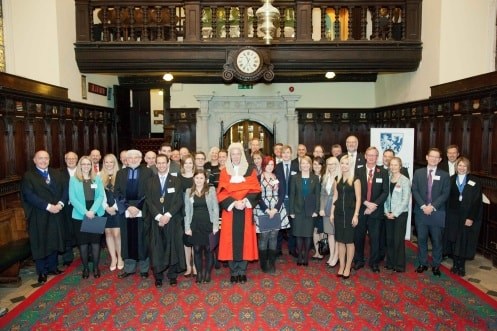
Admissions Ceremony 2017 Invitation
DASLS Newly Qualified Solicitors Admissions Ceremony
Monday 9th October 2017
at 5.30pm for 6pm at Exeter Guildhall — by invitation only!
Did you / will you qualify between 1st September 2016 and 30th September 2017?
If so, please contact Monique Bertoni at DASLS office
to make sure that you receive your personal invitation.
Email: Monique@dasls.com or call 01392 366333
Devon & Somerset Law Society would like to congratulate
all NQ Solicitors from Member Firms in DASLS area.
Below photo of the 2016 Admissions Ceremony...
Time for Staff Awareness Sessions by Sponsor Alchemy
| 05th September 2017 |
Newsletters
Time for Staff Awareness Sessions by Sponsor Alchemy
A recent report by the Institute of Directors (IoD) based on a survey by the IoD and Barclays Bank reported that whilst 95% of respondents considered cyber security to be important to their business 45% still lacked a formal cyber security strategy. Some 40% of respondents would not know who to contact if they were the victim of an attack.
The report says: "Over the last 12 months, the number of cyber security incidents has continued to increase, and more and more it is being demonstrated that it isn’t just ‘the usual suspects’ being attacked. From Lincolnshire County Council to Tesco Bank, it’s clear that cyber security is an issue for just about every organisation. With new legislation in the form of the EU’s GDPR on the way, firms must ensure that they’re equipped for the 21st century."
Only 44% of respondents had provided their staff with cyber awareness training and many left gaps of more than a year between their training programmes. Since staff are invariably the weakest links in cyber security this is a particularly worrying statistic. Firms need to develop and deliver robust staff awareness programmes.
Is it really that urgent?
As cyber crime increases and with GDPR on the horizon the time for action is NOW – no more hoping that it won’t happen to your firm; no more hiding under a blanket of false security. Law and accounting firms as well as organisations in the health sector are particularly vulnerable given the vast amounts of client data that they hold. Phishing and social engineering attacks are growing exponentially.
Marc Dautlich, Data Legislation Partner at Pinsent Masons LLP warns in the IoD report: “Today, many personal data breaches in the UK go unreported by businesses. In jurisdictions that already have mandatory breach reporting requirements, such as the US, unprepared directors have found themselves losing their job after a breach for failing to give...
Exeter Legal Walk 2017
| 05th September 2017 |
Newsletters

Exeter Legal Walk 2017
We hope members can join DASLS team for The Exeter Legal Walk 2017
This is the annual 10km walk around the sights of Exeter which takes place after work to raise funds for local legal advice charities and support their work in helping vulnerable people in desperate need of advice.
Anyone can join the walk so we look forward to welcoming any friends, family, colleagues and pets!
Supported by The Law Society of England and Wales and The Access to Justice Foundation....
Costs on the Small Claims Track by Sponsor BsQ
| 05th September 2017 |
Newsletters
Costs on the Small Claims Track by Sponsor BsQ
Written by sponsor bSquared costs law
As many of you will know, the scope for recovering costs on the small claims track are notoriously limited and CPR 24.14 (2) sets out those costs that are recoverable with reference to fixed costs under CPR 45. These are largely limited to a fixed fee for commencing the claim, court fees and some limited disbursements.
However, CPR 27.14 (2) (g) also allows the recovery of “such further costs as the court may assess by the summary procedure and order to be paid by a party who has behaved unreasonably”. This issue was considered recently by the Court of Appeal inDammermann v Lanyon Bowdler LLP [2017] EWCA Civ 269 (12 April 2017).
The Appellant brought a claim against the Respondent to challenge the level of fees that they had incurred in representing United Trust Bank Ltd in selling the Appellant’s home as a result on defaults on his mortgage payments. The Appellant’s claim failed at first instance and also on appeal and the Respondent’s applied for their costs on the basis that the Appellant had “behaved unreasonably”, in particular by pursuing his appeal and failing to accept an offer of £1,000 made by the Appellant. As a result, the Appellant was ordered to pay the costs of the appeal.
The Appellant then sought to appeal the costs decision and this was heard by the Court of Appeal.
In allowing the appeal and overturning the costs order made in the Court below, it was held that the Appellant’s conduct did not amount to having “behaved unreasonably” for the purposes of CPR 24.14 (2) (g) for two main reasons:
The Judge who gave permission to appeal was the very same Judge who heard the appeal itself
The point on which the Appellant lost the appeal was an obscure one
The Court of Appeal went on to consider the “proper meaning” of CPR 24.14 (2) (g) but it was conceded that this was a difficult task as it is state...
Is your law firm exposed to a PAYE Compliance Risk? By sponsor Francis Clark
| 05th September 2017 |
Newsletters
Is your law firm exposed to a PAYE Compliance Risk? By sponsor Francis Clark
For all law firms the biggest expense is people and more specifically payroll costs. There are a large number of rules and regulations that surround the management of a payroll system and we have seen an increasing number of law firms experiencing challenges with keeping up to date with the requirements in this area.
Nationally, we have also seen an increasing number of inspections being undertaken by HMRC to carry out a review of the PAYE and National Insurance Contribution (NIC) records.
What happens during a HMRC inspection?
During such inspections HMRC look to assess whether the records and systems maintained support the operation of PAYE/NIC, that business expenses have been appropriately incurred and accounted for and that any tax and NI liabilities have been correctly addressed. In addition, the compliance check will often review the employment status position of workers engaged by the business to ensure that the correct tax and NIC position is being adhered to.
Many employers believe that these HMRC checks cover only the operation of PAYE/NIC and that they only have to provide details of the payroll records. This is not true. Any records relating to the payment of expenses and benefits will also need to be made available. This for example, could include expense claim forms and receipts, company credit card receipts and statements, petty cash records and company car information.
If errors are identified by HMRC, additional tax and NI liabilities can arise on which both interest and penalties may also be due. Information provided by the employer as to how and why the errors occurred will have a direct influence on how the penalties are viewed and calculated.
Where are the common risk areas for law firms?
• Subsistence payments to employees during training and other work activities.
• Motor expense arrangements.
• Place of work and ...
Brexit & Article 50 - what we know so far by Sponsor Barclays
| 05th September 2017 |
Newsletters

Brexit & Article 50 - what we know so far by Sponsor Barclays
Brexit & Article 50 – what we know so far
The proverbial starting gun has been fired on Brexit with Prime Minister Theresa May formally giving notice of the intention to withdraw from the European Union on 29 March 2017. There are many key questions that British businesses will be keen to see answered over the coming years. Where possible, as your financial partner, we are here to help keep on top of these questions.
Here’s what we know so far.
The single market
The PM has already said that she does not intend to remain a member of the EU’s single market. In her speech, setting out her 12 key aims for Brexit negotiations, she stated, “What I am proposing cannot mean membership of the Single Market." She explained that European leaders have made it clear that membership of the single market means signing up to the "four freedoms" of movement of goods, capital, services and people – something that would "to all intents and purposes mean not leaving the EU at all."
Possible future models for the UK/EU trading relationship
EEA (single market only) – the Norwegian model – requires the UK to remain fully compliant with EU legislation, meaning that current regulation and timelines for adoption of new legislation would remain in force, as would the free movement of people. The PM has all-but ruled this out.
EFTA (free trade agreement) – the Swiss model – a number of bilateral agreements on free trade for specific industries including much of the service sector. Free movement still applies.
Comprehensive Economic and Trade Agreement (CETA) – the Canadian model – free trade agreement for most areas notably excluding financial services.
Swiss, Canadian or Norwegian model?
Commentators have asked whether the UK would adopt trade deals with the EU similar to those of Switzerland, Canada or Norway. In fact, we asked our clients for our Business Sentiment Survey and from over a t...
Tim Berry 1945 - 2017
| 05th September 2017 |
Newsletters
Tim Berry 1945 - 2017
1945 - 2017
It is with immense sadness that we announce the death of our Senior Partner, Tim Berry, following a short illness. Tim was articled to the late Charles Wyndham Harris, and became a partner in Harris & Harris upon qualification as a solicitor in 1970. He became Senior Partner in 1975.
Tim was a nationally recognised specialist in Ecclesiastical and Charity Law and served as Diocesan Registrar to the Diocese of Bath and Wells from 1993 to 2015 and the Diocese of Bristol from 1997 until 2015. To our clients, and our colleagues, Tim was a guide, mentor, and friend.
During a career that spanned 50 years, Tim played a leading role in the continuing growth of Harris & Harris, and in particular the firm’s Commercial Property and specialist Ecclesiastical and Charity Law practices. Tim’s enthusiastic, incisive, and thoughtful approach was appreciated by his clients and colleagues alike. Tim was a trusted advisor who approached his work with uncompromising integrity, empathy, and humility. His approach personified the guiding principles of our firm which are his lasting professional legacy. Tim’s loss is immeasurable to all those that knew him, personally and professionally.
Our thoughts are with Tim’s wife, Shirley, his sons Jonathan and Daniel, and their family at this difficult time.
Roland Callaby, the present Diocesan Registrar of the Diocese of Bath and Wells and the Diocese of Bristol succeeds Tim as Senior Partner of Harris & Harris.
There will be a Book of Condolence in the Reception area of our offices at 14 Market Place, Wells. Tim’s family has requested that any messages of condolence are sent via Harris & Harris and that their privacy is respected at this time.
HARRIS & HARRIS
14 Market Place, Wells BA5 2RE
10th April 2017...
Leaving it too late: the Cost Consequences
| 05th September 2017 |
Newsletters
Leaving it too late: the Cost Consequences
Kathy Trist
The Courts have recently considered the above issue in Car Giant Ltd. And another v London Borough of Hammersmith.
In this case the Claimant was successful in claiming damages for dilapidations following the end of the Defendant’s lease.
The Claimant had failed to beat the Defendant’s part 36 offer, it was accepted that the Claimant should pay the Defendant’s costs from the date of expiry of the date for accepting that part 36 offer. One argument the Defendant used was that, pursuant to CPR 44.3, those costs ought to be paid on an indemnity basis because the Claimant had unreasonably delayed in agreeing to mediate or take part in some form of ADR.
The Judge appreciated that an unreasonable refusal to engage in mediation might be a reason to order indemnity costs. However this was not a case where there had been an outright refusal to mediate – a mediation had taken place – it was just the mediation only took place shortly before the trial. The mediation date was October 2016 whereas the offer to mediate was made in May 2015.
The Judge’s view was this was a case where mediation had taken place but unfortunately was not successful. He did not accept that if mediation had taken place earlier on in the case, say in May 2015, that it would have been more likely to have been successful. Therefore he did not consider the delay to mediation could have caused any increase in costs.
The Judge also gave further guidance to say that the court should be slow to criticise a party over a decision when to mediate when those decisions have tactical importance. In this case the party required the experts to provide their complete view. The Judge considered this a reasonable position to take in not agreeing to mediate at an earlier stage.
The judge therefore ordered that the Defendant's costs after the expiry of the relevant period were to be assessed on the standard basis....
What makes the compliance team an effective team?
| 05th September 2017 |
Newsletters
What makes the compliance team an effective team?
Tracey Calvert
Oakalls Consultancy Limited
tcalvert@oakallsconsultancy.co.uk
www.oakallsconsultancy.co.uk
11 April 2017
The compliance team (whether that is the COLP and COFA working on their own, or a committee selected from members of the firm, or a team of compliance specialists) must complement the business in which it operates. This in turn requires everyone in the business to work in a supportive manner with the compliance team rather than fighting against them or not involving them in decision-making. Easy for me to say! How is this achieved in practice?
My reflections on what’s needed are based on my experiences over the past couple of decades. I have witnessed a noticeable change in attitude to regulatory compliance and a revolution-like transformation in firms’ attitudes to the business-end of their work. There is a need to be open to the concept that being a good lawyer is not all that’s needed to survive and prosper in the legal services industry these days. Amongst other things, it is necessary to acknowledge that a good lawyer must work in a compliant way amongst like-minded colleagues.
Why? The bottom line, or the persuasive argument for compliance, is actually very simple. Without a commitment to understanding and upholding regulatory compliance standards, the firm will quickly lose favour with the SRA with consequences for the ongoing survival of the business. The firm may find its authorised status is subject to scrutiny. This in turn may have financial repercussions for the owners of the business who will be unable to deliver services to clients. This means that compliance is good for business. Who could argue anything else?
Of course, reaching this position of harmony between the compliance team and the rest of the firm, does not simply happen because an individual is given a compliance title and a desk within the building. Effort is needed to make the compliance ...
Stepping Up
| 05th September 2017 |
Newsletters

Stepping Up
Tony Steiner
Francesca Hobbs
It might not seem like a radical or new initiative to produce a printed Newsletter but for those who would find it easier to catch up with DASLS news and what we have to offer in a print format, that is what we have done. We hope you like it. The email version will continue to be circulated to subscribing members and the articles contained here will be reproduced on DASLS website. This is part of our ongoing commitment to improve our PR and marketing. You may opt out of either service if you wish. In March the DASLS Committee agreed to a new marketing plan that will be driven from DASLS office. I have already asked for volunteers to be DASLS spokespeople and a few members have taken up this challenge. The aim is for DASLS to become the ‘go to’ organisation when the media seek comment. If you would be interested in helping with this please get in touch. Capitalising on the successful Legal Awards programme and attendant publicity, we are raising our profile through topical press releases. Another objective is to have greater engagement with the SME business community, especially through the Chambers of Commerce. News from Aston Court – you may have noticed a new name on recent emails. Francesca Hobbs joined us in February and has quickly settled into all things DASLS. Francesca graduated in Journalism last year from the University of St Mark & St John, Plymouth. Francesca will be helping with our various training and social events as well as our media and publicity activities....
The South West Peninsular Family Drug and Alcohol Court (FDAC)
| 05th September 2017 |
Newsletters

The South West Peninsular Family Drug and Alcohol Court (FDAC)
District Judge Penny Taylor,
Lead FDAC Judge for the Southwest Peninsula
Her Honour Judge Miranda Robertshaw,
The Designated Family Judge for Devon
I began to write this article in December 2016 in the hope that by the New Year our three Local Authorities; Devon, Plymouth and Torbay (who fund FDAC going forward) will have been able to finalise a plan for the FDAC to continue in the South West. Happily we can now report that an extension for a year has been agreed. Great news.
This has been our pilot year since November 2015 after Sir James Munby challenged all Designated Family Judges in the country to have an FDAC in each DFJ area. HHJ Robertshaw rose to that challenge which was unique because of the size of our County and number of authorities who would have to commit to the pilot.
I am one of the five District Judges who sit in the South West Peninsula FDAC. I sit in the Torquay FDAC, District Judges Richards and Leech sit in the Plymouth FDAC and District Judges Gamwell and Arnold in the Exeter FDAC. It is hoped that we will also be able to hold a FDAC court in Barnstaple.
As you read this, you may be asking what is FDAC? I can do no better than to refer you to the FDAC website and blog http://www.familylaw.co.uk/news_and_comment/family-drug-and-alcohol-court-an-introduction#.WGzpIcZFDZ4 for detailed information about this innovative and successful program.
Essentially the FDAC model is about Local Authorities identifying those families with drugs and alcohol addictions with perhaps also domestic abuse and mental health issues mixed in which affect their ability to parent and where care proceedings are about to be or in some cases have been launched. Be under no illusion, these are care proceedings so the threshold is reached but what the court and the TEAM do is try to help the parents beat their addictions so their children can remain with them, or be returned to their care i...
"Our staff have said how proud they feel to have won the award"
| 05th September 2017 |
Newsletters

"Our staff have said how proud they feel to have won the award"
Beviss & Beckingsale talk about winning at DASLS Legal Awards
Photo credit: Pyramid Torbay Photography We had heard about the 2016 Awards, but, as is often the way, we simply didn’t get round to preparing an application for that year. Having read about the success of those awards we thought that we should get involved this time around and gave some thought to the categories which would apply to us. Our firm is split across four offices and in recent years we have been trying to do more to bring those offices together by emphasising a set of common values. We therefore decided to enter the Law Firm of the Year (1-10 Partners) category on the basis that it seemed to fit well with our ethos of being One Team rather than focusing on one individual. When we looked further into the process we realised that there was a lot to cover, but that we also had a lot to talk about. We decided to apply because, as they say, nothing ventured-nothing gained! It was a rewarding process in that it made us objectively evaluate our firm and also enabled us to focus on the good things which we were doing. The more that we started to note down, the more things we thought of which were relevant to the criteria that had been provided. It also provided an opportunity to take stock of some of the things that we had not perhaps concentrated as much on in the past and therefore which we could look to explore in the future. We involved our staff in the process of preparing the application and this provided us with a great insight into the way that they saw the firm. It also allowed us to take stock of just how many very long serving members of staff we have which we felt said a lot about what it was like to work for our firm. We were delighted to hear that we had been shortlisted. We didn’t know how popular the awards would be and so we didn’t really have any expectations when we put in our application. DASLS ...
Winning at DASLS Legal Awards
| 05th September 2017 |
Newsletters

Winning at DASLS Legal Awards
Trowers & Hamlins incorporating Stones speaks about their time at DASLS Legal Awards
Photo courtesy of Pyramid Torbay Photography
Trowers & Hamlins were delighted to receive the Innovation Award at this year's DASLS Awards. We were also shortlisted for the Team of the Year award, and were extremely proud to accept our award at the celebratory ceremony that took place at a Gala Dinner on 2nd March 2017 at Sandy Park, Exeter.
We were recognised for our innovative career framework, for opening up opportunities for entering into the legal profession for those from a 'non-traditional' background. This recognition, which has been well documented in the local media, has been a great profile-raiser for us as a firm. Trowers & Hamlins merged with Stones Solicitors in Exeter in October 2015, and winning such an award from DASLS clearly demonstrates the benefit of our integrated offering in this region.
We were commended by the judges for anticipating the needs and aspirations of aspiring lawyers from all backgrounds, by developing a dedicated career path for paralegals; and by providing funding for training and qualifications; and by allotting trainee solicitor roles for those in our paralegal ranks.
We also chose to enter our Travel Team for the Team of the Year award. The merger of Trowers & Hamlins with Stones has allowed for growth and expansion of our offering to both individuals and insurers. Our Travel Team is a truly lawyer-led specialist legal team, based in the South West, but whose direct competitors are both national and international. The team itself provides legal services to clients across the whole of the UK. We felt that this should be recognised across the region and we were extremely proud that our Travel Team was also shortlisted.
Through the process for each entry, we were encouraged to showcase our work and demonstrate our innovation, integrity and leadership in the legal profe...
Newly Elected Presidential Team
| 05th September 2017 |
Newsletters

Newly Elected Presidential Team
As of the AGM held on Tuesday 25th April 2017, we have a newly elected Presidential Team. President: Sue Aggett of Teignbridge District Council. Vice - President (Left): Stephen Mahoney of Porter Dodson, Wellington. Deputy Vice - President (Right): Nigel Lyons of Browne Jacobson, Exeter....
President's Diary
| 05th September 2017 |
Newsletters

President's Diary Sue Aggett
I am very proud and delighted to have been elected as your President for 2017/2018.
Personally, I qualified as a legal executive in 1985 and as a solicitor in 1987.My early career was in private practice with the majority spent in local government at South Hams and Teignbridge District Councils. In 2011, I was elected the local government representative of DASLS, a role which I have thoroughly enjoyed and which, I hope, has made a positive contribution to our profession.
I have had the privilege of spending the last two years learning the ropes, firstly as Deputy Vice President when Will Michelmore was President and for the last year as Vice President to Mark Roome. This has given me an opportunity to see at first hand their incredible work and dedication for DASLS. Thank you very much Mark for your hard work over the past three years and in particular for your guidance, leadership and commitment throughout the past year. I very much hope I can follow in your footsteps and, indeed, those of all my very distinguished predecessors.
The legal landscape is continually changing but a constant has been our Society. We have a steady growth in individual and corporate membership totalling 1400, a healthy bank balance, and excellent support from our wonderful team at DASLS’ office of Tony Steiner, Monique Bertoni and Francesca Hobbs, together with our Honorary Secretary Chris Hart and Honorary Treasurer, Richard Adams.
Solicitors are central to any community, whether in private practice or in-house. Our advice on many issues whether business, litigation, matrimonial, property, housing or many other topics is crucial to those who live and work in our communities. The importance of our ethics, professionalism, understanding and pragmatism cannot be underestimated.
Throughout my year as President I would like to continue to build on the enormous amount of work that has gone into promoting the skills and services of solicitors an...
Admissions Ceremony 2017 Invitation
| 05th September 2017 |
Newsletters
DASLS Newly Qualified Solicitors Admissions Ceremony
Monday 9th October 2017
at 5.30pm for 6pm at Exeter Guildhall — by invitation only!
Did you / will you qualify between 1st September 2016 and 30th September 2017?
If so, please contact Monique Bertoni at DASLS office
to make sure that you receive your personal invitation.
Email: Monique@dasls.com or call 01392 366333
Devon & Somerset Law Society would like to congratulate
all NQ Solicitors from Member Firms in DASLS area.
Below photo of the 2016 Admissions Ceremony...
Devon Air Ambulance delighted to be chosen as the President’s chosen Charity
| 05th September 2017 |
Newsletters
Devon Air Ambulance delighted to be chosen as the President’s chosen Charity
Devon Air Ambulance (DAA) are delighted to have been chosen, alongside Dorset and Somerset Air Ambulance (DSAA), as Devon and Somerset Law Society’s President’s chosen Charity/ies for the years 2017/19. Business support is an essential and integral part of DAA’s fundraising. DAA are immensely proud and excited to be celebrating 25 years of service this year and it is due to the fantastic support DAA receives from the people, businesses and communities of Devon that they have reached this impressive milestone. DAA have continued to grow and develop the service they provide and today they own two Eurocopter EC135 helicopters which operate seven days a week. In 2016 DAA assisted 843 patients who had suffered either life threatening or life changing incidents. It costs £5.5million every year to keep Devon’s Air Ambulances flying and they are extremely proud to be independent of Government and National Lottery Funding; this safeguards the service for the long-term and ensures they can deliver what the people of Devon tell them they want from their Air Ambulance. With one helicopter based in Exeter and one in North Devon they can get to most of Devon within 10 minutes and the whole of Devon within 15. The speed of DAA’s service ensures patients receive treatment within the critical period immediately following acute illness or an accident before they are conveyed to the appropriate specialist treatment centre; in 2016 29% of DAA’s missions bypassed the nearest hospital to ensure patients were taken to the hospital most appropriate for their needs. This ensures all airlifted patients receive the best possible care and have the best chance of survival. In addition, DAA has substantially improved patient care through the creation of a ground breaking Master’s Degree for air paramedics aimed at making them amongst the highest qualified in the profession. Working with Plymou...
News from the Devon & Somerset Junior Lawyers' Division
| 05th September 2017 |
Newsletters
News from the Devon & Somerset Junior Lawyers' Division
This month's article has been written by the JLD's Social Secretaries, Beth Nash and Philippa Collison and the Sports Representative, Hannah McGown.
Social Events
Throughout the year the JLD's social secretaries have the arduous but rewarding task of organising a number of social events for young professionals across Devon and Somerset. Whether it be cocktails after a day's work, a wine and cheese tasting or themed event, the social events are always a highlight of the JLD calendar.
On Friday 9 June, junior lawyers from across the region were treated to a vintage Hollywood extravaganza at the annual Devon & Somerset Junior Lawyers' Division Summer Ball. Held at Sandy Park, guests were welcomed with a glass of prosecco, before being treated to live sets from a local jazz band throughout the sumptuous three course dinner. After dinner the disco took hold with some fun group photos in the obligatory photo booth.
Guests also had the opportunity to purchase raffle tickets throughout the night, with loads of prizes up for grabs including vouchers for champagne afternoon tea for two, and Exeter Chiefs goodies including a squad signed rugby ball and rugby tickets. Over the course of the night, an amazing £373 was raised for YMCA Exeter, this year's Devon & Somerset Junior Lawyers' Division Charity of the Year. They are a local organisation that aims to ensure "all young people can be equipped with the tools they need to achieve economic independence, grow in their unique skills and gifts and ultimately contribute positively to society."
The Summer Ball is a key event on the Junior Lawyers' Division calendar, offering guests the chance to meet their peers from other firms around the region, and to catch up with colleagues outside of the work place, as well as taking embarrassing photos in the photo booth!
The Devon and Somerset Junior Lawyers' Division would like to extend their tha...
Emails to be avoided... by Sponsor Alchemy
| 05th September 2017 |
Newsletters
Emails to be avoided... by Sponsor Alchemy
You know from our previous articles about phishing and spearphishing attacks and how staff are a firm’s weakest links. This time we’re detailing the different types of emails that might appear in your inbox – emails that can look genuine but which could well be from a cyber criminal; emails designed to infect your systems, hold your firm to ransom, prevent your business from operating (think WannaCry) and severely damage your reputation.
Emails to be wary of
An email that purports to be regarding a completion certification. In a recent phishing simulation exercise this type of email was sent to all staff in a large firm. Within 48 hours 10 people had clicked on the link, some had replied and several staff provided their username and password.
An email with links to Google Drive – this could look quite genuine if you’re expecting documents from a client. A variation on the same theme is the email that requests help on a legal matter (and who doesn’t want to assist a prospective client?) with a relevant file available in Dropbox.
An email containing scanned documents from a photocopier. This is a good one – invariably works like a charm in law firms where numerous documents are being scanned throughout the working week.
Emails with fake invoices – another winner in firms that purchase a lot of items. A variation are emails with fake receipts from Amazon - click the link if you don’t recognise the purchase and want to know more about your supposed order.
How about a fax from the government digital fax service which can appear legitimate because it includes the logo. A logo is not a sign that the fax is from a genuine source.
Then there are emails from banks requesting account codes. Non-accounts staff often fall for this one.
An email from Microsoft advising of unusual sign in activity on your 365 account. Have you had one of those? We get them all the time. Ignore the...
Employment Status: Employed or Self-employed advice for Engagers by Sponsor Francis Clark
| 04th September 2017 |
Newsletters
Employment Status: Employed or Self-employed advice for Engagers by Sponsor Francis Clark
Employment Status: Employed or Self-employed advice for Engagers Status is not a matter of choice... . Francis Clark LLP
The facts surrounding a working relationship will determine whether the worker is an employee or self-employed. However, the working relationship between the worker and the engager IS a matter of choice.
Getting the employment status position wrong can have serious financial consequences for an engager. If HMRC reviews the engager’s or employer’s records and considers that the consultant was not genuinely self-employed but rather the terms and conditions were that of an employee, the engager or employer will be liable for the PAYE tax and national insurance contributions (NIC) considered due in respect of the payments made. HMRC can look to go back a number of years to recover the tax and NIC considered due. In addition to the tax and NIC liabilities, interest and penalties will also be due.
Therefore it is crucial that the correct employment status is established at the start of the engagement and that clarification is sought in areas of concern as this should help to prevent disputes with HMRC at a later date.
The law does not define ‘self-employment’ or ‘employment’ so it is the terms and conditions of the particular engagement that determine whether the contract is one of employment or self-employment. If the individual is engaged under ‘a contract of service’ then they will be an employee and PAYE would apply. Only genuine self-employed consultants should be paid outside of the PAYE payroll system.
The onus is on the engager or employer to ensure that they are applying the correct employment status. The fact that an individual may say they are self-employed or that they have worked previously as a self-employed consultant is irrelevant in determining their employment status as the decision must be made on the current...
Apportioning Costs by Sponsor bSquared
| 04th September 2017 |
Newsletters
Apportioning Costs by Sponsor bSquared
Apportioning Costs by Sponsor bSquared
The general rule for civil litigation costs is “the loser pays”. That is to say, the losing party is liable for all of the winning party’s costs, subject to the usual test of reasonableness and proportionality. However, there are certain circumstances in which the costs award does not follow the general rule and issues can arise as to what costs are recoverable. Specific examples include:
Counter Claim
If a party succeeds with a counter claim, irrespective of the outcome of the original claim, they will more than likely be awarded their costs in respect of that counter claim. But what costs can be recovered?
The leading case is Medway Oil & Storage v Continental Contractors [1929] AC 88 in which it was held that the costs of a counter claim should be treated as if the claim stood alone and that there should be no apportionment of common costs. The practical effect of this is that when a party receives the costs of a counter claim, they are likely to be minimal as the vast majority of costs would have been incurred in the main action in any event, irrespective of whether there was a counter claim or not.
However, Medway Oil did state that the Court has the power to order that common costs be apportioned but, in the absence of such an order, the scope for recovering costs of a counter claim are greatly reduced.
Claimant successful against some, but not all Defendants
There are two leading cases which deal with what costs may be recovered when the Claimant is not successful against all Defendants.
In Hay v Szterbin [2010] EWHC 1967 the Claimant was successful against the third of three Defendants. The parties agreed that costs relating specifically to the third Defendant could be recovered whereas costs relating specifically to the first and second Defendants could not. However, no agreement could be reached over common costs. The Court held...
Psychology - the art of the scam by Sponsor Barclays
| 04th September 2017 |
Newsletters
Psychology - the art of the scam by Sponsor Barclays
Psychology - the art of the scam
Social engineering scams have come more into focus through the Take Five campaigns run by Financial Fraud Action UK, and industry participants and regulators. They typically focus on the warning signs to look out for, rather than explaining why they continue to work. As a behavioural economist, Dr. Peter Brooks, Head of Behavioural Finance Barclays Wealth and Investments, has an interest in the tactics the scammers use to defraud an organisation. Social engineering scams are effective because they recognise that the weakest point in a security procedure is often human psychology. The study of behavioural economics has many demonstrations of how our decisions can be manipulated. In this article, he looks at why social engineering can be so effective by examining the CEO fraud scam. In this scam someone claiming to be the CEO unexpectedly approaches a colleague in the finance department to make a prioritised payment. This pulls three psychological levers which can lower our defences against the scammers: authority, urgency and consequence. When combined, they create an effective way to defraud an individual. In the 1960s psychologist Stanley Milgram conducted experiments into how individuals respond to orders from someone in a position of authority. The rather uncomfortable (and somewhat controversial) experiment involved a participant trying to teach pairs of words to a fellow participant. If the ‘learner’ got the pair wrong then the ‘teacher’ would have to administer larger and larger electric shocks. In fact, the learner was an actor and there were no electric shocks involved. However, the experiments found that many individuals would continue to apply the electric shocks even after the actor had stopped describing the pain of each shock and had fallen quiet. When questioned, the experimenter just informed the teacher to continue the experiment. In the CEO fraud sca...
Taking Client Care Letters to the next Level by Sponsor Aon
| 04th September 2017 |
Newsletters
Taking Client Care Letters to the next Level by Sponsor Aon
Taking client care letters to the next level
The client care letter is the bedrock of the client relationship, or at least it should be. The difficulty is that it has become so standardised that there are real concerns that it does not meet the needs of clients. Indeed, for many clients it is such an irrelevance that they do not read to the end. Often the crucial information that clients expect to see is missing, or only dealt with in passing. Instructing a solicitor is an emotionally charged event for many clients regardless of the nature of the instructions. If it relates to a house purchase, where the underlying event is positive, the process can still be very stressful. Accordingly, even if there has been a telephone call or meeting first, clients often look forward to the first letter only to be disappointed when it arrives. Rather than seeing it as tailored to their needs, many see it as being more for the solicitor’s benefit. Research jointly commissioned by all frontline legal regulators (including the Solicitors Regulation Authority (SRA), although the results have not been published on its website) and the Legal Services Consumer Panel (LSCP) was published in November 2016. The study was prompted by concerns that the language used in Client Care Letters (CCLs) is often a barrier to effective communication and engagement. The findings show that CCLs are often not as effective as they should be in making sure that clients understand the work that is being carried out on their behalf or in outlining what is required of them. Up until 2011, the SRA was a firm advocate of the CCL but since implementation of its 2011 handbook, the requirements that must be communicated in writing at the outset are really quite modest. Accordingly, it was unfortunate that the press release publicising the research stated that all regulated legal professionals are required to send CCLs. Happily, the report’s ...
FBE International Contract Competition
| 04th September 2017 |
Newsletters

FBE International Contract Competition
FBE International Contract Competition 12-14 May 2017 DASLS Team: Benjamin Thomson and Laura Britton
Ben Thomson and Laura Britton
The competition, created and hosted by the Warsaw Bar Association, was organised by the Fédération des Barreaux d'Europe (FBE) and took place from the 12th to the 14th of May. Teams from Poland, Belgium, Bulgaria, Romania, Spain and the UK took part in the competition, which aimed to encourage cooperation between different member bars, give us the opportunity to practise and hone our negotiation and drafting skills and meet lawyers (trainees and associates) from other member bars. We were given two case studies 30 days before the competition with the aim being to negotiate a distribution and supply agreement with a team from another European country. We acted for the supplier in both cases; on the first day acting for a company selling gardening items and on the second acting for a company that manufactured and sold cosmetics and personal care products. As all of the competitors represented real companies it was important to research both ours and the other side’s companies. This included their accounts and filing history which could then be used as tools in the negotiations. The competition rewarded careful research and thorough preparation, as well as the ability to be collaborative in negotiations and draft a clear and concise contract. The Warsaw Bar Association hosted dinner on both Friday and Saturday, serving local food and drink at different locations in the city. The Bar also gave us time between the negotiations and dinner in the evenings to explore the city and sightsee. We finished in 3rd place, with framed certificates to show for it! We hope to keep in touch with the other participants and members of the host bar who were warm, welcoming and extremely enthusiastic to discuss and share their approach to practicing law and to encourage cooperation between different mem...
The (Past) President who fell to Earth
| 04th September 2017 |
Newsletters

The (Past) President who fell to Earth
Immediate Past President, Mark Roome, discusses his recent skydive in aid of North Devon Hospice
Ben Thomson, Tozers, all dressed up and ready to go
Wikipedia describes it as “a method of transiting from a high point to Earth with the aid of gravity”. I prefer to call it skydiving… so much simpler!
Although I passed over the presidential mantle in April - and you’ve probably already forgotten about that - hopefully you haven’t forgotten about the constant badgering to sponsor my jump from a perfectly sound light aircraft.
Well, that has now happened (finally!), and I live to tell the tale.
After abortive attempts – due to low cloud - I eventually made it down to Dunkeswell Airfield on a cloudy Friday morning ready, willing, and able to jump.
I’d picked up intrepid Ben Thomson (trainee at Tozers) on the way, and after the initial check-in and briefing (which we’d both heard before) we were asked to wait in the holding area (also more commonly known as the café) until there was a break in the weather.
One coffee, then two, and I had a sinking feeling that yet again we would have a frustrating day of freeze-dried beverages and intermittent mobile reception. But hang on a moment, what’s this, clear skies.
The call came, and we were shuffled into the “dressing room”, where we were trussed up like turkeys, and made to wear silly hats, as you’ll see from Ben’s picture.
Then out to the plane and up we go. No messing around this time.
Ten minutes later and at 15,000 feet I’m being told to move down the bench. By now, I’m strapped to Chris my instructor, so there isn’t much else to do other than what he says. “Arch your back, and lift your legs off the floor”. Yep, I can do that. A couple of the other lemmings had already jumped before me. I look out of the gaping hole in the side of the plane, and see vague shapes three miles below. Above 15,000 feet, ...
Why would SMEs Mediate?
| 04th September 2017 |
Newsletters

Why would SMEs Mediate?
Kathy Trist, Chair DASLS Mediation Sub-Committee considers the benefits of SMEs of using Mediation
Time
If a business is in dispute over any issue this costs the Company not only in terms of money but in management time in dealing with the issue. Court proceedings are lengthy and expensive whereas mediation gives those involved the opportunity of exploring the issues that they face, identifying where they can reach agreement and taking steps to resolve the dispute at an early stage. The Company will not want to devote all its time and effort to a dispute, they will want to concentrate on building and ensuring their business remains profitable. The sooner a resolution is reached, so far as your client Company is concerned, the better.
Cost Effective
Mediation can be set up quickly and is very affordable and money well spent if it achieves the desired aim which is settlement. Devon and Somerset Law Society Panel of Mediators are trained particularly in time limited mediation and in some circumstances we can even assist with offering a venue for the mediation to take place. Even if initially your clients look to you for advice on the merits of their case, mediation should be considered a real alternative to court and be explored by you with your clients. An early mediation is a method of achieving the aim of your clients which ultimately will be a resolution of the dispute they are involved in. Devon and Somerset Law Society offer an affordable alternative which can achieve a resolution – please see the fee structure below.
Speed of Result
If you go to mediation early a decision will hopefully be reached that all parties will be satisfied with. The alternative, as we all know is a long and drawn out process governed by timelines given by the Court as to when and how matters are to be determined by a Judge where by at that point there can be no guarantee of success. The earlier you mediate in my view, the bette...
Joined Up Compliance: Considering Forthcoming Legal and Regulatory Challenges
| 04th September 2017 |
Newsletters
Joined Up Compliance: Considering Forthcoming Legal and Regulatory Challenges
Tracey Calvert
Oakalls Consultancy Limited
tcalvert@oakallsconsultancy.co.uk
www.oakallsconsultancy.co.uk
It’s important to remember that law firm compliance requires a consideration of both legal and regulatory standards and that these often overlap. Whilst we are waiting for the SRA to publish further consultations on regulatory policy changes and their review of the Handbook, law-based matters will keep compliance practitioners busy this summer. We are of course talking about the changes in anti-money laundering related legislation which no one in a compliance role, whatever specific title or function they hold, can ignore. Not only does the legal/regulatory overlap become explicit with the COLP’s oversight of compliance with the law but quite often conversations about AML provoke cross references with the SRA Accounts Rules and the COFA function to ensure that client money is safe. These topics are of great concern to the SRA who have them in mind when considering their own risk management priorities. When things go wrong in terms of a solicitor’s or law firm’s response, then the regulator takes speedy action. A recent case which illustrates this point is the disciplinary ruling made against Clyde and Co, and published in April, in respect of breaches of AML duties and the SRA Accounts Rules. In a nutshell, the firm has been fined £50,000 and three partners have been fined £10,000 each in respect of incidents dating back to 2013. The issues were as follows: the client account had been used for banking purposes in circumstances when there was no underlying legal transaction; the firm had failed to comply with client due diligence procedures in the Money Laundering Regulations 2007; had failed to take account of Law Society warning notices on money laundering and fraudulent financial arrangements; and had not dealt with aged residual balances holding more tha...
Solicitor wins top Translation Award
| 04th September 2017 |
Newsletters
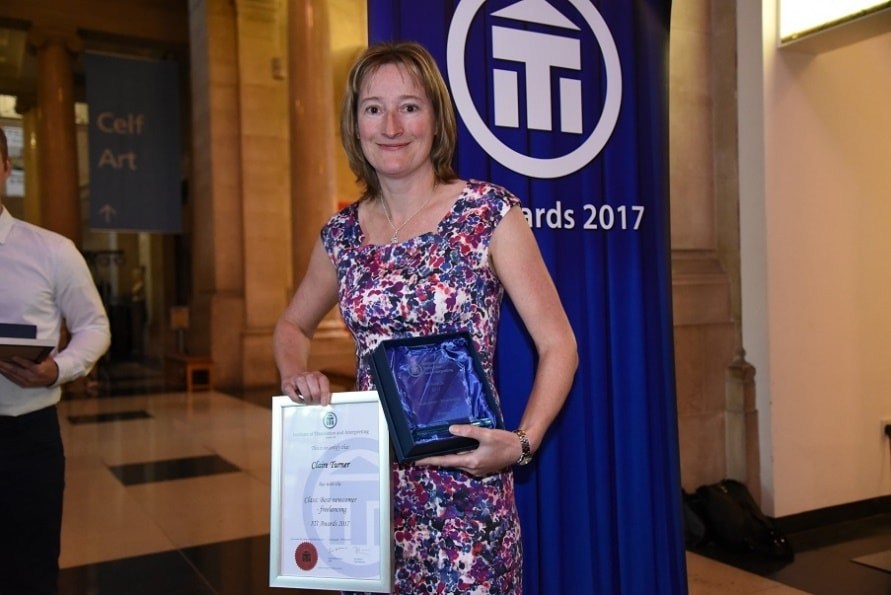
Solicitor wins top Translation Award
Solicitor Claire Turner wins top translation award
Legal consultant and translator Claire Turner has received a prestigious translation award from the Institute of Translation and Interpreting (ITI). She was named winner in the Best Newcomer - Freelancing class at the Institute’s international conference and gala dinner in Cardiff, Wales, on 19 May. This award recognises outstanding progress in individuals who have been freelance translators for two years or less. It considers achievement in business planning, marketing, development of client relationships and systems, networking and personal professional development. Claire worked as an in-house solicitor for a number of years prior to starting her combined legal consultancy and legal translation business. Her research prior to setting up her business suggested that relatively few legal translators were also practising solicitors – a USP for her as a translation professional. Claire is the first-ever winner of this award, as part of a new, expanded awards programme the Institute has launched to recognise the best in translation and interpreting and to set a benchmark for what quality and professionalism should look like in the sector. Awards Chair Catherine Park commented: ‘Many congratulations to Claire for her success in what was a very competitive class. It is heartening to see so many new freelancers coming through with a good understanding of how to achieve business success in today’s markets. ‘Translation today isn’t about sitting in a room working on a text in isolation. It’s about understanding your markets and your clients, and fully grasping and delivering on business needs. The ITI judges were very impressed by Claire’s meticulous business planning, combined with extensive continuing professional development and language training and commitment to exploring all opportunities to develop her network.’...
Family Law Company score Hat Trick at DASLS Legal Awards
| 04th September 2017 |
Newsletters

Family Law Company score Hat Trick at DASLS Legal Awards
L-R Grace Bradley, Rachel Buckley and Gemma Sparks
As a firm with our heart in the South West region, The Family Law Company was keen to enter the 2017 DASLS Awards. These are local awards in our industry and we felt the categories were very relevant to our company. Not all awards have as much relevance to our business, and our judgement was that winning a DASLS award would mean something to our staff, clients, and our peers. At the first awards, we won the Team of the Year, so we were aware that a DASLS award provides excellent recognition, particularly for staff who are doing well. We received excellent publicity and being involved in the event helped to raise awareness of what The Family Law Company does. The award provided a real boost for everyone, so we were inspired to enter more categories this year. This time round, we opted to enter four categories, including Solicitor of the Year with Grace Bradley. We chose Grace as she has been frequently recognised by counsel and clients for her remarkable commitment and dedication, handling gruelling cases involving Honour Based Violence, Domestic Violence and Child Abduction in England and overseas. She successfully juggles her career and family life, and still finds time to volunteer at a Child Contact Centre in Exeter. For Leader/Law Manager of the Year we put forward Business Development Director, Rachel Buckley. Rachel is pivotal to the ongoing success of The Family Law Company, and this was her tenth year with the firm. As a bubbly and outgoing leader who directs, manages, inspires and rewards using creative methods, we thought hers would be an outstanding submission. Our entry for Support Team Member of the Year had to be Gemma Sparks. Gemma is a Chartered Legal Executive, and she uses her own personal experiences to bring a unique and unmatchable understanding of family law issues. Gemma has trained in British Sign Language and was pivotal in set...
Raising the Profile: A Call to Action
| 04th September 2017 |
Newsletters
Raising the Profile: A Call to Action
Raising the profile of solicitors continues to be a DASLS theme. Our Legal Awards partnership with DC Media / Trinity Mirror is helping us achieve this and has greatly helped us develop our media contacts.
We have had preliminary discussions with some of the local papers in the region about a regular legal page. To take this forward we will need membership support both in terms of firms that would be willing to advertise and also people who would be able to provide interesting and current editorial.
From time to time we receive requests from the media for solicitors to comment or be interviewed about legal issues in the news. We have already started compiling a list of members but more volunteers are needed.
If there are any budding Joshua Rozenberg’s in DASLS membership it would be great to be more proactive by preparing commentary about the legal issues surrounding current news stories. For example: as and when Julian Assange leaves the Ecuadorian Embassy, and assuming he is arrested, an article about the law surrounding his arrest would be of interest. These can be fed to the local press and of course published on DASLS website.
What to do next: Contact me! tony@dasls.com / 01392 366444
I need to know whether there is any enthusiasm for a DASLS led legal page in the local press – will you support it through advertising?
I also need volunteers; if any of this appeals to you please let me know. It would be great to have a few DASLS members involved with this work.
Tony Steiner
Executive Director...
President's Review
| 04th September 2017 |
Newsletters
President's Review
Sue Aggett
The first few months as your President have flown by and it has been a very busy time. At the beginning of May I attended the Presidents’ and Secretaries’ Conference at Chancery Lane, with our Honorary Secretary, Chris Hart. This was an extremely timely and useful couple of days and I certainly picked up some practical advice on dealing with the media, sharing learning for promoting local law societies and learning from other professions. Tony Steiner was part of the line up in a workshop which looked at engaging with in house lawyers. We will be looking at the learning as part of our ongoing organisational and strategic review. The event launched The Law Society’s “Vision for law and justice” campaign in preparation for whichever political party was returned at the General Election. I’m certain that The Law Society will lose no time in continuing to communicate with the new government the messages around maintaining legal certainty in light of Brexit, ensuring every individual has effective access to justice and safeguarding of human rights.(https://www.lawsociety.org.uk/Support-services/documents/our-vision-for-justice/)
We have since had the opportunity to meet with Robert Bourns at a well-attended round table meeting in Taunton to discuss these themes in more detail. Robert spoke passionately about The Law Society’s vision and the need for continuing strength in the solicitor brand.
Also at the beginning of May I was honoured to be a guest of Katharine Jones, President of Dorset Law Society at their annual dinner. The Law Society Vice President, Joe Egan, also attended and we had a very enjoyable evening in Dorchester.
The Federation of European Bars General Assembly in early June was in The Hague with the theme "the lawyer in dialogue with the International Criminal Court" and a day of presentations held at the ICC. It was sobering to hear of challenges facing other European countries as j...