Social Events & Meetings
Admissions Ceremony 2016
Admissions Ceremony 2016

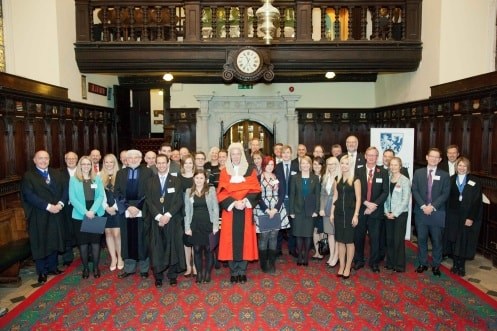
Group photo in Exeter Guildhall - copyright www.marionfrances.co.uk
19 recently qualified solicitors were welcomed into the Solicitors' Profession on Monday 7 November 2016 at the Guildhall in Exeter.
His Honour Judge Geoffrey Mercer QC warmly congratulated them on their achievement. District Judge Collins was also present. The function concluded with wine and canapes.
Like Back to Top Seen 471 times Liked 0 times
Subscribe to Updates
If you enjoyed this, why not subscribe to free email updates and join over 1283 subscribers today!
Subscribe to updates
Alternatively, you can subscribe via RSS 
All email subscriptions must be confirmed to comply with GDPR.
Related Posts
11th September 2017 | November 2016

President's Charity FREEFALL FROM 15,000FT TO HELP LOCAL HOSPICE PATIENTS AND FAMILIES North Devon Hospice has been named as charity of the year for the Devon & Somerset Law Society, as nominated by President Mark Roome. On Friday 10th March 2017 everyone connected with the Society is invited to take the ultimate leap and join in a skydive in aid of the President’s charity. The 15,000ft freefall will take place at Dunkeswell Airfield near Honiton and your President Mark Roome will be leading from the front by taking part himself! Stephen Roberts, Chief Executive of North Devon Hospice, said that he hoped to see as many people as possible sign up. “We have arranged a dedicated day at the airfield for DASLS members to skydive together and, in the nicest possible way, we hope to see lots of you falling from the sky on Friday 10th March!” Stephen said that skydiving is an unparalleled experience, and a great way to raise funds for the cause. “Everyone who has done a parachute jump will tell you it is one of the most exhilarating things you could ever do. There is no feeling like freefalling from 15,000ft, it is an unbelievable rush that is sharply contrasted by the tranquility you experience when the parachute opens. As you glide back to earth, you appreciate the beautiful landscape around you from a completely new perspective. Skydiving is a popular way of raising funds for North Devon Hospice, because people are always willing to sponsor you for doing something as challenging as this.” All funds raised from the DASLS skydive day will help North Devon Hospice care for local people affected by cancer and other life-limiting illnesses. “We care for people through the toughest of times,” said Stephen. “When someone is diagnosed with a life-limiting illness like cancer, their whole world changes. But the impact is also felt greatly by their loved ones, which is why we pride ourselves on being there for all the family. Our care helps everyone cope with what is happening and we are here to support those involved for the entire journey. The funds raised through the DASLS skydive day will make a huge difference to those we care for, so I want to thank you in advance for signing up and helping us care for local people who really need us.” To find out more about the DASLS skydive day on Friday 10th March, please contact Monique Bertoni, DASLS Administrator, on 01392 366333 or Monique.Bertoni@dasls.com. ...
11th September 2017 | November 2016

LawCare - Caring for your Colleagues LawCare Helpline: 0800 279 6888 Open 365 days a year from 9.00 a.m. to 7.30 p.m. on weekdays, 10.00 a.m. to 4.00 p.m. weekends and bank holidays. help@lawcare.org.uk • www.lawcare.org.uk • Admin: 01268 771333 Caring for your Colleagues Lawyers are kind, considerate people. They work very hard for their clients, and are diligent and dedicated. They tend to be highly intelligent, ambitious and driven people. They do not find delegation easy, believing honestly that no one else could ever do a job as well as they can. They see their work as a fascinating intellectual challenge, and perfectionism is the norm. When it comes to getting work done to a high standard these qualities are of real value, but the downside is that stress levels tend to be very high. There is also a very real tendency to take on too much work. Clients cannot be allowed to go elsewhere: they might never come back. Many lawyers are robust enough to take this in their stride, but some end up calling LawCare for help. The caller will often have endured enormous pressure for months. His or her health may have been damaged and home life and work quality will almost certainly have suffered. The irony is that the departmental head may well be wondering whether the caller is up to the job, whilst completely failing to realise that the real problem, in fact, rests on the departmental head’s shoulders. Firms simply cannot ignore issues such as risk management, and employing stressed lawyers is a sure-fire way to wreck a good indemnity claims record and risk the reputation of the firm. Colleagues, managers, heads of department and partners, need to care enough about stressed lawyers to speak up and offer help. Older lawyers sometimes self-medicate. Many of them tell LawCare that they were driven to drink by stress, a stiff drink being the quickest fix after a hard day. Lunchtime drinking follows, and their work will deteriorate steadily. Alcohol makes things seem better in the short term, but in reality leads to dwindling productivity and mistakes. Although the drinker may believe that they are hiding their problem, frequently it will long ago have become obvious to colleagues and clients, but all co-operate in the conspiracy of silence that is so much easier than confronting the problem. The people in your organisation are your colleagues and some may also be your friends. Taking good care of them is not only a responsible, human thing to do, but also makes compelling commercial sense. As lawyers we are used to caring for our clients and giving them our best. It’s time we started doing the same for our colleagues. LawCare Helpline 0800 279 6888 www.lawcare.org.uk ...
11th September 2017 | November 2016

How to maximise your costs recovery By SPONSOR bSquared costs law HOW TO MAXIMISE YOUR COSTS RECOVERY - HINTS AND TIPS Our bSquared costs lawyers understand that your costs recovery is essential to your firm’s growth and profitability. The following hints and tips will help you to maximise your recovery either through negotiations with your opponent or formal assessment by the Court: Time recording is crucial, but not the only element that will help to achieve an excellent costs settlement or assessment. Detailed attendance notes aid between the parties recovery and will remove doubt from a Costs Judge’s mind when carrying out an assessment. Filing of all correspondence is extremely important; if correspondence is not there then it will not be recovered. Evidence of the work carried out must be on file, it is important to keep a record of draft and superseded documents. Expert reports and correspondence must also be on file, the Judge may want to see the evidence when considering how long to allow for the consideration of a report. Ensure your file is neat and tidy. A Costs Judge is also likely to simply disallow an item claimed rather than spend a disproportionate amount of time searching for an attendance note. When requesting a Provisional or Detailed Assessment, the guidance provided in respect of the documentation to be provided to the Court should be followed to the letter. Transparency is important, particularly with regard to funding in pre-Jackson cases. Ensure compliance with the relevant pre-action protocols and CPR at the outset of the matter in order to avoid sticky situations when it comes to costs recovery. “Failure to plan means you plan to fail” has never been so true following the Jackson Reforms. The above is just a flavour of what you should be doing to maximise your costs recovery. For more information please request a free copy of our litigation costs recovery guide, which takes you through the costs recovery process and is designed to help you achieve even better costs recovery results. bSquared costs law are experienced in preparing and submitting bills to courts nationwide and to the Senior Courts Costs Office for assessment. We provide neat and tidy paperwork and anticipate the courts requirements, which can ensure that the court is on your side before they even come to start the assessment! Contact us to request your free litigation costs recovery guide, to discuss how we can support your firm or for free initial advice on any cost law matters: 0117 930 84 84 info@bsqcostslaw.com www.bsqcostslaw.com 7825 Bristol ...
11th September 2017 | November 2016

Minimising environmental risk by SPONSOR Wessex Searches At Wessex Searches we know it’s the story behind your client’s property transaction that really matters. Families making room for a new arrival. Businesses in need of space to grow. Or sometimes, sadly, when circumstances change and assets need to be sold quickly. We understand that for your clients their stories are what conveyancing is all about and they often want things done quickly. Our service is all about helping you to make your client’s property transactions easier. One of the ways we do this is through sharing practical tips and ideas at our CPD training sessions, and for allthree speakers at our recent Devon and Somerset Law Society event there was one big question. How do you minimise environmental risks in property transactions? Here are our highlights. Failed environmental search? What next? Environmental law specialist Keith Davidson gave a useful explanation of the options available following a negative environmental search. Keith has a wealth of experience. He’s the founder of ELM Law, a specialist environmental law firm that provides support in transactions. As a property lawyer you know the frustration of a negative desktop report. A property found “in need of further assessment” usually results in the lender being reluctant to proceed. This can impact property value and delay a transaction. So, what are the options following a negative report? Regulatory enquiries Regulatory enquiries usually help switch a negative report to a positive one. However, with it taking up to 20 days for results from sources including local authorities and the Environment Agency, many clients simply can’t afford to wait. Phase 1 site inspection Adding a site visit to regulatory enquiries adds cost, but will increase confidence in the overall result. Unfortunately, that wait of up to 20 days for the relevant authorities to reply still stands. Indemnity insurance Indemnity insurance can be in place in just a couple of days. Providing cover for regulatory action under Part 2A and WRA for 15 years, and including legal defence costs and loss in property value. However, it is important to explain to clients that third party claims, tank spills and development are not covered. Environmental Liability Review The fastest fix, with a next day turnaround possible, is to take legal opinion from an environmental law firm. This can conclude that a property reported in need of further assessment is in fact suitable for lending. This expert option can be relied upon by purchaser, funder and tenant. The Environmental Liability Review is increasingly used when purchasers and funders need reassurance. This is a service available through ELM LAW. Residential property risk in the South West Danielle Orosa a strategic account manager of Groundsure gave an interesting talk on residential property risk in the South West. A clear risk to property transactions, Groundsure tell us that 2.6% of the South West has potentially contaminative historical land use. Amongst that are 3,527 old landfill sites. Danielle also explained some figures behind the headlines on the often contentious topic, energy and energy infrastructure. It was thought provoking to learn that 83% of the South West region is within 5km of planned or existing energy infrastructure. Adding to the long list of energy infrastructure that need to be considered we must now add fracking. Mentioned by both Keith and Danielle, 48% of British landmass has potential for fracking. CON29DW changes Julian Okoye, Director of Wessex Searches, shared practical tips and insight to help solicitors explain the benefits and implications of drainage and water searches to their clients. For example, did you know that with the right permissions your client could get a build over agreement for a sewer but not for a water main? Knowledge of this little known fact may hav...
06th March 2020 | March 2020

Dear All, This year really is flying by. I have just had my birthday. After updating you previously on the excellent catch up I had with the Law Society CEO Paul Tennant on his visit to the south west last November, I had not expected to be back in touch with him quite so soon. Sadly, this time it was in less happy circumstances. I was, like many of you, shocked and saddened in January to hear the news and see the pictures of the substantial fire at Chancery Lane in London. I have emailed Paul Tennant and James Shepherd, our Law Society Relationship Management Executive, to send our best wishes and we are hoping that the building will be back to full use very soon. As I write this report, preparations are in full swing for the 2020 DASLS Legal Awards & Dinner. As you know the Annual Dinner is being held again this year at Exeter Cathedral. The event is to take place on the 30th April 2020. After the success of last year, we are hoping that once again the event is sold out which would mean we will have around 480 people attending. If you have not done so already, please contact Llew Nicholls and the team at our Awards partners ‘Grow Marketing’ who have worked very hard alongside our very own Tony and Monique to achieve full sponsorship of this event. You can contact Llew to book the remaining places by emailing Llew directly at Llew@growmarketinguk.com. There have been more nominations than ever before with more entries making the short list. Please do not miss this dazzling occasion. You will all have received DASLS latest 2020 training courses programme. Tony Steiner and the team have worked hard to arrange these events. You will see that as members you get preferential rates and if appropriate reduced rates for multiple attendees from your firms. Please take advantage of these services as a proportion of the monies do go to support our Society’s broad continuing education offering. If I do not see you individually before I look forward to catching up with you at the 2020 DASLS Legal Awards and Annual Dinner in April. With very best wishes Nigel Lyons President 2019-2020...
06th March 2020 | March 2020

New AML Regulations and the pursuit of the beneficial owner. Introduction The new Money Laundering & Terrorist Finance (Amendment) Regulations 2019 which came into force on 10 January have modified a number of aspects of the 2017 AML Regulations, with which we have been complying for some time. However, many firms’ procedures hark back to the earlier days of the 2007 Regulations and have not been modified or updated much over recent years. This article seeks to set out what the new Regulations in fact require, and the steps we should be taking in relevant cases. The Policy It has been true for some time that the ultimate aim of all the regulatory rules is transparency – it has always been the case that the use of artificial structures such as trusts, companies, bearer shares, foundations and charities – whilst perfectly legal – have to some extent also benefitted from the extra anonymity they offer to the true owner and recipient of the funds and services we provide. If we offer services to these types of entity, the Regulations require us to go some way to identifying the individuals who are actually benefitting from our services, and this entails uncovering the true ownership of the organisation. Whilst this would be difficult in many instances – Cayman Island companies with bearer shares, for example – we must nevertheless attempt to get some assurances from the creators of the companies, accountants or registrars as to the ownership of the shares, and have some way of being notified of any change in ownership. We also need to be aware of the PEP and Sanctions status of these individuals. Further, for UK companies, the PSC Regulations 2016 impose an exactly similar obligation on the companies themselves to identify their beneficial owners and notify Companies House of any shareholder with 25% or more of the shares or exercising control over management of the business. The Regulations The Regulations provide that we must, as part of our CDD procedures Identify the client – this means coming to know who they are, by name and some other characteristic, e.g. address, date of birth, date of incorporation Verify that identity – by means of reliable and independent data and documentation Identify the beneficial owner (if the client is an entity) – though not necessarily verifying that identity Identify and verify the identity of the person actually instructing us (if not already done). What this means for us When acting for a COMPANY (that is not a listed company) the Regulations require us to obtain Details of the company as registered (which must be proven by a copy of the register entries available from Companies House or equivalent registry) – name, number, registered office address, principal place of business the law to which it is subject details of its governing documentation (its memorandum) names of the directors. Names of any beneficial owners, and the identity of any individual owners of legal entities which own the client Names and verification of the persons instructing us on behalf of the company, and their authority to do so. Note that we cannot rely on the information provided by the company under the PSC Regulations but we must undertake our own research in order to fulfil our CDD duties. Further, if as part of that research, we discover that the Companies House data on PSC’s is incorrect, then we are now under a further obligation to notify the Registrar of Companies of this fact. We also need to establish that PEPs and Sanctions checks are also undertaken. If genuinely positive entries are revealed in response we should undertake enhanced CDD steps or cease to act, accordingly. Electronic searches are a permissible avenue to use provided the search provider can offer us the necessary assurances that the person actually claiming an identity is IN FACT that person. Check also whether ...