Social Events & Meetings
Self Hacking aka Pen Testing by SPONSOR - Alchemy
Self Hacking aka Pen Testing by SPONSOR - Alchemy

Self Hacking aka Pen Testing
Businesses are being exposed to an exponential number of potential threats, each of which could severely damage their reputation and their bottom line. But what can a firm do? Of course they can (and should) conduct regular risk assessments, adopt a multi-layer approach to cyber resilience, train their staff and keep them constantly updated on potential threats. But they should also use techniques such as Penetration (or Pen) Testing to determine how far a hacker could get into their business and then rapidly take steps to remedy any identified shortcomings.
Put simply Penetration Testing is a controlled way of trying to hack into your company’s systems to detect vulnerabilities.
Penetration testing goes further than vulnerability testing which simply aims to identify areas that are vulnerable to an attack - it seeks to gain as much access as possible to a company’s infrastructure, operating systems, applications, processes and people. It’s an extremely effective way for a firm to test the effectiveness of the policies, procedures and processes they’ve put in place to make their business as cyber resilient as possible.
How does Penetration Testing work?
Specialist firms are hired to legitimately attempt to breach an organisation’s defences, testing infrastructure, applications, networks, software, servers, firewalls, telephone equipment, VOIP, smartphones, tablets, printers. Yes, even printers can be a weak spot.
A combination of manual and automated technologies are used to systematically compromise servers, endpoints, web applications, wireless networks, network devices, and other potential points of exposure.
Penetration testing should be conducted internally and externally. External testing will identify avenues cyber criminals might take to access to your network and systems. An internal test looks for ways that information could ‘leak’ out, deliberately or accidentally. Testing will also include the staff – the weakest link in any organisation. Unfortunately staff often use easily guessable passwords; they may indiscriminately open email attachments and links; and often even when they encounter something unusual they don’t always tell someone.
The risk of staff not being cautious and security aware can be tested for example by using simulated phishing attacks.
Common findings of Penetration Testing
The most common findings include of penetration testing include design flaws, configuration errors, unpatched software, weak encryption algorithms, unsecure coding practices.
When considered individually these might appear inconsequential to the uninitiated but when combined they can create a lethal cocktail giving even the average hacker a wide open door to bring a business to a standstill.
Next Steps
The results of a penetration test need to be analysed, weaknesses remedied and staff provided with feedback and – where appropriate - further training.
Penetration testing should be performed on a routine basis. In addition it should be carried out whenever new network infrastructure or applications are added or major upgrades or modifications are applied to those infrastructures and applications.
Benefits of Penetration Testing
Penetration testing enables a firm to become more cyber resilient and therefore less likely to suffer downtime, lose data, incur the high costs of restoring data. Such a firm can maintain its reputation with clients, suppliers, insurance companies and regulatory bodies.
Maybe it’s time your firm did some penetration testing?
Alchemy Systems have 20 years of IT systems experience and are a Microsoft Partner.Alchemy Systems Designs, Supplies, Installs, Supports and Protects clients’ IT systems. The legal sector has always been a strategic focus. Our staff are experienced in the specific needs and challenges of law firms from service desk to strategy to protection services.
Tel. 0330-043-0801
email. info@alchemysys.co.uk
www.alchemysys.co.uk
Like Back to Top Seen 603 times Liked 0 times
Subscribe to Updates
If you enjoyed this, why not subscribe to free email updates and join over 1283 subscribers today!
Subscribe to updates
Alternatively, you can subscribe via RSS 
All email subscriptions must be confirmed to comply with GDPR.
Related Posts
05th September 2017 | March 2017

LawCare - Keeping Fit in a Sedentary Job Keeping Fit in a Sedentary Job Physical inactivity currently costs the NHS in England around £1.8 billion per year, and around £8.3 billion to the wider economy in sick days and premature deaths 1. For lawyers working long hours in a job which essentially involves sitting at a desk all day, being active and keeping fit can be a challenge. Walking is one of the easiest ways to meet your physical activity recommendations; it’s cheap, requires no special equipment, and has a low risk of injury. Walking regularly at any speed can help to manage weight, boost the immune system and even reduce the risk of some cancers as well as osteoporosis. Brisk walking has even more benefits, including lowering blood pressure, improving heart and lung health, and raising mood. The rise in popularity of wearable fitness trackers means that there’s probably someone in your workplace who is trying to get in their recommended 10,000 steps per day (including 250 per hour). Even if that’s not you, walking as much as possible throughout the day isn’t as difficult as you might imagine. The standard advice to take the stairs not the lift, and get off the bus/tube/tram a stop early or park further away has been oft-repeated, but once you’re at your desk, how can you factor those extra steps into your day? Always volunteer for the coffee run. Then collect up the dirty cups afterwards and take them to the kitchen. Set your default printer to one on a different floor. Drink plenty of water (which has its own health benefits), and use a toilet on the other side of the building. Stand up and walk around when on the phone. Not only will it help with your step count, but standing when you speak can make you sound more confident and authoritative. Go for a walk in your lunch break. Make the most of your fitness tracker. Many prompt you to move each hour. If yours doesn’t or you don’t have one, set an alarm on Google or an app to remind you to get up and move or stretch every hour. Put the waste-paper bin on the opposite side of the room. When meeting with local clients, colleagues, or others, offer to go to them rather than have them come to your office. Go to speak to colleagues in person, rather than emailing or phoning. Encourage others at your workplace to get involved, leading lunchtime walks, holding walking meetings, or an after work running club (ensure it will suit beginners). Even if you can’t walk about, standing is better than sitting, so if there’s any aspect of your work you could do standing up, do. Adjustable desks are available which convert from sitting to standing height. Walking 250 steps (recommended per hour by some fitness trackers) takes less than three minutes, so if all else fails, simply get up and pace. Don’t let a sedentary job mean your health suffers. With just a few changes you could meet your fitness goals even at work. 1 Statistics from the 'Economic costs of physical inactivity' report published by the British Heart Foundation LawCare 0800 279 6888 www.lawcare.org.uk ...
05th September 2017 | March 2017

News from the Devon & Somerset Junior Lawyers' Division This month's article has been written by the JLD's National Representative, Georgia Wookey.As National Representative of the Devon and Somerset JLD, I provide a voice to our members at National JLD level by meeting my counterparts from JLDs across England and Wales at the Law Society, London, three times a year. We last met at the end of January 2017 and as expected at the top of the agenda for discussion was the SRA's proposal for the introduction of the solicitors qualifying exam (SQE). 6 January marked the close of the SRA's second consultation into the introduction of the SQE and I understand that there may be a third consultation on its way later this year. The JLD encourage everyone to take part and respond either as firms or as individuals as the introduction of the SQE will mark a huge change to entry in to the legal profession. Should you wish to see the full consultation paper please visit https://www.sra.org.uk/sra/consultations/solicitors-qualifying-examination.page In general, the JLD is supportive of the idea of a centralised solicitors qualifying exam regulated by the SRA - at present each academic provider delivers its own program for the LPC which means there is variation and no consistency in the academic stage of training undertaken by current trainee solicitors. However there are a few concerns and suggestions which the JLD raises in its response to the consultation, three of which are:- 1) Work experience element - , the JLD would like to see a minimum of two years 'work experience' which should be split across no more than four separate placements, comparative to the current training contract system. The time spent in each placement should be of a sufficient standard to actually equip junior lawyers with the necessary legal skills for when they qualify as solicitors and not merely give them 'the opportunity' to gain legal skills. 2) Preparatory study - the SRA provides no information at present as to the likely cost of any preparatory training course to be taken ahead of sitting any SQE exams. It is also concerning that there is the suggestion that there will be no need to attend such a course as "would-be" junior lawyers could have the option to study without the course, giving rise to the possibility of a two tier system whereby some junior lawyers will have paid to study a course, whilst others have taken the self-study route potentially disadvantaging those from lower socio-economic backgrounds as a result. 3) Implementation date - the proposed implementation date of the new SQE route is August 2019. This start date is considered to be too soon and does not give firms or academic providers the chance to change their systems and courses in readiness for the new system. This is particularly concerning as some firms have already started to recruit their 2019 trainee solicitors. Universities are already working on their 2019 course content and some current undergraduates will be graduating in 2019, causing uncertainty for them. I have only highlighted three of the points raised by the JLD. To see the full JLD response, please visit http://communities.lawsociety.org.uk/junior-lawyers/policy/sra-a-new-route-to-qualification-the-solicitors-qualifying-exam-sqe/5060068.article If you have any comments or concerns you'd wish to raise with Devon and Somerset JLD in relation to the SQE please do contact us on dsjld17@gmail.com. We will keep you posted on any further developments as we become aware of them....
05th September 2017 | March 2017

President's Charity - Thanks for amazing support THANKS FOR AMAZING SUPPORT THROUGHOUT CHARITABLE PARTNERSHIP North Devon Hospice has been named as charity of the year for the Devon & Somerset Law Society, as nominated by President Mark Roome. We are coming to the end of a fantastic year-long partnership between North Devon Hospice and the Devon and Somerset Law Society. Society President, Mark Roome, chose the hospice as his charity of the year having seen at close quarters just what a different their care makes to local patients and families, all of whom are affected by life-limiting illnesses such as cancer. Chief Executive of North Devon Hospice, Stephen Roberts, thanked members of DASLS for their tremendous support throughout the year. “This has been a very fruitful partnership, where some really fun opportunities have been taken up by members, and in turn, vital funds have been raised for the hospice. We’ve seen Society members get down and dirty by taking part in our Mission:Unbreakable commando challenge event, and also donate generously at the annual Somerset dinner. It was an honour to attend this year and speak to you all about how your support allows us to care for local people going through the toughest of times.” Mark Roome said of the charity of the year partnership, “I’m very proud of the way that members of DASLS have taken this cause to their hearts and shown such generous support. North Devon Hospice is very dear to me, being based in the same town as my own practice. The care they provide is absolutely second to none, and there are few families in this area who have not been touched by their loving support down the years. It has been a pleasure to have the hospice as my charity of the year, and my thanks go out to all members who have shown such fantastic support.” Stephen Roberts added, that to mark the end of the partnership, there was one more notable fundraising activity happening… 10,000ft up in the air! “On Friday 10th March, we are holding a special DASLS Skydive event at Honiton airfield, where several brave folk will be doing a sponsored parachute jump in aid of North Devon Hospice. President Mark Roome has already signed up, alongside many other colleagues, and it’s not too late to join them! Once again, our immense thanks go to all who have supported North Devon Hospice throughout the last 12 months. It has helped us provide even more care to local people. For example, we have doubled our Hospice to Home team in the last year. They care for patients round the clock in their own homes when symptoms become more severe, but this kind of service development is only possible thanks to local generosity, just like we’ve seen from the Devon and Somerset Law Society.” To find out more about the DASLS skydive day on Friday 10th March, please contact the Fundraising Team at North Devon Hospice: Tel: 01271 344248 Email: clairesherwood@northdevonhospice.org.uk ...
05th September 2017 | March 2017
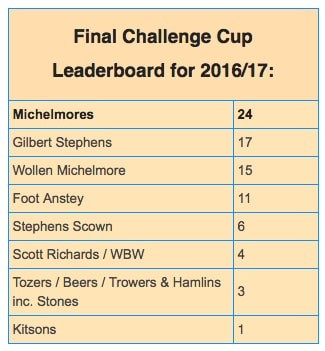
Challenge Cup 2016/17 - and the winner is .... Congratulations to Michelmores Solicitors who have won the Devon & Somerset Law Society Challenge Cup for 2016/17. The DASLS Challenge Cup is a fun tournament of six competitive events held over a twelve month period commencing March of each year. Law Firms or other groups of DASLS members may enter as many events as they choose, and different people may enter each event, depending on individual preferences. This year teams have enjoyed events including Skittles, Footgolf, 5-a-Side Football, Pitch & Putt Golf, Ten Pin Bowling and a Quiz Night. The Challenge Cup was presented at the Society's Annual Dinner & Legal Awards at Sandy Park, Exeter on 2nd March 2017. Challenge Cup Quiz Night Report - well done Wollen Michelmore For those who like their general knowledge tested you can’t beat a good old fashioned Pub Quiz. DASLS Annual Challenge Cup Quiz on 26th January 2017 saw entrants agonise over which London landmark was designed so that it could act, albeit unsuccessfully as a giant telescope and from which country did different Coca Cola bottles originate from. In the end it was the collective brains of Wollen Michelmore that took the title of DASLS Challenge Cup Quiz Champions 2017 – prestige that money can’t buy! Congratulations also to Gilbert Stephens in second and WBW in third. Everyone seemed to enjoy themselves, even if they didn’t know you sit in a Sulky when Harness Racing or that Megadeth were the trash metal band that released the album Dystopia. In fairness most didn’t actually know what trash metal is but did know that flamingos derived their colour from their diet of brine shrimp. Thanks go to the Globe at Topsham which proved, once again, to be an excellent venue and to all the teams that entered and helped us raise £58 for DASLS President’s Charity; The North Devon Hospice. ...
06th March 2020 | March 2020

Dear All, This year really is flying by. I have just had my birthday. After updating you previously on the excellent catch up I had with the Law Society CEO Paul Tennant on his visit to the south west last November, I had not expected to be back in touch with him quite so soon. Sadly, this time it was in less happy circumstances. I was, like many of you, shocked and saddened in January to hear the news and see the pictures of the substantial fire at Chancery Lane in London. I have emailed Paul Tennant and James Shepherd, our Law Society Relationship Management Executive, to send our best wishes and we are hoping that the building will be back to full use very soon. As I write this report, preparations are in full swing for the 2020 DASLS Legal Awards & Dinner. As you know the Annual Dinner is being held again this year at Exeter Cathedral. The event is to take place on the 30th April 2020. After the success of last year, we are hoping that once again the event is sold out which would mean we will have around 480 people attending. If you have not done so already, please contact Llew Nicholls and the team at our Awards partners ‘Grow Marketing’ who have worked very hard alongside our very own Tony and Monique to achieve full sponsorship of this event. You can contact Llew to book the remaining places by emailing Llew directly at Llew@growmarketinguk.com. There have been more nominations than ever before with more entries making the short list. Please do not miss this dazzling occasion. You will all have received DASLS latest 2020 training courses programme. Tony Steiner and the team have worked hard to arrange these events. You will see that as members you get preferential rates and if appropriate reduced rates for multiple attendees from your firms. Please take advantage of these services as a proportion of the monies do go to support our Society’s broad continuing education offering. If I do not see you individually before I look forward to catching up with you at the 2020 DASLS Legal Awards and Annual Dinner in April. With very best wishes Nigel Lyons President 2019-2020...
06th March 2020 | March 2020

New AML Regulations and the pursuit of the beneficial owner. Introduction The new Money Laundering & Terrorist Finance (Amendment) Regulations 2019 which came into force on 10 January have modified a number of aspects of the 2017 AML Regulations, with which we have been complying for some time. However, many firms’ procedures hark back to the earlier days of the 2007 Regulations and have not been modified or updated much over recent years. This article seeks to set out what the new Regulations in fact require, and the steps we should be taking in relevant cases. The Policy It has been true for some time that the ultimate aim of all the regulatory rules is transparency – it has always been the case that the use of artificial structures such as trusts, companies, bearer shares, foundations and charities – whilst perfectly legal – have to some extent also benefitted from the extra anonymity they offer to the true owner and recipient of the funds and services we provide. If we offer services to these types of entity, the Regulations require us to go some way to identifying the individuals who are actually benefitting from our services, and this entails uncovering the true ownership of the organisation. Whilst this would be difficult in many instances – Cayman Island companies with bearer shares, for example – we must nevertheless attempt to get some assurances from the creators of the companies, accountants or registrars as to the ownership of the shares, and have some way of being notified of any change in ownership. We also need to be aware of the PEP and Sanctions status of these individuals. Further, for UK companies, the PSC Regulations 2016 impose an exactly similar obligation on the companies themselves to identify their beneficial owners and notify Companies House of any shareholder with 25% or more of the shares or exercising control over management of the business. The Regulations The Regulations provide that we must, as part of our CDD procedures Identify the client – this means coming to know who they are, by name and some other characteristic, e.g. address, date of birth, date of incorporation Verify that identity – by means of reliable and independent data and documentation Identify the beneficial owner (if the client is an entity) – though not necessarily verifying that identity Identify and verify the identity of the person actually instructing us (if not already done). What this means for us When acting for a COMPANY (that is not a listed company) the Regulations require us to obtain Details of the company as registered (which must be proven by a copy of the register entries available from Companies House or equivalent registry) – name, number, registered office address, principal place of business the law to which it is subject details of its governing documentation (its memorandum) names of the directors. Names of any beneficial owners, and the identity of any individual owners of legal entities which own the client Names and verification of the persons instructing us on behalf of the company, and their authority to do so. Note that we cannot rely on the information provided by the company under the PSC Regulations but we must undertake our own research in order to fulfil our CDD duties. Further, if as part of that research, we discover that the Companies House data on PSC’s is incorrect, then we are now under a further obligation to notify the Registrar of Companies of this fact. We also need to establish that PEPs and Sanctions checks are also undertaken. If genuinely positive entries are revealed in response we should undertake enhanced CDD steps or cease to act, accordingly. Electronic searches are a permissible avenue to use provided the search provider can offer us the necessary assurances that the person actually claiming an identity is IN FACT that person. Check also whether ...